Your journey0/53Decisions consideredBuild and test your reasons
Look · explore the evidence · read a crystal, then keep it · decide what you can defend
An argument in 12 rooms
Morality, between us.
We argue that human morality is an intersubjective framework: its standards are constituted by what can be justified to those affected, with personal judgment and accountability.
If morality is made between people, why isn’t anything allowed?
Start with objectivity. Follow the reasons. Put them under pressure in real cases.
36 values to consider · 39 main decisions · 14 conditional follow-ups · Three case-study rooms
The 3D view is unavailable. Rooms and In this room still provide every argument, decision and collectible value. The reading version is below.
MORARG · The reading version
Morality, between us.
We argue that human morality is an intersubjective framework: its standards are constituted by what can be justified to those affected, with personal judgment and accountability.
The claim concerns what makes a human moral standard valid. We defend affected interests, agency and reciprocity as its basis, then test that account against serious objections and real cases.
A distinction that makes the disagreement precise.
Argument
An authored philosophical argument, open to challenge.
Evidence
A documented fact or finding, within its stated limits.
Commitment
A normative premise defended with reasons, not a laboratory result.
Provisional
A conclusion whose remaining burden is identified.
Research tests factual claims; reasons connect facts and principles to decisions. The argument does not treat a study as a proof of metaethysics. Choice feedback specifies a claim to repair or a disagreement to work through. Branches adapt to selected answers; dependent responses need reconfirmation if their context changes. Selected-claim checks show the paired answers and permit a recorded explanation. Values record priorities, not evidence weights.
00 · Good, Bad and Objective?
When would a judgment of “good” be objective?
We argue that human morality is an intersubjective framework: its standards are constituted by what can be justified to those affected, with personal judgment and accountability.
Human evaluation needs a defended standard; conviction and vocabulary cannot supply its authority.
Three different claims Definition
A consequence can occur regardless of what we wish. A judgment can be tested publicly and impartially. A moral truth can be said to hold independently of our evaluative approval. These are different senses of objectivity. A realist may ground rightness in human needs while denying that our approval makes it right; realism need not imagine a morality with no humans in it.
Moral RealismPrimary philosophy · The Philosophical Review 95(2), 163–207; especially pp. 164–176 and 189–198What this source supports
A naturalist, relational account that permits criticism of actual approval.
Access: Full primary article retrieved; selected sections on objectivity, informed interests and social rationality inspected in pass002
Limits: Selected-section review, not an exhaustive assessment. The natural basis of interests must not be confused with approval creating the truth.
Challenges evolutionary reliability and sketches how actual evaluative error can survive an account grounded in a wider system of attitudes.
Access: Full primary article retrieved; selected sections inspected in pass002; reflective-equilibrium and concluding antirealist passages inspected in pass003
Limits: Evolutionary causes alone do not refute realism. The concluding sketch is not a full defence of one constructivism and does not itself establish MORARG’s equal-standing premise.
Good and bad
Good for what, and for whom? Definition
“Good” and “bad” evaluate, but they do different work in different claims. Make the standard visible before treating the judgment as a description of reality or a report of taste.
Good for a purpose
A tool may perform its task well. That can be tested, even by someone who rejects the task. An effective instrument of coercion need not be morally good. Success at an aim does not justify the aim.
Good for someone
A policy may improve a person’s health, security or opportunities. Specify whose welfare, over what time and at what cost. Facts can defeat a person’s current belief about what benefits them; benefiting one person may burden another.
Morally good
Now the question is which ends and burdens deserve support, whose claims count and what is owed. Geach’s account connects evaluation with the kind of thing assessed; it does not make goodness depend on the speaker’s approval. Moore offers a rival account of goodness. Neither settles this moral question by a dictionary.
Good and EvilPrimary philosophy: article transcription · Analysis 17(2), 33–42; transcription paragraphs 1–3, 8–12 and 15–16What this source supports
Argues that good and bad are logically attributive, and rejects reducing their descriptive use to the speaker’s commendation or tastes.
Access: Full article transcription available; selected passages inspected in pass004; publisher-indexed title, DOI and pagination checked, while direct publisher retrieval failed
Limits: Geach’s attributive thesis is contested. It does not entail subjectivism or MORARG’s constitutive thesis; his transition to moral assessment and motivation requires further argument. The transcription header gives 32–42; publisher metadata gives 33–42.
Moral RealismPrimary philosophy · The Philosophical Review 95(2), 163–207; especially pp. 164–176 and 189–198What this source supports
A naturalist, relational account that permits criticism of actual approval.
Access: Full primary article retrieved; selected sections on objectivity, informed interests and social rationality inspected in pass002
Limits: Selected-section review, not an exhaustive assessment. The natural basis of interests must not be confused with approval creating the truth.
Principia EthicaPrimary philosophy: public-domain transcription · Chapter I, §§5–10, especially §6 on verbal definition and substantive claims; printed pp. 5–10What this source supports
Distinguishes a verbal definition from inquiry into goodness and argues against treating a substantive account of the good as a result of word meaning.
Access: Full book transcription available at Project Gutenberg; selected opening passages inspected in pass004, not the whole book
Limits: Moore’s indefinability thesis is his philosophical position, not an established refutation of every naturalist identity theory. MORARG uses it as a serious countermodel to the proposed semantic shortcut.
A judgment is made by a subject, from a standpoint. That does not mean its truth is whatever that person approves. A realist can agree that judging is a human activity while denying approval makes the judgment true. Our stronger claim needs its own argument.
Begin with what matters to lives
Pain, dependence, agency and aspiration give evaluation its human stakes. They are not erased by a spectator’s dislike. Hume’s sentimental route also distinguishes moral assessment from the judge’s immediate advantage.
Add the moral premise openly
When a judgment claims authority over someone else, their comparable interests deserve standing in its justification. My satisfaction alone cannot answer their serious loss. This premise is defended through reciprocal claims; it is not contained in the word “good”.
Make the standard intersubjective
We propose that a defensible relation among affected people constitutes interpersonal validity. Evidence constrains our judgments, other people can correct them, and personal responsibility remains. This is a substantive account of human morality, stronger than individual preference and still challenged by realism.
A Treatise of Human Nature, Book IIIPrimary philosophy · T 3.1.1.27; T 3.1.2.1–4, SBN 470–472; T 3.3.1.15–18, SBN 581–584What this source supports
Defends a sentimental account while distinguishing moral approval from immediate private advantage and describing correction toward a steadier general standpoint.
Access: Selected primary passages inspected in pass001; pass004 directly inspects sentiment, private-interest distinctions and the general standpoint in Hume Texts Online
Limits: An argued philosophical account, not empirical confirmation or a complete interpretation of Hume. The general standpoint is a precedent for correction, not proof of MORARG’s equal-standing or constitutive-authority premises; the is–ought passage alone does not refute naturalism.
Moral RealismPrimary philosophy · The Philosophical Review 95(2), 163–207; especially pp. 164–176 and 189–198What this source supports
A naturalist, relational account that permits criticism of actual approval.
Access: Full primary article retrieved; selected sections on objectivity, informed interests and social rationality inspected in pass002
Limits: Selected-section review, not an exhaustive assessment. The natural basis of interests must not be confused with approval creating the truth.
Connects equal normative authority with reciprocal justification and explicitly states that constructed norms depend on prior normativity of principles and standing.
Access: Berkeley-hosted full manuscript available; selected grounding passages inspected in pass004; publisher-indexed PDF verified publication metadata but direct publisher retrieval failed
Limits: Focuses on basic legal rights of recognised members; the membership question is bracketed. Not a premise-free derivation, proof of all moral constructivism or independent review of every rival rights theory.
Good and bad
Being sure is not what makes it so Argument
Feeling a judgment as obvious tells us about conviction. It may reflect insight, experience or habit; certainty alone cannot decide which. Equally, having an emotional response does not discredit a judgment. The reasons and the people affected still need to be heard.
Keep conviction and warrant apart
Two people can be equally certain of incompatible judgments. Their certainty does not make both judgments true, nor show that neither has a better case. Ask what supports each claim.
Correct the standpoint
Hume describes judging from a steadier, more general view rather than letting proximity or private advantage determine praise. Here that becomes a practical discipline: hear affected people, test facts, compare alternatives and allow challenge.
Defend the conclusion
A humane judgment can be firm and revisable. We favour standards people can answer for to one another; a realist may understand the same correction as discovering independent truth. The difference concerns their ground, not how confident their supporters sound.
A Treatise of Human Nature, Book IIIPrimary philosophy · T 3.1.1.27; T 3.1.2.1–4, SBN 470–472; T 3.3.1.15–18, SBN 581–584What this source supports
Defends a sentimental account while distinguishing moral approval from immediate private advantage and describing correction toward a steadier general standpoint.
Access: Selected primary passages inspected in pass001; pass004 directly inspects sentiment, private-interest distinctions and the general standpoint in Hume Texts Online
Limits: An argued philosophical account, not empirical confirmation or a complete interpretation of Hume. The general standpoint is a precedent for correction, not proof of MORARG’s equal-standing or constitutive-authority premises; the is–ought passage alone does not refute naturalism.
Principia EthicaPrimary philosophy: public-domain transcription · Chapter I, §§5–10, especially §6 on verbal definition and substantive claims; printed pp. 5–10What this source supports
Distinguishes a verbal definition from inquiry into goodness and argues against treating a substantive account of the good as a result of word meaning.
Access: Full book transcription available at Project Gutenberg; selected opening passages inspected in pass004, not the whole book
Limits: Moore’s indefinability thesis is his philosophical position, not an established refutation of every naturalist identity theory. MORARG uses it as a serious countermodel to the proposed semantic shortcut.
Moral RealismPrimary philosophy · The Philosophical Review 95(2), 163–207; especially pp. 164–176 and 189–198What this source supports
A naturalist, relational account that permits criticism of actual approval.
Access: Full primary article retrieved; selected sections on objectivity, informed interests and social rationality inspected in pass002
Limits: Selected-section review, not an exhaustive assessment. The natural basis of interests must not be confused with approval creating the truth.
The case on offer Commitment
Our claim is stronger than recommending discussion. A human moral standard is valid in virtue of being defensible to those affected under reciprocal, informed and unforced consideration of their claims. Those justificatory relations constitute the standard; actual approval does not. People still interpret and decide. Equal standing, agency and constraints on imposed harm are the moral starting points we will defend, rather than pretend to derive from observations alone.
Contractualism and UtilitarianismPrimary philosophy · In Utilitarianism and Beyond, pp. 103–128; indexed opening discussion of justification and moral theoryWhat this source supports
A primary route into interpersonal justification and its substantive moral background.
Access: Selected indexed primary passages inspected in pass002; scanned PDF retrieved but text extraction was empty
Limits: Not a full-book review. MORARG develops its own constructive proposal; Scanlon’s contractualism alone does not establish antirealism.
A Treatise of Human Nature, Book IIIPrimary philosophy · T 3.1.1.27; T 3.1.2.1–4, SBN 470–472; T 3.3.1.15–18, SBN 581–584What this source supports
Defends a sentimental account while distinguishing moral approval from immediate private advantage and describing correction toward a steadier general standpoint.
Access: Selected primary passages inspected in pass001; pass004 directly inspects sentiment, private-interest distinctions and the general standpoint in Hume Texts Online
Limits: An argued philosophical account, not empirical confirmation or a complete interpretation of Hume. The general standpoint is a precedent for correction, not proof of MORARG’s equal-standing or constitutive-authority premises; the is–ought passage alone does not refute naturalism.
What would make a demand authoritative? Argument
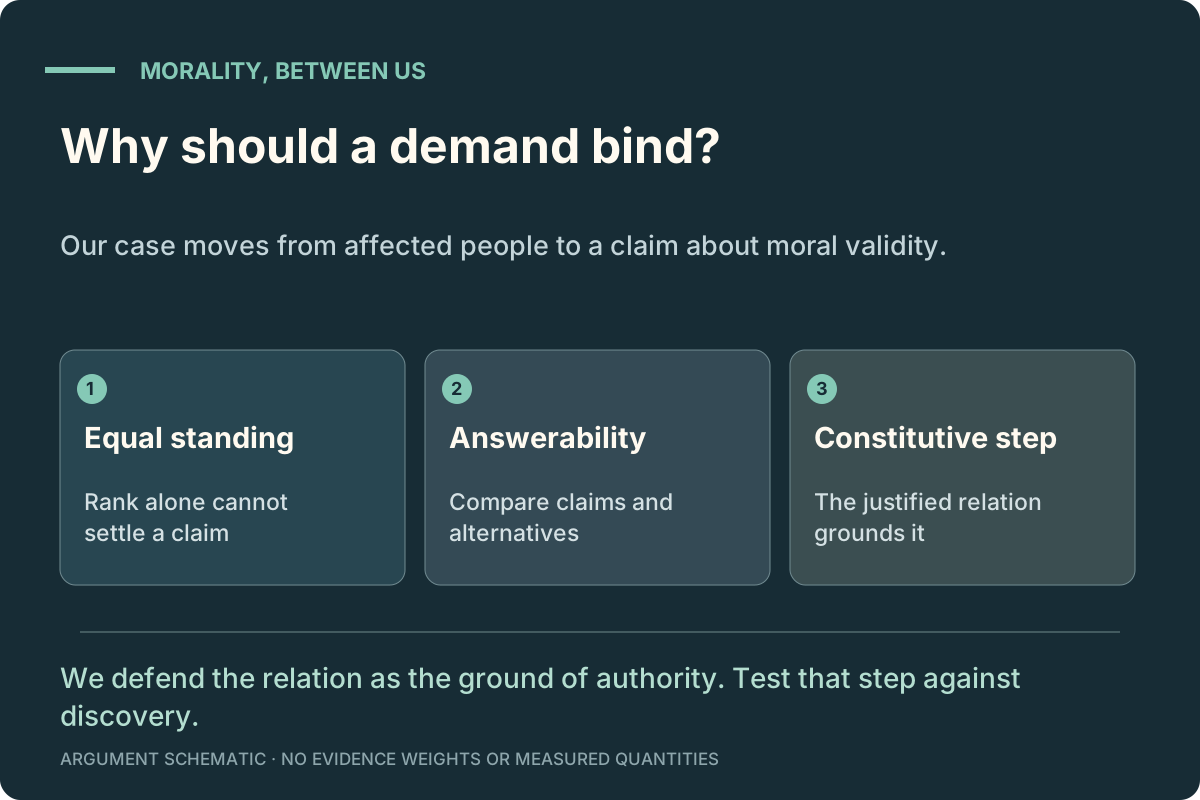
Knowing a beneficial action is not the same as having authority to demand it. Someone wronged can be owed an answer or repair. We argue that a properly justified relation between people constitutes that interpersonal authority. This gives standing, agency and correction a common explanation. A realist can accept all these relations while grounding their authority in independent reasons. The case therefore needs a defended grounding step; useful discussion or a shared verdict cannot settle it. Construction can also let us discover what a valid relation requires.
Authority and Second-Personal Reasons for ActingPrimary philosophy: author manuscript · Reasons for Action, chapter 7, pp. 134–154; accessed manuscript pp. 1–7 and 13–16What this source supports
Distinguishes reasons for beneficial compliance from a person’s standing to demand compliance and hold another accountable.
Access: Yale-hosted full manuscript available; selected passages on authority, accountability and expertise inspected in pass004; Cambridge publication record verified
Limits: The interdefinition of valid demand and authority does not establish everyone’s standing or prove antirealism. The 2006 book and 2013 reprint were not reviewed in full.
Connects equal normative authority with reciprocal justification and explicitly states that constructed norms depend on prior normativity of principles and standing.
Access: Berkeley-hosted full manuscript available; selected grounding passages inspected in pass004; publisher-indexed PDF verified publication metadata but direct publisher retrieval failed
Limits: Focuses on basic legal rights of recognised members; the membership question is bracketed. Not a premise-free derivation, proof of all moral constructivism or independent review of every rival rights theory.
Distinguishes construction of interpersonal right and wrong from prior reasons, and epistemic justification from normative grounding; Lecture 5 examines contextual comparisons of reasons.
Access: Official Oxford-hosted full lecture PDFs available; selected sections inspected in pass003
Limits: These are 2009 lectures, not the revised 2014 book. Selected passages do not provide a complete theory of conflicting claims or settle the prior-reasons objection.
Take a position
When you say morality is objective, which claim matters most to you?
Separate what happens, how a judgment is tested, and what makes it morally true. None of these selections is an error.
Argument
Independence from approval differs from independence from human interests.
Moral RealismPrimary philosophy · The Philosophical Review 95(2), 163–207; especially pp. 164–176 and 189–198What this source supports
A naturalist, relational account that permits criticism of actual approval.
Access: Full primary article retrieved; selected sections on objectivity, informed interests and social rationality inspected in pass002
Limits: Selected-section review, not an exhaustive assessment. The natural basis of interests must not be confused with approval creating the truth.
Moral truth is not made true by our approval.
This is the central realist challenge. It can allow moral facts to concern human needs and relationships; it need not put morality outside human life.
contested
Moral RealismPrimary philosophy · The Philosophical Review 95(2), 163–207; especially pp. 164–176 and 189–198What this source supports
A naturalist, relational account that permits criticism of actual approval.
Access: Full primary article retrieved; selected sections on objectivity, informed interests and social rationality inspected in pass002
Limits: Selected-section review, not an exhaustive assessment. The natural basis of interests must not be confused with approval creating the truth.
Moral judgment can be publicly tested beyond my preference.
This is the objectivity the proposed practice aims to earn. It leaves open whether its standards are discovered or constructed.
commitment
Contractualism and UtilitarianismPrimary philosophy · In Utilitarianism and Beyond, pp. 103–128; indexed opening discussion of justification and moral theoryWhat this source supports
A primary route into interpersonal justification and its substantive moral background.
Access: Selected indexed primary passages inspected in pass002; scanned PDF retrieved but text extraction was empty
Limits: Not a full-book review. MORARG develops its own constructive proposal; Scanlon’s contractualism alone does not establish antirealism.
Consequences occur regardless of what I want.
That gives moral reasoning factual constraints. Which consequences count as reasons, and how strongly, is a further question.
reflection
A Treatise of Human Nature, Book IIIPrimary philosophy · T 3.1.1.27; T 3.1.2.1–4, SBN 470–472; T 3.3.1.15–18, SBN 581–584What this source supports
Defends a sentimental account while distinguishing moral approval from immediate private advantage and describing correction toward a steadier general standpoint.
Access: Selected primary passages inspected in pass001; pass004 directly inspects sentiment, private-interest distinctions and the general standpoint in Hume Texts Online
Limits: An argued philosophical account, not empirical confirmation or a complete interpretation of Hume. The general standpoint is a precedent for correction, not proof of MORARG’s equal-standing or constitutive-authority premises; the is–ought passage alone does not refute naturalism.
I need these meanings kept separate before choosing.
Holding the distinction open avoids resolving a substantive debate by a definition.
reflection
Moral RealismPrimary philosophy · The Philosophical Review 95(2), 163–207; especially pp. 164–176 and 189–198What this source supports
A naturalist, relational account that permits criticism of actual approval.
Access: Full primary article retrieved; selected sections on objectivity, informed interests and social rationality inspected in pass002
Limits: Selected-section review, not an exhaustive assessment. The natural basis of interests must not be confused with approval creating the truth.
Good and bad
A proposed service is efficient and benefits most users, but places a serious burden on a few. What should “good” require us to examine?
Hypothetical case: the evidence about efficiency is accepted. The size of the benefit, the burden, feasible alternatives and the people’s claims still need assessment. More than one question matters; choose your first priority.
Argument
Geach challenges treating every use of “good” as one free-standing property or as the speaker’s commendation. His account is an argued position, not a definition that proves subjectivism.
Good and EvilPrimary philosophy: article transcription · Analysis 17(2), 33–42; transcription paragraphs 1–3, 8–12 and 15–16What this source supports
Argues that good and bad are logically attributive, and rejects reducing their descriptive use to the speaker’s commendation or tastes.
Access: Full article transcription available; selected passages inspected in pass004; publisher-indexed title, DOI and pagination checked, while direct publisher retrieval failed
Limits: Geach’s attributive thesis is contested. It does not entail subjectivism or MORARG’s constitutive thesis; his transition to moral assessment and motivation requires further argument. The transcription header gives 32–42; publisher metadata gives 33–42.
Clarify the purpose before deciding whether the service performs it well.
This tests instrumental success. It still leaves whether that purpose and the chosen means deserve support; a harmful aim can be pursued efficiently.
reflection
Good and EvilPrimary philosophy: article transcription · Analysis 17(2), 33–42; transcription paragraphs 1–3, 8–12 and 15–16What this source supports
Argues that good and bad are logically attributive, and rejects reducing their descriptive use to the speaker’s commendation or tastes.
Access: Full article transcription available; selected passages inspected in pass004; publisher-indexed title, DOI and pagination checked, while direct publisher retrieval failed
Limits: Geach’s attributive thesis is contested. It does not entail subjectivism or MORARG’s constitutive thesis; his transition to moral assessment and motivation requires further argument. The transcription header gives 32–42; publisher metadata gives 33–42.
Examine what the benefits and burdens mean for each person’s welfare.
This makes “good for whom” concrete. Welfare can be misjudged, and someone’s present preference is not the whole account of their interests. A further judgment must compare competing claims.
reflection
Moral RealismPrimary philosophy · The Philosophical Review 95(2), 163–207; especially pp. 164–176 and 189–198What this source supports
A naturalist, relational account that permits criticism of actual approval.
Access: Full primary article retrieved; selected sections on objectivity, informed interests and social rationality inspected in pass002
Limits: Selected-section review, not an exhaustive assessment. The natural basis of interests must not be confused with approval creating the truth.
Ask whether the burdens can be justified to those who bear them.
This is the proposed moral test. It gives the minority standing without assuming every complaint is decisive. Explain severity, alternatives and the comparison of claims.
Distinguishes construction of interpersonal right and wrong from prior reasons, and epistemic justification from normative grounding; Lecture 5 examines contextual comparisons of reasons.
Access: Official Oxford-hosted full lecture PDFs available; selected sections inspected in pass003
Limits: These are 2009 lectures, not the revised 2014 book. Selected passages do not provide a complete theory of conflicting claims or settle the prior-reasons objection.
Connects equal normative authority with reciprocal justification and explicitly states that constructed norms depend on prior normativity of principles and standing.
Access: Berkeley-hosted full manuscript available; selected grounding passages inspected in pass004; publisher-indexed PDF verified publication metadata but direct publisher retrieval failed
Limits: Focuses on basic legal rights of recognised members; the membership question is bracketed. Not a premise-free derivation, proof of all moral constructivism or independent review of every rival rights theory.
Examine whether the service’s aim itself deserves moral support.
A good result relative to a selected aim need not vindicate that aim. State the values by which you assess it and answer the affected people’s competing claims.
reflection
Principia EthicaPrimary philosophy: public-domain transcription · Chapter I, §§5–10, especially §6 on verbal definition and substantive claims; printed pp. 5–10What this source supports
Distinguishes a verbal definition from inquiry into goodness and argues against treating a substantive account of the good as a result of word meaning.
Access: Full book transcription available at Project Gutenberg; selected opening passages inspected in pass004, not the whole book
Limits: Moore’s indefinability thesis is his philosophical position, not an established refutation of every naturalist identity theory. MORARG uses it as a serious countermodel to the proposed semantic shortcut.
Distinguishes construction of interpersonal right and wrong from prior reasons, and epistemic justification from normative grounding; Lecture 5 examines contextual comparisons of reasons.
Access: Official Oxford-hosted full lecture PDFs available; selected sections inspected in pass003
Limits: These are 2009 lectures, not the revised 2014 book. Selected passages do not provide a complete theory of conflicting claims or settle the prior-reasons objection.
Good and bad
Every moral judgment is made from a person’s standpoint. Which further claim about its validity would you defend?
“Subjective” can mean involving a subject who judges, or having truth fixed by that subject’s approval. The first does not entail the second. Choose a substantive account; each needs reasons beyond the existence of a judge.
Argument
Our positive bridge is normative: comparable affected interests deserve a place in justifying a demand that governs them. The vocabulary of evaluation does not supply that premise.
Connects equal normative authority with reciprocal justification and explicitly states that constructed norms depend on prior normativity of principles and standing.
Access: Berkeley-hosted full manuscript available; selected grounding passages inspected in pass004; publisher-indexed PDF verified publication metadata but direct publisher retrieval failed
Limits: Focuses on basic legal rights of recognised members; the membership question is bracketed. Not a premise-free derivation, proof of all moral constructivism or independent review of every rival rights theory.
Distinguishes construction of interpersonal right and wrong from prior reasons, and epistemic justification from normative grounding; Lecture 5 examines contextual comparisons of reasons.
Access: Official Oxford-hosted full lecture PDFs available; selected sections inspected in pass003
Limits: These are 2009 lectures, not the revised 2014 book. Selected passages do not provide a complete theory of conflicting claims or settle the prior-reasons objection.
A standard’s interpersonal validity is constituted by justification to those affected.
This is our preferred account: their claims have standing, so your approval alone cannot settle what they are owed. It must defend equal standing and why adequate justification is sufficient, rather than merely a way to discover the answer.
Connects equal normative authority with reciprocal justification and explicitly states that constructed norms depend on prior normativity of principles and standing.
Access: Berkeley-hosted full manuscript available; selected grounding passages inspected in pass004; publisher-indexed PDF verified publication metadata but direct publisher retrieval failed
Limits: Focuses on basic legal rights of recognised members; the membership question is bracketed. Not a premise-free derivation, proof of all moral constructivism or independent review of every rival rights theory.
Distinguishes construction of interpersonal right and wrong from prior reasons, and epistemic justification from normative grounding; Lecture 5 examines contextual comparisons of reasons.
Access: Official Oxford-hosted full lecture PDFs available; selected sections inspected in pass003
Limits: These are 2009 lectures, not the revised 2014 book. Selected passages do not provide a complete theory of conflicting claims or settle the prior-reasons objection.
Human judgments can be made true by facts or reasons independent of approval.
A serious realist view. Railton’s informed-interest account can be human and relational while independent of present endorsement. It needs a defended account of the relevant facts or reasons and their authority; the presence of a judge does not refute it.
contested
Moral RealismPrimary philosophy · The Philosophical Review 95(2), 163–207; especially pp. 164–176 and 189–198What this source supports
A naturalist, relational account that permits criticism of actual approval.
Access: Full primary article retrieved; selected sections on objectivity, informed interests and social rationality inspected in pass002
Limits: Selected-section review, not an exhaustive assessment. The natural basis of interests must not be confused with approval creating the truth.
Principia EthicaPrimary philosophy: public-domain transcription · Chapter I, §§5–10, especially §6 on verbal definition and substantive claims; printed pp. 5–10What this source supports
Distinguishes a verbal definition from inquiry into goodness and argues against treating a substantive account of the good as a result of word meaning.
Access: Full book transcription available at Project Gutenberg; selected opening passages inspected in pass004, not the whole book
Limits: Moore’s indefinability thesis is his philosophical position, not an established refutation of every naturalist identity theory. MORARG uses it as a serious countermodel to the proposed semantic shortcut.
Moral validity is relative to each judging person’s evaluative attitudes.
That is an individual subjectivist proposal, not a consequence of the word “judgment”. Explain which attitudes count, how mistaken beliefs are corrected and what authority one person’s standard has when another bears its cost.
Distinguishes constructivism as a substantive or metaethical position and questions a simple procedural characterisation.
Access: Publisher abstract and bibliographic record inspected in pass002; full article not reviewed
Limits: MORARG’s interpersonal proposal is not attributed to Street as her own theory. A fuller comparison with her practical-standpoint view remains open.
Moral RealismPrimary philosophy · The Philosophical Review 95(2), 163–207; especially pp. 164–176 and 189–198What this source supports
A naturalist, relational account that permits criticism of actual approval.
Access: Full primary article retrieved; selected sections on objectivity, informed interests and social rationality inspected in pass002
Limits: Selected-section review, not an exhaustive assessment. The natural basis of interests must not be confused with approval creating the truth.
The fact that people judge leaves the truth-making question open.
This preserves the distinction without answering the deeper dispute. To move further, compare the explanations of authority, error, correction and conflicting claims.
reflection
Principia EthicaPrimary philosophy: public-domain transcription · Chapter I, §§5–10, especially §6 on verbal definition and substantive claims; printed pp. 5–10What this source supports
Distinguishes a verbal definition from inquiry into goodness and argues against treating a substantive account of the good as a result of word meaning.
Access: Full book transcription available at Project Gutenberg; selected opening passages inspected in pass004, not the whole book
Limits: Moore’s indefinability thesis is his philosophical position, not an established refutation of every naturalist identity theory. MORARG uses it as a serious countermodel to the proposed semantic shortcut.
Moral RealismPrimary philosophy · The Philosophical Review 95(2), 163–207; especially pp. 164–176 and 189–198What this source supports
A naturalist, relational account that permits criticism of actual approval.
Access: Full primary article retrieved; selected sections on objectivity, informed interests and social rationality inspected in pass002
Limits: Selected-section review, not an exhaustive assessment. The natural basis of interests must not be confused with approval creating the truth.
Good and bad
You feel certain that a rule is good; a person burdened by it offers a reasoned objection. How will you test your judgment?
The objection may or may not succeed. Neither your confidence nor the other person’s emotion determines the answer. Assume time permits a serious review before acting.
Argument
In Hume’s account, a general standpoint corrects the influence of proximity and private advantage. This is a precedent for disciplined human evaluation, not a proof of MORARG’s grounding thesis.
A Treatise of Human Nature, Book IIIPrimary philosophy · T 3.1.1.27; T 3.1.2.1–4, SBN 470–472; T 3.3.1.15–18, SBN 581–584What this source supports
Defends a sentimental account while distinguishing moral approval from immediate private advantage and describing correction toward a steadier general standpoint.
Access: Selected primary passages inspected in pass001; pass004 directly inspects sentiment, private-interest distinctions and the general standpoint in Hume Texts Online
Limits: An argued philosophical account, not empirical confirmation or a complete interpretation of Hume. The general standpoint is a precedent for correction, not proof of MORARG’s equal-standing or constitutive-authority premises; the is–ought passage alone does not refute naturalism.
Examine their account of the burden and whether I missed an alternative.
You use another standpoint to test facts and assumptions. Hearing the complaint gives it a fair assessment, not an automatic victory. The eventual conclusion needs the comparison of reasons.
commitment
A Treatise of Human Nature, Book IIIPrimary philosophy · T 3.1.1.27; T 3.1.2.1–4, SBN 470–472; T 3.3.1.15–18, SBN 581–584What this source supports
Defends a sentimental account while distinguishing moral approval from immediate private advantage and describing correction toward a steadier general standpoint.
Access: Selected primary passages inspected in pass001; pass004 directly inspects sentiment, private-interest distinctions and the general standpoint in Hume Texts Online
Limits: An argued philosophical account, not empirical confirmation or a complete interpretation of Hume. The general standpoint is a precedent for correction, not proof of MORARG’s equal-standing or constitutive-authority premises; the is–ought passage alone does not refute naturalism.
Distinguishes construction of interpersonal right and wrong from prior reasons, and epistemic justification from normative grounding; Lecture 5 examines contextual comparisons of reasons.
Access: Official Oxford-hosted full lecture PDFs available; selected sections inspected in pass003
Limits: These are 2009 lectures, not the revised 2014 book. Selected passages do not provide a complete theory of conflicting claims or settle the prior-reasons objection.
Explain my principle and ask whether their objection defeats its application.
A firm, reasoned principle can survive challenge. Keep its moral premise visible and say what would defeat or limit it; confidence does not itself make that premise true.
Distinguishes construction of interpersonal right and wrong from prior reasons, and epistemic justification from normative grounding; Lecture 5 examines contextual comparisons of reasons.
Access: Official Oxford-hosted full lecture PDFs available; selected sections inspected in pass003
Limits: These are 2009 lectures, not the revised 2014 book. Selected passages do not provide a complete theory of conflicting claims or settle the prior-reasons objection.
Moral RealismPrimary philosophy · The Philosophical Review 95(2), 163–207; especially pp. 164–176 and 189–198What this source supports
A naturalist, relational account that permits criticism of actual approval.
Access: Full primary article retrieved; selected sections on objectivity, informed interests and social rationality inspected in pass002
Limits: Selected-section review, not an exhaustive assessment. The natural basis of interests must not be confused with approval creating the truth.
Examine what my strong response and their experience may each reveal.
Emotion and experience can bring relevant stakes into view. Test the interpretation and its proposed remedy; neither feeling deeply nor feeling calmly settles their warrant.
reflection
A Treatise of Human Nature, Book IIIPrimary philosophy · T 3.1.1.27; T 3.1.2.1–4, SBN 470–472; T 3.3.1.15–18, SBN 581–584What this source supports
Defends a sentimental account while distinguishing moral approval from immediate private advantage and describing correction toward a steadier general standpoint.
Access: Selected primary passages inspected in pass001; pass004 directly inspects sentiment, private-interest distinctions and the general standpoint in Hume Texts Online
Limits: An argued philosophical account, not empirical confirmation or a complete interpretation of Hume. The general standpoint is a precedent for correction, not proof of MORARG’s equal-standing or constitutive-authority premises; the is–ought passage alone does not refute naturalism.
Withhold my conclusion while the competing reasons remain unresolved.
Suspension can fit the available reasons. It does not show there is no truth to find or no standard to construct; identify what further inquiry could improve the judgment.
reflection
Moral RealismPrimary philosophy · The Philosophical Review 95(2), 163–207; especially pp. 164–176 and 189–198What this source supports
A naturalist, relational account that permits criticism of actual approval.
Access: Full primary article retrieved; selected sections on objectivity, informed interests and social rationality inspected in pass002
Limits: Selected-section review, not an exhaustive assessment. The natural basis of interests must not be confused with approval creating the truth.
Principia EthicaPrimary philosophy: public-domain transcription · Chapter I, §§5–10, especially §6 on verbal definition and substantive claims; printed pp. 5–10What this source supports
Distinguishes a verbal definition from inquiry into goodness and argues against treating a substantive account of the good as a result of word meaning.
Access: Full book transcription available at Project Gutenberg; selected opening passages inspected in pass004, not the whole book
Limits: Moore’s indefinability thesis is his philosophical position, not an established refutation of every naturalist identity theory. MORARG uses it as a serious countermodel to the proposed semantic shortcut.
A reliable study predicts that a policy reduces injuries. What else does your moral conclusion need?
Assume the prediction is sound. The remaining question is why preventing those injuries justifies this policy, given its other costs.
An account of why the harms matter and how other burdens compare.
This supplies an explicit normative bridge. You may defend it through rights, welfare, reciprocity or another account.
commitment
A Treatise of Human Nature, Book IIIPrimary philosophy · T 3.1.1.27; T 3.1.2.1–4, SBN 470–472; T 3.3.1.15–18, SBN 581–584What this source supports
Defends a sentimental account while distinguishing moral approval from immediate private advantage and describing correction toward a steadier general standpoint.
Access: Selected primary passages inspected in pass001; pass004 directly inspects sentiment, private-interest distinctions and the general standpoint in Hume Texts Online
Limits: An argued philosophical account, not empirical confirmation or a complete interpretation of Hume. The general standpoint is a precedent for correction, not proof of MORARG’s equal-standing or constitutive-authority premises; the is–ought passage alone does not refute naturalism.
A defended naturalist account connecting those facts to rightness.
A serious realist route. The identification must be argued for; it is not supplied merely by measuring an outcome.
contested
Moral RealismPrimary philosophy · The Philosophical Review 95(2), 163–207; especially pp. 164–176 and 189–198What this source supports
A naturalist, relational account that permits criticism of actual approval.
Access: Full primary article retrieved; selected sections on objectivity, informed interests and social rationality inspected in pass002
Limits: Selected-section review, not an exhaustive assessment. The natural basis of interests must not be confused with approval creating the truth.
The measured reduction alone logically entails that the policy is right.
The inference omits a premise connecting the measured outcome to rightness and ignores possible competing reasons. Add that premise; the policy itself has not been judged wrong.
inference · claim requires repair
A Treatise of Human Nature, Book IIIPrimary philosophy · T 3.1.1.27; T 3.1.2.1–4, SBN 470–472; T 3.3.1.15–18, SBN 581–584What this source supports
Defends a sentimental account while distinguishing moral approval from immediate private advantage and describing correction toward a steadier general standpoint.
Access: Selected primary passages inspected in pass001; pass004 directly inspects sentiment, private-interest distinctions and the general standpoint in Hume Texts Online
Limits: An argued philosophical account, not empirical confirmation or a complete interpretation of Hume. The general standpoint is a precedent for correction, not proof of MORARG’s equal-standing or constitutive-authority premises; the is–ought passage alone does not refute naturalism.
I would withhold judgment until the alternatives and uncertainties are clearer.
Evidence can be reliable yet incomplete for a particular decision. Name which missing information could change your choice.
reflection
What role could a shared procedure play in your view?
Two people may use the same careful method while disagreeing about why its conclusions have authority.
It helps us discover moral truths that do not depend on approval.
Realism can endorse public criticism and personal judgment. This experience must address that explanation rather than count your participation as conversion.
contested
Moral RealismPrimary philosophy · The Philosophical Review 95(2), 163–207; especially pp. 164–176 and 189–198What this source supports
A naturalist, relational account that permits criticism of actual approval.
Access: Full primary article retrieved; selected sections on objectivity, informed interests and social rationality inspected in pass002
Limits: Selected-section review, not an exhaustive assessment. The natural basis of interests must not be confused with approval creating the truth.
Under justified constraints, it helps constitute our moral standards.
This is the stronger constructive proposal. You inherit a burden to justify the constraints and explain their authority over dissenters.
commitment
Contractualism and UtilitarianismPrimary philosophy · In Utilitarianism and Beyond, pp. 103–128; indexed opening discussion of justification and moral theoryWhat this source supports
A primary route into interpersonal justification and its substantive moral background.
Access: Selected indexed primary passages inspected in pass002; scanned PDF retrieved but text extraction was empty
Limits: Not a full-book review. MORARG develops its own constructive proposal; Scanlon’s contractualism alone does not establish antirealism.
Taking Moral Skepticism SeriouslyPrimary philosophical critique · Philosophical Studies 168, 843–851; author manuscript pp. 2–6What this source supports
Questions whether taking deliberation seriously establishes robust realism rather than another account of reasons.
Access: Author-hosted symposium manuscript retrieved; argument about deliberation, construction and skepticism inspected in pass002
Limits: A substantive critic’s argument, not a neutral verdict on Enoch or proof of error theory.
It helps us coordinate while the truth question remains open.
A narrower but substantial practical position. Coordination needs criticism too: a cooperative system can distribute benefits unjustly.
Shared political commitments can be pursued amid deeper disagreement.
Access: Primary excerpts inspected in pass001; full article not newly reviewed in pass002
Limits: This is a political account, not a complete antirealist theory of morality.
I doubt a shared procedure can escape domination or circularity.
That is a substantive objection. Later rooms test whether contestability and explicit commitments answer enough of it.
contested
Contractualism and UtilitarianismPrimary philosophy · In Utilitarianism and Beyond, pp. 103–128; indexed opening discussion of justification and moral theoryWhat this source supports
A primary route into interpersonal justification and its substantive moral background.
Access: Selected indexed primary passages inspected in pass002; scanned PDF retrieved but text extraction was empty
Limits: Not a full-book review. MORARG develops its own constructive proposal; Scanlon’s contractualism alone does not establish antirealism.
Conditional follow-up. Shown when “What role could a shared procedure play in your view?” → “Under justified constraints, it helps constitute our moral standards.” or “I doubt a shared procedure can escape domination or circularity.”. In the interactive version, a changed trigger requires reconsidering dependent responses.
Two perfectly informed groups reason coherently, but one protects equal standing and the other accepts hereditary domination. Can the procedure distinguish them, and which premise does that work?
This tests the construction’s starting conditions. Neither factual accuracy nor internal consistency settles whose claims deserve weight. The proposed account must defend its reciprocal starting point, rather than treating every coherent agreement as valid.
The dominated person’s comparable claim must count; coherence cannot cancel it.
This is the account’s substantive commitment. Defend why another person’s lower status is not itself a reason to discount the very complaint against that status. It is not a deduction from coherence alone.
Distinguishes construction of interpersonal right and wrong from prior reasons, and epistemic justification from normative grounding; Lecture 5 examines contextual comparisons of reasons.
Access: Official Oxford-hosted full lecture PDFs available; selected sections inspected in pass003
Limits: These are 2009 lectures, not the revised 2014 book. Selected passages do not provide a complete theory of conflicting claims or settle the prior-reasons objection.
Kantian Constructivism in Moral TheoryPrimary philosophy: journal text through public mirror · The Journal of Philosophy 77(9), 515–572; pp. 516–519, 528–530 and selected passages of Lecture III, especially pp. 565–569What this source supports
Person-conceptions and reasonable constraints shape a construction; the reasonable is not reduced to individual advantage.
Access: Selected primary-text OCR passages inspected in pass003; JSTOR publication record checked
Limits: Rawls frames justice as fairness for democratic public culture. This is not a general proof of MORARG’s metaethics, nor a complete review of Rawls’s later political liberalism.
Challenges evolutionary reliability and sketches how actual evaluative error can survive an account grounded in a wider system of attitudes.
Access: Full primary article retrieved; selected sections inspected in pass002; reflective-equilibrium and concluding antirealist passages inspected in pass003
Limits: Evolutionary causes alone do not refute realism. The concluding sketch is not a full defence of one constructivism and does not itself establish MORARG’s equal-standing premise.
A prior truth about equal standing is needed to choose the procedure.
This is a strong rival explanation: construction may organise demands whose authority comes from reasons it does not construct. The framework must answer that challenge.
Distinguishes construction of interpersonal right and wrong from prior reasons, and epistemic justification from normative grounding; Lecture 5 examines contextual comparisons of reasons.
Access: Official Oxford-hosted full lecture PDFs available; selected sections inspected in pass003
Limits: These are 2009 lectures, not the revised 2014 book. Selected passages do not provide a complete theory of conflicting claims or settle the prior-reasons objection.
Kantian Constructivism in Moral TheoryPrimary philosophy: journal text through public mirror · The Journal of Philosophy 77(9), 515–572; pp. 516–519, 528–530 and selected passages of Lecture III, especially pp. 565–569What this source supports
Person-conceptions and reasonable constraints shape a construction; the reasonable is not reduced to individual advantage.
Access: Selected primary-text OCR passages inspected in pass003; JSTOR publication record checked
Limits: Rawls frames justice as fairness for democratic public culture. This is not a general proof of MORARG’s metaethics, nor a complete review of Rawls’s later political liberalism.
Challenges evolutionary reliability and sketches how actual evaluative error can survive an account grounded in a wider system of attitudes.
Access: Full primary article retrieved; selected sections inspected in pass002; reflective-equilibrium and concluding antirealist passages inspected in pass003
Limits: Evolutionary causes alone do not refute realism. The concluding sketch is not a full defence of one constructivism and does not itself establish MORARG’s equal-standing premise.
These starting points remain contested; no uniquely valid procedure has yet been shown.
You withhold the sufficiency claim rather than denying that criticism or reform can matter. Identify what could justify preferring one starting point.
Distinguishes construction of interpersonal right and wrong from prior reasons, and epistemic justification from normative grounding; Lecture 5 examines contextual comparisons of reasons.
Access: Official Oxford-hosted full lecture PDFs available; selected sections inspected in pass003
Limits: These are 2009 lectures, not the revised 2014 book. Selected passages do not provide a complete theory of conflicting claims or settle the prior-reasons objection.
Kantian Constructivism in Moral TheoryPrimary philosophy: journal text through public mirror · The Journal of Philosophy 77(9), 515–572; pp. 516–519, 528–530 and selected passages of Lecture III, especially pp. 565–569What this source supports
Person-conceptions and reasonable constraints shape a construction; the reasonable is not reduced to individual advantage.
Access: Selected primary-text OCR passages inspected in pass003; JSTOR publication record checked
Limits: Rawls frames justice as fairness for democratic public culture. This is not a general proof of MORARG’s metaethics, nor a complete review of Rawls’s later political liberalism.
Challenges evolutionary reliability and sketches how actual evaluative error can survive an account grounded in a wider system of attitudes.
Access: Full primary article retrieved; selected sections inspected in pass002; reflective-equilibrium and concluding antirealist passages inspected in pass003
Limits: Evolutionary causes alone do not refute realism. The concluding sketch is not a full defence of one constructivism and does not itself establish MORARG’s equal-standing premise.
Compare what each standpoint must ask affected people to endure and accept.
Comparative scrutiny can expose privilege, omissions and costs. It still needs a defended judgment about why those complaints count, so the test is not value-free.
Distinguishes construction of interpersonal right and wrong from prior reasons, and epistemic justification from normative grounding; Lecture 5 examines contextual comparisons of reasons.
Access: Official Oxford-hosted full lecture PDFs available; selected sections inspected in pass003
Limits: These are 2009 lectures, not the revised 2014 book. Selected passages do not provide a complete theory of conflicting claims or settle the prior-reasons objection.
Kantian Constructivism in Moral TheoryPrimary philosophy: journal text through public mirror · The Journal of Philosophy 77(9), 515–572; pp. 516–519, 528–530 and selected passages of Lecture III, especially pp. 565–569What this source supports
Person-conceptions and reasonable constraints shape a construction; the reasonable is not reduced to individual advantage.
Access: Selected primary-text OCR passages inspected in pass003; JSTOR publication record checked
Limits: Rawls frames justice as fairness for democratic public culture. This is not a general proof of MORARG’s metaethics, nor a complete review of Rawls’s later political liberalism.
Challenges evolutionary reliability and sketches how actual evaluative error can survive an account grounded in a wider system of attitudes.
Access: Full primary article retrieved; selected sections inspected in pass002; reflective-equilibrium and concluding antirealist passages inspected in pass003
Limits: Evolutionary causes alone do not refute realism. The concluding sketch is not a full defence of one constructivism and does not itself establish MORARG’s equal-standing premise.
Three values to consider
Clarity
Say which objectivity you mean.
Keep physical consequences, public methods and truth independent of approval distinct. A dispute about one should not be won by silently switching to another.
Moral RealismPrimary philosophy · The Philosophical Review 95(2), 163–207; especially pp. 164–176 and 189–198What this source supports
A naturalist, relational account that permits criticism of actual approval.
Access: Full primary article retrieved; selected sections on objectivity, informed interests and social rationality inspected in pass002
Limits: Selected-section review, not an exhaustive assessment. The natural basis of interests must not be confused with approval creating the truth.
Challenges evolutionary reliability and sketches how actual evaluative error can survive an account grounded in a wider system of attitudes.
Access: Full primary article retrieved; selected sections inspected in pass002; reflective-equilibrium and concluding antirealist passages inspected in pass003
Limits: Evolutionary causes alone do not refute realism. The concluding sketch is not a full defence of one constructivism and does not itself establish MORARG’s equal-standing premise.
Truth beyond us
What makes a judgment true?
Carry the realist question forward: could a whole community be mistaken, and what would make it so? Selecting this concern is compatible with valuing shared inquiry.
Moral RealismPrimary philosophy · The Philosophical Review 95(2), 163–207; especially pp. 164–176 and 189–198What this source supports
A naturalist, relational account that permits criticism of actual approval.
Access: Full primary article retrieved; selected sections on objectivity, informed interests and social rationality inspected in pass002
Limits: Selected-section review, not an exhaustive assessment. The natural basis of interests must not be confused with approval creating the truth.
Being Realistic about ReasonsPrimary work: author and publisher synopsis · Book abstract and contents; Harvard author abstract; preview preface describing revision of the lecturesWhat this source supports
Defends irreducible normative truths and a role for reflective equilibrium.
Access: Publisher and author abstracts inspected; preview preface checked in pass003; full book not read
Limits: The 2009 lectures have a separate entry: the 2014 preface reports substantial revision, so their selected passages cannot be passed off as a full review of this book. Normative cognitivism is not interchangeable with Enoch’s robust realism.
Public answerability
Let others examine the reasons.
A claim governing shared lives should expose its evidence, premises and remaining burdens to challenge. This is a proposed standard of justification, with its own defence to make.
Contractualism and UtilitarianismPrimary philosophy · In Utilitarianism and Beyond, pp. 103–128; indexed opening discussion of justification and moral theoryWhat this source supports
A primary route into interpersonal justification and its substantive moral background.
Access: Selected indexed primary passages inspected in pass002; scanned PDF retrieved but text extraction was empty
Limits: Not a full-book review. MORARG develops its own constructive proposal; Scanlon’s contractualism alone does not establish antirealism.
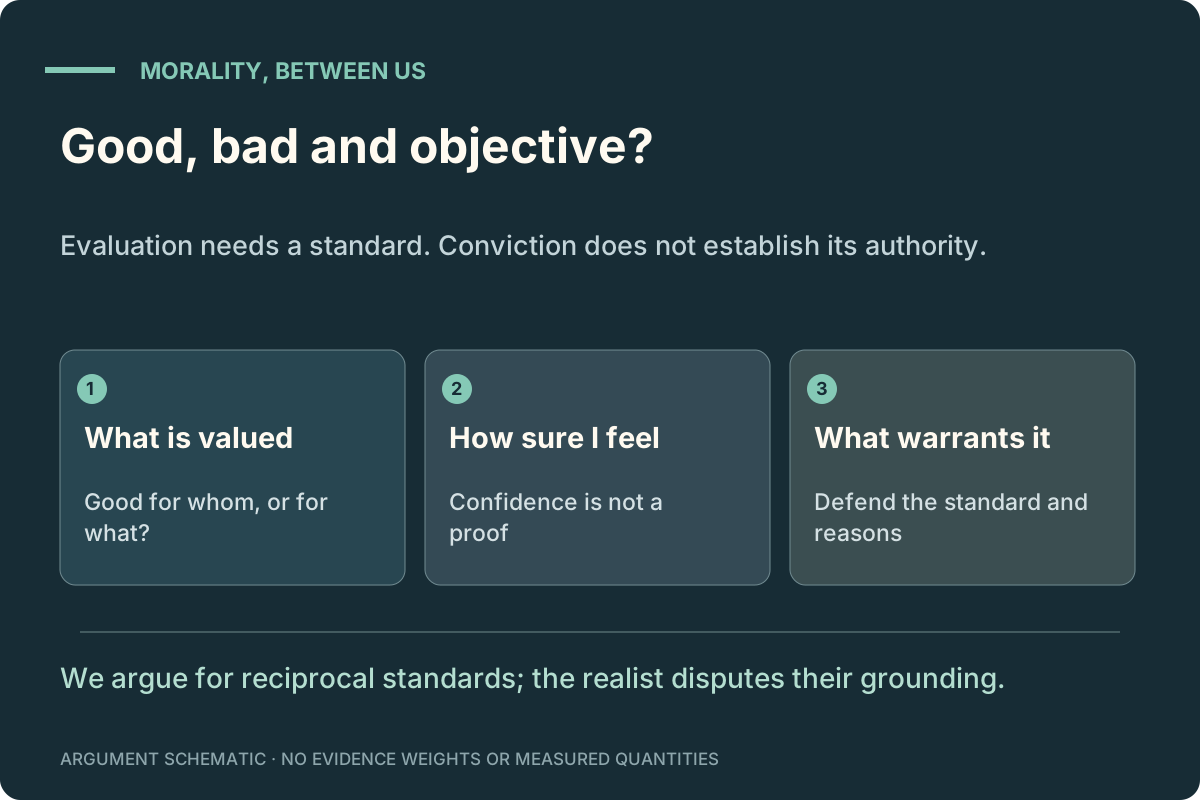
Good, bad and objective?. Evaluation needs a standard. Conviction does not establish its authority. We argue for reciprocal standards; the realist disputes their grounding. MORARG authored argument schematic; no measured quantities or simulated outcomes.
01 · Evolved Fairness?
From a reaction to a reason
A monkey refusing a lesser reward is observable. What that reaction means—and whether it gives us a moral obligation—requires further argument.
A capacity may have an evolutionary history without settling what justice requires.
A famous experiment Evidence
In 2003 researchers reported that capuchin monkeys sometimes rejected a less desirable reward when another received a better one for a similar exchange. The observation inspired a hypothesis about evolutionary roots of fairness. Refusing food, however, does not by itself tell us whether an animal judged an outcome unjust.
Monkeys reject unequal payPrimary empirical research · Nature 425, 297–299; experiment and controlsWhat this source supports
Reported capuchin refusals under unequal reward conditions.
Access: Primary article PDF indexed and selected abstract and methods inspected
Limits: The interpretation as inequity aversion is contested by later reanalysis and alternative explanations.
What the newer evidence adds Evidence
A 2024 reanalysis of 23 accept/reject studies across 18 species found no statistically clear pooled inequity effect in that paradigm. A 2025 capuchin group study and a 2026 chimpanzee study report responses sensitive to food and social context; another 2026 four-species study found no increased refusals when inequality occurred in 25% or 50% of trials. The pooled analysis also found increased refusals when better food was salient, supporting a disappointment explanation; task design still matters. A null result in one task does not rule out every capacity.
Reports context-sensitive responses in a group of chimpanzees.
Access: Pass003: selected methods, results and discussion inspected in publisher-provided full text hosted on ResearchGate; no data reanalysis
Limits: Voluntary participation in six captive groups; affiliation is not experimentally assigned. Advantageous refusals were too rare for statistical analysis. These measures do not establish a justice concept.
At 25% or 50% unequal trials the studied primates did not increase refusals relative to controls.
Access: Publisher and PubMed primary-study abstracts inspected; full text not reviewed
Limits: Null refusal effects do not establish absence of noticing or other responses; task frequency and measures matter.
Evidence that pushes back Evidence
A 2025 bonobo study compared human and machine reward delivery. Its results challenge the idea that refusals are merely disappointment with a human experimenter. The small captive sample and partly matching pattern still limit the conclusion. This is positive evidence to assess, not something a pooled null lets us ignore. Neither pattern establishes a universal moral rule.
Two bonobo studies report unequal-reward responses; a human/machine manipulation challenges the social-disappointment explanation.
Access: Primary full-text indexed methods/results/discussion inspected in pass003; no independent reanalysis
Limits: Six newly tested bonobos in one group; one analysis pooled an older sample. Study 2 was only partly consistent with inequity aversion; partner variation and task constraints limit generalisation.
What about human beginnings? Evidence
Human development needs its own evidence. A large 2025 hill-task replication found no above-chance preference for helpers among 567 included infants aged 5.5–10.5 months. A 2026 study using looking measures at 14–15 months found expectations about particular caring relationships. Different ages and measures answer different questions. Neither finding licenses “babies have no social capacities” or “humans are born knowing universal justice”.
A large coordinated hill-task replication found no above-chance helper preference.
Access: Primary abstract and indexed methods inspected; published correction inspected by Terra; no independent reanalysis
Limits: 567 included infants aged 5.5–10.5 months; this task is not a test of all moral capacities. The 2025 correction changes an exploratory analysis, with conclusions unchanged.
Looking-time findings in 14–15-month-olds suggest relationship-specific expectations about helping.
Access: Primary abstract and selected indexed methods/results inspected; full independent assessment not completed
Limits: An indirect measure at a different age, not a direct replication of the hill-choice task; it establishes neither innateness nor moral authority.
A feeling is a starting point Argument
Sensitivity to outcomes or expectations may be among the capacities from which social practices develop; these experiments do not establish an innate, fixed sense of justice. To argue that a distribution is unjust, we must also ask whose interests count, what differences matter and how burdens are justified. An evolutionary explanation neither proves nor disproves moral realism. This exhibit defends moral standards constituted through reasons people can contest and share, rather than claiming those standards follow automatically from biology.
Reports context-sensitive responses in a group of chimpanzees.
Access: Pass003: selected methods, results and discussion inspected in publisher-provided full text hosted on ResearchGate; no data reanalysis
Limits: Voluntary participation in six captive groups; affiliation is not experimentally assigned. Advantageous refusals were too rare for statistical analysis. These measures do not establish a justice concept.
Challenges evolutionary reliability and sketches how actual evaluative error can survive an account grounded in a wider system of attitudes.
Access: Full primary article retrieved; selected sections inspected in pass002; reflective-equilibrium and concluding antirealist passages inspected in pass003
Limits: Evolutionary causes alone do not refute realism. The concluding sketch is not a full defence of one constructivism and does not itself establish MORARG’s equal-standing premise.
Contractualism and UtilitarianismPrimary philosophy · In Utilitarianism and Beyond, pp. 103–128; indexed opening discussion of justification and moral theoryWhat this source supports
A primary route into interpersonal justification and its substantive moral background.
Access: Selected indexed primary passages inspected in pass002; scanned PDF retrieved but text extraction was empty
Limits: Not a full-book review. MORARG develops its own constructive proposal; Scanlon’s contractualism alone does not establish antirealism.
Take a position
What can a refusal of a lesser reward tell us?
The monkey rejects food after an exchange in a particular experimental context.
A measurable response that may have several explanations.
That keeps the behaviour distinct from its interpretation. Social comparison, expectation and reward value can require different controls.
reflection
Monkeys reject unequal payPrimary empirical research · Nature 425, 297–299; experiment and controlsWhat this source supports
Reported capuchin refusals under unequal reward conditions.
Access: Primary article PDF indexed and selected abstract and methods inspected
Limits: The interpretation as inequity aversion is contested by later reanalysis and alternative explanations.
Reports no statistically clear pooled evidence of inequity aversion in studied accept/reject tasks.
Access: Indexed primary full text and abstract inspected; PMC page returned an access challenge on this pass
Limits: A null result is not proof of no effect or no capacity in all paradigms; samples and available data limit inference.
How should the apparently conflicting newer results affect your view?
Compare the pooled dyadic tasks with later group settings and with unequal rewards on only 25% or 50% of trials. These designs test related but distinct conditions.
Evidence
2024: pooled accept/reject data across 23 studies and 18 species did not show a statistically clear inequity effect.
Scope: This pooled result concerns the included tasks and data. It is not a census of every possible animal response.
Reports no statistically clear pooled evidence of inequity aversion in studied accept/reject tasks.
Access: Indexed primary full text and abstract inspected; PMC page returned an access challenge on this pass
Limits: A null result is not proof of no effect or no capacity in all paradigms; samples and available data limit inference.
Evidence
A 2025 bonobo study manipulated human versus machine reward delivery; the response pattern challenged social disappointment alone but only partly matched inequity-aversion predictions.
Scope: Six newly tested bonobos in one captive group. An older sample was pooled for one analysis; methods and limitations were inspected, without reanalysis.
Two bonobo studies report unequal-reward responses; a human/machine manipulation challenges the social-disappointment explanation.
Access: Primary full-text indexed methods/results/discussion inspected in pass003; no independent reanalysis
Limits: Six newly tested bonobos in one group; one analysis pooled an older sample. Study 2 was only partly consistent with inequity aversion; partner variation and task constraints limit generalisation.
Evidence
2026: the chimpanzee group study (27 individuals) reported refusals mainly for low-value food, with responses related to social bonds.
Scope: Selected full-text sections inspected. Social bonds were not randomly assigned; group participation differs from the pooled dyadic tasks.
Reports context-sensitive responses in a group of chimpanzees.
Access: Pass003: selected methods, results and discussion inspected in publisher-provided full text hosted on ResearchGate; no data reanalysis
Limits: Voluntary participation in six captive groups; affiliation is not experimentally assigned. Advantageous refusals were too rare for statistical analysis. These measures do not establish a justice concept.
Evidence
September 2026: four primate species showed no increased refusals in the tested 25% and 50% unequal-trial conditions.
Scope: A null refusal outcome does not show that the subjects never noticed a disparity.
At 25% or 50% unequal trials the studied primates did not increase refusals relative to controls.
Access: Publisher and PubMed primary-study abstracts inspected; full text not reviewed
Limits: Null refusal effects do not establish absence of noticing or other responses; task frequency and measures matter.
Compare the tasks and avoid a universal conclusion.
The pooled null and context-sensitive results both deserve attention. A task’s result limits claims about that task, not every possible social capacity.
Reports context-sensitive responses in a group of chimpanzees.
Access: Pass003: selected methods, results and discussion inspected in publisher-provided full text hosted on ResearchGate; no data reanalysis
Limits: Voluntary participation in six captive groups; affiliation is not experimentally assigned. Advantageous refusals were too rare for statistical analysis. These measures do not establish a justice concept.
Challenges evolutionary reliability and sketches how actual evaluative error can survive an account grounded in a wider system of attitudes.
Access: Full primary article retrieved; selected sections inspected in pass002; reflective-equilibrium and concluding antirealist passages inspected in pass003
Limits: Evolutionary causes alone do not refute realism. The concluding sketch is not a full defence of one constructivism and does not itself establish MORARG’s equal-standing premise.
Contractualism and UtilitarianismPrimary philosophy · In Utilitarianism and Beyond, pp. 103–128; indexed opening discussion of justification and moral theoryWhat this source supports
A primary route into interpersonal justification and its substantive moral background.
Access: Selected indexed primary passages inspected in pass002; scanned PDF retrieved but text extraction was empty
Limits: Not a full-book review. MORARG develops its own constructive proposal; Scanlon’s contractualism alone does not establish antirealism.
Evolution might affect our access to independent moral truths.
A realist can take evolutionary evidence seriously. A reliability argument must explain the connection; an origin story alone settles neither truth nor falsity.
Challenges evolutionary reliability and sketches how actual evaluative error can survive an account grounded in a wider system of attitudes.
Access: Full primary article retrieved; selected sections inspected in pass002; reflective-equilibrium and concluding antirealist passages inspected in pass003
Limits: Evolutionary causes alone do not refute realism. The concluding sketch is not a full defence of one constructivism and does not itself establish MORARG’s equal-standing premise.
Contractualism and UtilitarianismPrimary philosophy · In Utilitarianism and Beyond, pp. 103–128; indexed opening discussion of justification and moral theoryWhat this source supports
A primary route into interpersonal justification and its substantive moral background.
Access: Selected indexed primary passages inspected in pass002; scanned PDF retrieved but text extraction was empty
Limits: Not a full-book review. MORARG develops its own constructive proposal; Scanlon’s contractualism alone does not establish antirealism.
An evolved reaction automatically makes its associated rule morally right.
A causal history does not supply the needed normative premise or show that this particular reaction is a reliable guide.
Challenges evolutionary reliability and sketches how actual evaluative error can survive an account grounded in a wider system of attitudes.
Access: Full primary article retrieved; selected sections inspected in pass002; reflective-equilibrium and concluding antirealist passages inspected in pass003
Limits: Evolutionary causes alone do not refute realism. The concluding sketch is not a full defence of one constructivism and does not itself establish MORARG’s equal-standing premise.
Contractualism and UtilitarianismPrimary philosophy · In Utilitarianism and Beyond, pp. 103–128; indexed opening discussion of justification and moral theoryWhat this source supports
A primary route into interpersonal justification and its substantive moral background.
Access: Selected indexed primary passages inspected in pass002; scanned PDF retrieved but text extraction was empty
Limits: Not a full-book review. MORARG develops its own constructive proposal; Scanlon’s contractualism alone does not establish antirealism.
I doubt public justification can establish moral authority.
That is a substantive objection. Explaining the psychology would not by itself resolve the authority question.
Challenges evolutionary reliability and sketches how actual evaluative error can survive an account grounded in a wider system of attitudes.
Access: Full primary article retrieved; selected sections inspected in pass002; reflective-equilibrium and concluding antirealist passages inspected in pass003
Limits: Evolutionary causes alone do not refute realism. The concluding sketch is not a full defence of one constructivism and does not itself establish MORARG’s equal-standing premise.
Contractualism and UtilitarianismPrimary philosophy · In Utilitarianism and Beyond, pp. 103–128; indexed opening discussion of justification and moral theoryWhat this source supports
A primary route into interpersonal justification and its substantive moral background.
Access: Selected indexed primary passages inspected in pass002; scanned PDF retrieved but text extraction was empty
Limits: Not a full-book review. MORARG develops its own constructive proposal; Scanlon’s contractualism alone does not establish antirealism.
Three values to consider
Careful observation
Separate behaviour from interpretation.
A refusal is observable; its meaning needs controls and comparisons. Keep alternative explanations open.
Monkeys reject unequal payPrimary empirical research · Nature 425, 297–299; experiment and controlsWhat this source supports
Reported capuchin refusals under unequal reward conditions.
Access: Primary article PDF indexed and selected abstract and methods inspected
Limits: The interpretation as inequity aversion is contested by later reanalysis and alternative explanations.
Reports no statistically clear pooled evidence of inequity aversion in studied accept/reject tasks.
Access: Indexed primary full text and abstract inspected; PMC page returned an access challenge on this pass
Limits: A null result is not proof of no effect or no capacity in all paradigms; samples and available data limit inference.
Context matters
Results can depend on the task.
Food value, partners and the frequency of unequal trials may change responses. Neither a positive nor a null result establishes every species’ capacities.
Reports context-sensitive responses in a group of chimpanzees.
Access: Pass003: selected methods, results and discussion inspected in publisher-provided full text hosted on ResearchGate; no data reanalysis
Limits: Voluntary participation in six captive groups; affiliation is not experimentally assigned. Advantageous refusals were too rare for statistical analysis. These measures do not establish a justice concept.
At 25% or 50% unequal trials the studied primates did not increase refusals relative to controls.
Access: Publisher and PubMed primary-study abstracts inspected; full text not reviewed
Limits: Null refusal effects do not establish absence of noticing or other responses; task frequency and measures matter.
From impulse to justification
Why should a norm bind?
Shared capacities can inform the story of morality, but a defended account of standing, reasons and authority is still needed.
Contractualism and UtilitarianismPrimary philosophy · In Utilitarianism and Beyond, pp. 103–128; indexed opening discussion of justification and moral theoryWhat this source supports
A primary route into interpersonal justification and its substantive moral background.
Access: Selected indexed primary passages inspected in pass002; scanned PDF retrieved but text extraction was empty
Limits: Not a full-book review. MORARG develops its own constructive proposal; Scanlon’s contractualism alone does not establish antirealism.
Challenges evolutionary reliability and sketches how actual evaluative error can survive an account grounded in a wider system of attitudes.
Access: Full primary article retrieved; selected sections inspected in pass002; reflective-equilibrium and concluding antirealist passages inspected in pass003
Limits: Evolutionary causes alone do not refute realism. The concluding sketch is not a full defence of one constructivism and does not itself establish MORARG’s equal-standing premise.
An evolved feeling, a justified rule?. Separate the behaviour, its explanation and the authority of a moral claim. Evolutionary origins alone neither prove nor refute moral realism. MORARG authored argument schematic; no measured quantities or simulated outcomes.
02 · Beyond “Just Preference”
A life is more than a taste.
Consider deliberately killing a non-threatening person for convenience. The example excludes self-defence and disputed end-of-life cases.
Rejecting one account of moral truth does not erase the stakes or settle the reasons.
What remains when approval changes? Commitment
The loss of a person’s future, the violation of their agency, the effects on those who depend on them, and the threat posed to others do not disappear because an aggressor approves. To condemn the act, we add an explicit premise: those interests count, and another person’s comparable interests cannot be dismissed merely because they are not mine. This is a moral commitment with reasons behind it, not a fact manufactured by agreement.
Contractualism and UtilitarianismPrimary philosophy · In Utilitarianism and Beyond, pp. 103–128; indexed opening discussion of justification and moral theoryWhat this source supports
A primary route into interpersonal justification and its substantive moral background.
Access: Selected indexed primary passages inspected in pass002; scanned PDF retrieved but text extraction was empty
Limits: Not a full-book review. MORARG develops its own constructive proposal; Scanlon’s contractualism alone does not establish antirealism.
Moral RealismPrimary philosophy · The Philosophical Review 95(2), 163–207; especially pp. 164–176 and 189–198What this source supports
A naturalist, relational account that permits criticism of actual approval.
Access: Full primary article retrieved; selected sections on objectivity, informed interests and social rationality inspected in pass002
Limits: Selected-section review, not an exhaustive assessment. The natural basis of interests must not be confused with approval creating the truth.
Why the dessert analogy fails Argument
Preferring one flavour and imposing an irreversible loss on another person differ in what is at stake, who bears the cost, and whether refusal is possible. Calling both “preferences” does not erase these differences. The intersubjective case asks for a justification to the person whose life is taken. The objection “I do not care” reveals the authority problem; it does not answer that person’s complaint.
Contractualism and UtilitarianismPrimary philosophy · In Utilitarianism and Beyond, pp. 103–128; indexed opening discussion of justification and moral theoryWhat this source supports
A primary route into interpersonal justification and its substantive moral background.
Access: Selected indexed primary passages inspected in pass002; scanned PDF retrieved but text extraction was empty
Limits: Not a full-book review. MORARG develops its own constructive proposal; Scanlon’s contractualism alone does not establish antirealism.
Taking Moral Skepticism SeriouslyPrimary philosophical critique · Philosophical Studies 168, 843–851; author manuscript pp. 2–6What this source supports
Questions whether taking deliberation seriously establishes robust realism rather than another account of reasons.
Access: Author-hosted symposium manuscript retrieved; argument about deliberation, construction and skepticism inspected in pass002
Limits: A substantive critic’s argument, not a neutral verdict on Enoch or proof of error theory.
Take the skeptic literally Definition
An error theorist can deny that any act has moral wrongness without endorsing it or denying nonmoral reasons to oppose it. Constructivists and expressivists offer different accounts again. The exhibit rejects the inference from “no stance-independent moral facts” to “no serious reason against killing”. It has not proved that every possible agent must accept its reasons.
Error TheoryPrimary philosophy by an error theorist · International Encyclopedia of Ethics entry; author manuscript, pp. 1–3 and pp. 6–7 on conceptual and ontological premisesWhat this source supports
Moral error theory denies moral properties, rather than granting that everything is morally permissible.
Access: Author-hosted manuscript retrieved; selected conceptual and practical distinctions inspected in pass002
Limits: Error theory, antirealism and indifference are distinct. The author site labels papers generally as drafts; consult the publication for the definitive text.
Taking Moral Skepticism SeriouslyPrimary philosophical critique · Philosophical Studies 168, 843–851; author manuscript pp. 2–6What this source supports
Questions whether taking deliberation seriously establishes robust realism rather than another account of reasons.
Access: Author-hosted symposium manuscript retrieved; argument about deliberation, construction and skepticism inspected in pass002
Limits: A substantive critic’s argument, not a neutral verdict on Enoch or proof of error theory.
Expressivism differs from attitude-reporting subjectivism and error theory.
Access: Selected sections inspected in pass001
Limits: A short classification is not an exhaustive evaluation of these theories.
Take a position
Which account best explains your objection to killing a non-threatening person for convenience?
The victim’s future and agency are at stake. Choose an account of the objection, not a level of moral concern.
The victim has a claim that the aggressor cannot justify overriding for convenience.
This gives the person’s interests standing against the aggressor’s preference. The force of that standing is the normative premise to defend.
commitment
Contractualism and UtilitarianismPrimary philosophy · In Utilitarianism and Beyond, pp. 103–128; indexed opening discussion of justification and moral theoryWhat this source supports
A primary route into interpersonal justification and its substantive moral background.
Access: Selected indexed primary passages inspected in pass002; scanned PDF retrieved but text extraction was empty
Limits: Not a full-book review. MORARG develops its own constructive proposal; Scanlon’s contractualism alone does not establish antirealism.
The act is wrong independently of anyone’s approval.
A serious realist judgment. Its practical condemnation can match the framework’s while its explanation differs.
contested
Moral RealismPrimary philosophy · The Philosophical Review 95(2), 163–207; especially pp. 164–176 and 189–198What this source supports
A naturalist, relational account that permits criticism of actual approval.
Access: Full primary article retrieved; selected sections on objectivity, informed interests and social rationality inspected in pass002
Limits: Selected-section review, not an exhaustive assessment. The natural basis of interests must not be confused with approval creating the truth.
I oppose the act for nonmoral reasons while doubting moral truth.
Error theory does not entail indifference. State the reasons you retain and what kind of authority you think they have.
contested
Error TheoryPrimary philosophy by an error theorist · International Encyclopedia of Ethics entry; author manuscript, pp. 1–3 and pp. 6–7 on conceptual and ontological premisesWhat this source supports
Moral error theory denies moral properties, rather than granting that everything is morally permissible.
Access: Author-hosted manuscript retrieved; selected conceptual and practical distinctions inspected in pass002
Limits: Error theory, antirealism and indifference are distinct. The author site labels papers generally as drafts; consult the publication for the definitive text.
The objection is compelling, but I am unsure what grounds it.
Confidence about a case can exceed confidence in a metaethical theory. That is a position to investigate, not a failure to care.
reflection
Taking Moral Skepticism SeriouslyPrimary philosophical critique · Philosophical Studies 168, 843–851; author manuscript pp. 2–6What this source supports
Questions whether taking deliberation seriously establishes robust realism rather than another account of reasons.
Access: Author-hosted symposium manuscript retrieved; argument about deliberation, construction and skepticism inspected in pass002
Limits: A substantive critic’s argument, not a neutral verdict on Enoch or proof of error theory.
What follows if you reject stance-independent moral facts?
This step examines an inference, not whether the rejection itself is correct.
I must still assess harm, agency and the reasons my account can support.
Rejecting one foundation does not settle every alternative account of reasons. The task is to state which claims survive and why.
reflection
Taking Moral Skepticism SeriouslyPrimary philosophical critique · Philosophical Studies 168, 843–851; author manuscript pp. 2–6What this source supports
Questions whether taking deliberation seriously establishes robust realism rather than another account of reasons.
Access: Author-hosted symposium manuscript retrieved; argument about deliberation, construction and skepticism inspected in pass002
Limits: A substantive critic’s argument, not a neutral verdict on Enoch or proof of error theory.
Ordinary moral claims may fail, though nonmoral reasons remain.
This is an error-theoretic position, not the claim that every act is permissible or equally worth doing. Its case about ordinary meaning remains contested.
contested
Error TheoryPrimary philosophy by an error theorist · International Encyclopedia of Ethics entry; author manuscript, pp. 1–3 and pp. 6–7 on conceptual and ontological premisesWhat this source supports
Moral error theory denies moral properties, rather than granting that everything is morally permissible.
Access: Author-hosted manuscript retrieved; selected conceptual and practical distinctions inspected in pass002
Limits: Error theory, antirealism and indifference are distinct. The author site labels papers generally as drafts; consult the publication for the definitive text.
That rejection by itself proves nobody has any reason to oppose the killing.
The conclusion covers all reasons, while the premise denies one kind of moral foundation. It needs an additional argument ruling out practical, constructed and other reasons.
inference · claim requires repair
Error TheoryPrimary philosophy by an error theorist · International Encyclopedia of Ethics entry; author manuscript, pp. 1–3 and pp. 6–7 on conceptual and ontological premisesWhat this source supports
Moral error theory denies moral properties, rather than granting that everything is morally permissible.
Access: Author-hosted manuscript retrieved; selected conceptual and practical distinctions inspected in pass002
Limits: Error theory, antirealism and indifference are distinct. The author site labels papers generally as drafts; consult the publication for the definitive text.
Taking Moral Skepticism SeriouslyPrimary philosophical critique · Philosophical Studies 168, 843–851; author manuscript pp. 2–6What this source supports
Questions whether taking deliberation seriously establishes robust realism rather than another account of reasons.
Access: Author-hosted symposium manuscript retrieved; argument about deliberation, construction and skepticism inspected in pass002
Limits: A substantive critic’s argument, not a neutral verdict on Enoch or proof of error theory.
I reject the premise: stance-independent moral truth is needed.
You may defend that necessity. The objection must explain why the alternative accounts fail rather than simply rename them preferences.
An explicit robust realist case takes objective normative reasons seriously in deliberation.
Access: Publisher abstract and contents inspected in pass002; full book not read
Limits: The complete positive argument and replies remain deeper reading. Joyce’s critique is read as a critic, not substituted for Enoch’s own book.
The aggressor says, “I understand your reasons and still do not care.” What does that show?
Distinguish a reason’s authority from its ability to motivate this particular person.
It exposes the hardest question about the framework’s authority.
Yes: a case addressed to shared commitments may not compel a person who rejects them. Other people can still deliberate about protection and resistance.
reflection
Contractualism and UtilitarianismPrimary philosophy · In Utilitarianism and Beyond, pp. 103–128; indexed opening discussion of justification and moral theoryWhat this source supports
A primary route into interpersonal justification and its substantive moral background.
Access: Selected indexed primary passages inspected in pass002; scanned PDF retrieved but text extraction was empty
Limits: Not a full-book review. MORARG develops its own constructive proposal; Scanlon’s contractualism alone does not establish antirealism.
The reason may bind even if it does not motivate.
A realist can distinguish applicability from an agent’s motivation. The project cannot refute that view merely by exhibiting a refusal.
contested
Moral RealismPrimary philosophy · The Philosophical Review 95(2), 163–207; especially pp. 164–176 and 189–198What this source supports
A naturalist, relational account that permits criticism of actual approval.
Access: Full primary article retrieved; selected sections on objectivity, informed interests and social rationality inspected in pass002
Limits: Selected-section review, not an exhaustive assessment. The natural basis of interests must not be confused with approval creating the truth.
I would seek practical protection without pretending to settle metaethics.
Immediate action can be justified from defended commitments while the ultimate debate remains open. Protection itself still needs proportionate means.
Shared political commitments can be pursued amid deeper disagreement.
Access: Primary excerpts inspected in pass001; full article not newly reviewed in pass002
Limits: This is a political account, not a complete antirealist theory of morality.
I see no categorical authority here, only reasons relative to commitments.
This challenges a stronger form of moral authority. It is a philosophical disagreement, not evidence of callousness.
contested
Error TheoryPrimary philosophy by an error theorist · International Encyclopedia of Ethics entry; author manuscript, pp. 1–3 and pp. 6–7 on conceptual and ontological premisesWhat this source supports
Moral error theory denies moral properties, rather than granting that everything is morally permissible.
Access: Author-hosted manuscript retrieved; selected conceptual and practical distinctions inspected in pass002
Limits: Error theory, antirealism and indifference are distinct. The author site labels papers generally as drafts; consult the publication for the definitive text.
Conditional follow-up. Shown when “The aggressor says, “I understand your reasons and still do not care.” What does that show?” → “It exposes the hardest question about the framework’s authority.” or “I see no categorical authority here, only reasons relative to commitments.”. In the interactive version, a changed trigger requires reconsidering dependent responses.
The aggressor can escape punishment and rejects reciprocity. What remains of the victim’s claim?
Keep the original case fixed: intentional killing of a non-threatening person for convenience. Stipulate that deterrence and advantage cannot move this aggressor. We must distinguish a reason’s authority, the person’s recognition of it, and the reasons others have to intervene.
The victim’s claim remains a constraint even though the aggressor rejects it.
The defended account locates the claim in the affected life and reciprocal justification, not in the aggressor’s consent. You still owe a defence of that authority to the skeptic.
Distinguishes construction of interpersonal right and wrong from prior reasons, and epistemic justification from normative grounding; Lecture 5 examines contextual comparisons of reasons.
Access: Official Oxford-hosted full lecture PDFs available; selected sections inspected in pass003
Limits: These are 2009 lectures, not the revised 2014 book. Selected passages do not provide a complete theory of conflicting claims or settle the prior-reasons objection.
Error TheoryPrimary philosophy by an error theorist · International Encyclopedia of Ethics entry; author manuscript, pp. 1–3 and pp. 6–7 on conceptual and ontological premisesWhat this source supports
Moral error theory denies moral properties, rather than granting that everything is morally permissible.
Access: Author-hosted manuscript retrieved; selected conceptual and practical distinctions inspected in pass002
Limits: Error theory, antirealism and indifference are distinct. The author site labels papers generally as drafts; consult the publication for the definitive text.
Constitutive features of agency do not by themselves establish their authority; the later epistemic appeal to deliberative indispensability is a separate argument.
Access: Selected primary text inspected through an indexed public mirror; title and publication checked against author records; publisher PDF not retrieved
Limits: Mirror OCR can contain errors. This is a selected-argument review, not a full reading of Taking Morality Seriously or all replies to constitutivism.
I retain reasons to protect the victim, but deny a categorical reason for the aggressor.
This is a substantive limit on the account, not indifference. It separates your reasons to resist from a claim about what reasons the aggressor has.
Distinguishes construction of interpersonal right and wrong from prior reasons, and epistemic justification from normative grounding; Lecture 5 examines contextual comparisons of reasons.
Access: Official Oxford-hosted full lecture PDFs available; selected sections inspected in pass003
Limits: These are 2009 lectures, not the revised 2014 book. Selected passages do not provide a complete theory of conflicting claims or settle the prior-reasons objection.
Error TheoryPrimary philosophy by an error theorist · International Encyclopedia of Ethics entry; author manuscript, pp. 1–3 and pp. 6–7 on conceptual and ontological premisesWhat this source supports
Moral error theory denies moral properties, rather than granting that everything is morally permissible.
Access: Author-hosted manuscript retrieved; selected conceptual and practical distinctions inspected in pass002
Limits: Error theory, antirealism and indifference are distinct. The author site labels papers generally as drafts; consult the publication for the definitive text.
Constitutive features of agency do not by themselves establish their authority; the later epistemic appeal to deliberative indispensability is a separate argument.
Access: Selected primary text inspected through an indexed public mirror; title and publication checked against author records; publisher PDF not retrieved
Limits: Mirror OCR can contain errors. This is a selected-argument review, not a full reading of Taking Morality Seriously or all replies to constitutivism.
The victim’s claim binds because a moral truth holds independently of endorsement.
Realism preserves the distinction between motivation and authority. It must still explain that truth and our warrant for it; the aggressor’s indifference alone does not disprove it.
Distinguishes construction of interpersonal right and wrong from prior reasons, and epistemic justification from normative grounding; Lecture 5 examines contextual comparisons of reasons.
Access: Official Oxford-hosted full lecture PDFs available; selected sections inspected in pass003
Limits: These are 2009 lectures, not the revised 2014 book. Selected passages do not provide a complete theory of conflicting claims or settle the prior-reasons objection.
Error TheoryPrimary philosophy by an error theorist · International Encyclopedia of Ethics entry; author manuscript, pp. 1–3 and pp. 6–7 on conceptual and ontological premisesWhat this source supports
Moral error theory denies moral properties, rather than granting that everything is morally permissible.
Access: Author-hosted manuscript retrieved; selected conceptual and practical distinctions inspected in pass002
Limits: Error theory, antirealism and indifference are distinct. The author site labels papers generally as drafts; consult the publication for the definitive text.
Constitutive features of agency do not by themselves establish their authority; the later epistemic appeal to deliberative indispensability is a separate argument.
Access: Selected primary text inspected through an indexed public mirror; title and publication checked against author records; publisher PDF not retrieved
Limits: Mirror OCR can contain errors. This is a selected-argument review, not a full reading of Taking Morality Seriously or all replies to constitutivism.
Protection is urgent; I leave the authority dispute unresolved.
A practical decision can precede a settled metaethics. State the burden and available protective means without treating urgency as proof of your foundation.
Distinguishes construction of interpersonal right and wrong from prior reasons, and epistemic justification from normative grounding; Lecture 5 examines contextual comparisons of reasons.
Access: Official Oxford-hosted full lecture PDFs available; selected sections inspected in pass003
Limits: These are 2009 lectures, not the revised 2014 book. Selected passages do not provide a complete theory of conflicting claims or settle the prior-reasons objection.
Error TheoryPrimary philosophy by an error theorist · International Encyclopedia of Ethics entry; author manuscript, pp. 1–3 and pp. 6–7 on conceptual and ontological premisesWhat this source supports
Moral error theory denies moral properties, rather than granting that everything is morally permissible.
Access: Author-hosted manuscript retrieved; selected conceptual and practical distinctions inspected in pass002
Limits: Error theory, antirealism and indifference are distinct. The author site labels papers generally as drafts; consult the publication for the definitive text.
Constitutive features of agency do not by themselves establish their authority; the later epistemic appeal to deliberative indispensability is a separate argument.
Access: Selected primary text inspected through an indexed public mirror; title and publication checked against author records; publisher PDF not retrieved
Limits: Mirror OCR can contain errors. This is a selected-argument review, not a full reading of Taking Morality Seriously or all replies to constitutivism.
Three values to consider
A person’s future
A life has projects and relationships.
Keep the loss imposed on the person visible. Explaining why that loss counts as a moral reason requires a premise about interests and standing; merely calling it a preference misses what is at stake.
Contractualism and UtilitarianismPrimary philosophy · In Utilitarianism and Beyond, pp. 103–128; indexed opening discussion of justification and moral theoryWhat this source supports
A primary route into interpersonal justification and its substantive moral background.
Access: Selected indexed primary passages inspected in pass002; scanned PDF retrieved but text extraction was empty
Limits: Not a full-book review. MORARG develops its own constructive proposal; Scanlon’s contractualism alone does not establish antirealism.
Care amid doubt
Uncertain foundations need not erase concern.
You may oppose cruelty while remaining unsure about moral truth. State the reasons you retain and resist treating philosophical skepticism as a personality diagnosis.
Error TheoryPrimary philosophy by an error theorist · International Encyclopedia of Ethics entry; author manuscript, pp. 1–3 and pp. 6–7 on conceptual and ontological premisesWhat this source supports
Moral error theory denies moral properties, rather than granting that everything is morally permissible.
Access: Author-hosted manuscript retrieved; selected conceptual and practical distinctions inspected in pass002
Limits: Error theory, antirealism and indifference are distinct. The author site labels papers generally as drafts; consult the publication for the definitive text.
The person who refuses
Why should an unwilling aggressor care?
Hold open the gap between giving a reason, establishing its authority and motivating compliance. The account owes an answer to the person who understands reciprocity yet rejects it.
Moral RealismPrimary philosophy · The Philosophical Review 95(2), 163–207; especially pp. 164–176 and 189–198What this source supports
A naturalist, relational account that permits criticism of actual approval.
Access: Full primary article retrieved; selected sections on objectivity, informed interests and social rationality inspected in pass002
Limits: Selected-section review, not an exhaustive assessment. The natural basis of interests must not be confused with approval creating the truth.
Error TheoryPrimary philosophy by an error theorist · International Encyclopedia of Ethics entry; author manuscript, pp. 1–3 and pp. 6–7 on conceptual and ontological premisesWhat this source supports
Moral error theory denies moral properties, rather than granting that everything is morally permissible.
Access: Author-hosted manuscript retrieved; selected conceptual and practical distinctions inspected in pass002
Limits: Error theory, antirealism and indifference are distinct. The author site labels papers generally as drafts; consult the publication for the definitive text.
A person is more than a preference. Examine what deliberate killing takes from someone. Calling harm bad is not the same as reporting a favourite flavour. MORARG authored argument schematic; no measured quantities or simulated outcomes.
03 · The Strongest Realist Case
Could everyone be wrong?
A good argument must survive an opponent who understands it.
Realism can share the method while contesting the foundation.
A realist who takes people seriously Argument
Railton’s naturalist realism ties value to facts about people’s interests and circumstances, including what fuller information would reveal. Present approval can be mistaken. Its claim is that natural facts ground the assessment, rather than approval creating those facts. This is a serious rival to construction, not a supernatural caricature.
Moral RealismPrimary philosophy · The Philosophical Review 95(2), 163–207; especially pp. 164–176 and 189–198What this source supports
A naturalist, relational account that permits criticism of actual approval.
Access: Full primary article retrieved; selected sections on objectivity, informed interests and social rationality inspected in pass002
Limits: Selected-section review, not an exhaustive assessment. The natural basis of interests must not be confused with approval creating the truth.
A procedure can depend on prior reasons Argument
Scanlon allows a constructivist account of interpersonal right and wrong while arguing that it relies on reasons it does not construct. That is a stronger challenge than rejecting all shared justification. Enoch asks why a feature constitutive of agency should bind someone who questions that agency; he separately argues that objective normativity may be indispensable to deliberation. Merely calling our procedure unavoidable answers neither objection. Our account must defend its substantive standing and reciprocity premises, then the further claim that they are sufficient.
Distinguishes construction of interpersonal right and wrong from prior reasons, and epistemic justification from normative grounding; Lecture 5 examines contextual comparisons of reasons.
Access: Official Oxford-hosted full lecture PDFs available; selected sections inspected in pass003
Limits: These are 2009 lectures, not the revised 2014 book. Selected passages do not provide a complete theory of conflicting claims or settle the prior-reasons objection.
Wrongness and Reasons: A Re-examinationPrimary philosophy: chapter in publisher preview · Oxford Studies in Metaethics, volume 2, pp. 5–20; especially pp. 7–11 and 16–18What this source supports
Reconsiders wrongness and reasons; treats contractualism as an account of an interpersonal form of wrongness rather than every possible moral ground.
Access: Full chapter present in publisher/distributor preview; selected passages inspected in pass003
Limits: MORARG owns its stronger constitutive proposal. This preview includes only the opening page of the following Enoch chapter and does not establish that chapter was read.
Constitutive features of agency do not by themselves establish their authority; the later epistemic appeal to deliberative indispensability is a separate argument.
Access: Selected primary text inspected through an indexed public mirror; title and publication checked against author records; publisher PDF not retrieved
Limits: Mirror OCR can contain errors. This is a selected-argument review, not a full reading of Taking Morality Seriously or all replies to constitutivism.
Distinguishes discovery procedures from constitutive ones, and local construction from a global account of practical reasons; challenges the latter’s deliberative resources.
Access: Selected sections of a full indexed primary manuscript inspected; journal metadata and DOI verified at Hebrew University
Limits: The accessed text is a draft, not a line-by-line comparison with the final publication. A local interpersonal account avoids the global target only by openly defending its remaining normative premises.
Same verdict, different grounds Provisional
The strongest rival accepts the victim’s standing, every relevant interest, accountable representation and the same justified outcome. They say independent normative truths make those considerations authoritative. They need no extra practical complaint. Our constitutive account instead places the ground in the justified relation itself. Its fit to answerability, repair and human authorship supports the proposal, but does not uniquely defeat this rival. A realist may also accept local construction while remaining realist about its starting reasons.
Moral RealismPrimary philosophy · The Philosophical Review 95(2), 163–207; especially pp. 164–176 and 189–198What this source supports
A naturalist, relational account that permits criticism of actual approval.
Access: Full primary article retrieved; selected sections on objectivity, informed interests and social rationality inspected in pass002
Limits: Selected-section review, not an exhaustive assessment. The natural basis of interests must not be confused with approval creating the truth.
Distinguishes construction of interpersonal right and wrong from prior reasons, and epistemic justification from normative grounding; Lecture 5 examines contextual comparisons of reasons.
Access: Official Oxford-hosted full lecture PDFs available; selected sections inspected in pass003
Limits: These are 2009 lectures, not the revised 2014 book. Selected passages do not provide a complete theory of conflicting claims or settle the prior-reasons objection.
Distinguishes discovery procedures from constitutive ones, and local construction from a global account of practical reasons; challenges the latter’s deliberative resources.
Access: Selected sections of a full indexed primary manuscript inspected; journal metadata and DOI verified at Hebrew University
Limits: The accessed text is a draft, not a line-by-line comparison with the final publication. A local interpersonal account avoids the global target only by openly defending its remaining normative premises.
Take a position
Which realist challenge deserves the strongest answer?
Choose the challenge you want the proposal to face.
Natural facts about informed interests may make moral judgments true.
The proposal needs to explain why construction is preferable to that identification. Social origins and relational content do not defeat it.
contested
Moral RealismPrimary philosophy · The Philosophical Review 95(2), 163–207; especially pp. 164–176 and 189–198What this source supports
A naturalist, relational account that permits criticism of actual approval.
Access: Full primary article retrieved; selected sections on objectivity, informed interests and social rationality inspected in pass002
Limits: Selected-section review, not an exhaustive assessment. The natural basis of interests must not be confused with approval creating the truth.
Our deliberation seems to presuppose reasons we do not create.
That pressure is substantial. A constructive answer must preserve the distinction between better judgment and whatever we currently endorse.
contested
Being Realistic about ReasonsPrimary work: author and publisher synopsis · Book abstract and contents; Harvard author abstract; preview preface describing revision of the lecturesWhat this source supports
Defends irreducible normative truths and a role for reflective equilibrium.
Access: Publisher and author abstracts inspected; preview preface checked in pass003; full book not read
Limits: The 2009 lectures have a separate entry: the 2014 preface reports substantial revision, so their selected passages cannot be passed off as a full review of this book. Normative cognitivism is not interchangeable with Enoch’s robust realism.
An explicit robust realist case takes objective normative reasons seriously in deliberation.
Access: Publisher abstract and contents inspected in pass002; full book not read
Limits: The complete positive argument and replies remain deeper reading. Joyce’s critique is read as a critic, not substituted for Enoch’s own book.
An entire society may be wrong, even if no one challenges it.
The account must make criticism possible before actual agreement changes. A later consensus is not enough.
contested
Moral RealismPrimary philosophy · The Philosophical Review 95(2), 163–207; especially pp. 164–176 and 189–198What this source supports
A naturalist, relational account that permits criticism of actual approval.
Access: Full primary article retrieved; selected sections on objectivity, informed interests and social rationality inspected in pass002
Limits: Selected-section review, not an exhaustive assessment. The natural basis of interests must not be confused with approval creating the truth.
The practical framework may leave the metaphysical question unanswered.
This is the exhibit’s acknowledged limit. A useful method is a genuine result, but a smaller result than disproving realism.
reflection
Taking Moral Skepticism SeriouslyPrimary philosophical critique · Philosophical Studies 168, 843–851; author manuscript pp. 2–6What this source supports
Questions whether taking deliberation seriously establishes robust realism rather than another account of reasons.
Access: Author-hosted symposium manuscript retrieved; argument about deliberation, construction and skepticism inspected in pass002
Limits: A substantive critic’s argument, not a neutral verdict on Enoch or proof of error theory.
Conditional follow-up. Shown when “Which realist challenge deserves the strongest answer?” → “Natural facts about informed interests may make moral judgments true.” or “Our deliberation seems to presuppose reasons we do not create.”. In the interactive version, a changed trigger requires reconsidering dependent responses.
A realist agrees with every safeguard here. What could favour the constitutive account over the discovery account?
The rival grants harm, agency, public evidence, dissent and correction. The disagreement is explanatory: do justified relations make a standard valid, or do they help us recognise a validity that has a different basis?
Adequate answers to affected people complete the work that interpersonal validity needs to do.
This defends sufficiency through the role of moral demands. The realist may accept the practical role while denying that it exhausts what makes the judgment true.
commitment
Moral RealismPrimary philosophy · The Philosophical Review 95(2), 163–207; especially pp. 164–176 and 189–198What this source supports
A naturalist, relational account that permits criticism of actual approval.
Access: Full primary article retrieved; selected sections on objectivity, informed interests and social rationality inspected in pass002
Limits: Selected-section review, not an exhaustive assessment. The natural basis of interests must not be confused with approval creating the truth.
Distinguishes construction of interpersonal right and wrong from prior reasons, and epistemic justification from normative grounding; Lecture 5 examines contextual comparisons of reasons.
Access: Official Oxford-hosted full lecture PDFs available; selected sections inspected in pass003
Limits: These are 2009 lectures, not the revised 2014 book. Selected passages do not provide a complete theory of conflicting claims or settle the prior-reasons objection.
Distinguishes discovery procedures from constitutive ones, and local construction from a global account of practical reasons; challenges the latter’s deliberative resources.
Access: Selected sections of a full indexed primary manuscript inspected; journal metadata and DOI verified at Hebrew University
Limits: The accessed text is a draft, not a line-by-line comparison with the final publication. A local interpersonal account avoids the global target only by openly defending its remaining normative premises.
Taking Moral Skepticism SeriouslyPrimary philosophical critique · Philosophical Studies 168, 843–851; author manuscript pp. 2–6What this source supports
Questions whether taking deliberation seriously establishes robust realism rather than another account of reasons.
Access: Author-hosted symposium manuscript retrieved; argument about deliberation, construction and skepticism inspected in pass002
Limits: A substantive critic’s argument, not a neutral verdict on Enoch or proof of error theory.
A justified procedure already relies on reasons whose authority it cannot supply.
This presses the strongest prior-reasons objection. The exhibit must defend a limited construction of interpersonal standards without claiming to create every reason from nothing.
contested
Moral RealismPrimary philosophy · The Philosophical Review 95(2), 163–207; especially pp. 164–176 and 189–198What this source supports
A naturalist, relational account that permits criticism of actual approval.
Access: Full primary article retrieved; selected sections on objectivity, informed interests and social rationality inspected in pass002
Limits: Selected-section review, not an exhaustive assessment. The natural basis of interests must not be confused with approval creating the truth.
Distinguishes construction of interpersonal right and wrong from prior reasons, and epistemic justification from normative grounding; Lecture 5 examines contextual comparisons of reasons.
Access: Official Oxford-hosted full lecture PDFs available; selected sections inspected in pass003
Limits: These are 2009 lectures, not the revised 2014 book. Selected passages do not provide a complete theory of conflicting claims or settle the prior-reasons objection.
Distinguishes discovery procedures from constitutive ones, and local construction from a global account of practical reasons; challenges the latter’s deliberative resources.
Access: Selected sections of a full indexed primary manuscript inspected; journal metadata and DOI verified at Hebrew University
Limits: The accessed text is a draft, not a line-by-line comparison with the final publication. A local interpersonal account avoids the global target only by openly defending its remaining normative premises.
Taking Moral Skepticism SeriouslyPrimary philosophical critique · Philosophical Studies 168, 843–851; author manuscript pp. 2–6What this source supports
Questions whether taking deliberation seriously establishes robust realism rather than another account of reasons.
Access: Author-hosted symposium manuscript retrieved; argument about deliberation, construction and skepticism inspected in pass002
Limits: A substantive critic’s argument, not a neutral verdict on Enoch or proof of error theory.
Natural facts about informed interests can supply an independent grounding.
Railton’s relational naturalism is a live countermodel. Human interests entering the account does not by itself make their normative role depend on approval.
contested
Moral RealismPrimary philosophy · The Philosophical Review 95(2), 163–207; especially pp. 164–176 and 189–198What this source supports
A naturalist, relational account that permits criticism of actual approval.
Access: Full primary article retrieved; selected sections on objectivity, informed interests and social rationality inspected in pass002
Limits: Selected-section review, not an exhaustive assessment. The natural basis of interests must not be confused with approval creating the truth.
Distinguishes construction of interpersonal right and wrong from prior reasons, and epistemic justification from normative grounding; Lecture 5 examines contextual comparisons of reasons.
Access: Official Oxford-hosted full lecture PDFs available; selected sections inspected in pass003
Limits: These are 2009 lectures, not the revised 2014 book. Selected passages do not provide a complete theory of conflicting claims or settle the prior-reasons objection.
Distinguishes discovery procedures from constitutive ones, and local construction from a global account of practical reasons; challenges the latter’s deliberative resources.
Access: Selected sections of a full indexed primary manuscript inspected; journal metadata and DOI verified at Hebrew University
Limits: The accessed text is a draft, not a line-by-line comparison with the final publication. A local interpersonal account avoids the global target only by openly defending its remaining normative premises.
Taking Moral Skepticism SeriouslyPrimary philosophical critique · Philosophical Studies 168, 843–851; author manuscript pp. 2–6What this source supports
Questions whether taking deliberation seriously establishes robust realism rather than another account of reasons.
Access: Author-hosted symposium manuscript retrieved; argument about deliberation, construction and skepticism inspected in pass002
Limits: A substantive critic’s argument, not a neutral verdict on Enoch or proof of error theory.
The shared safeguards do not yet discriminate between those explanations.
That is an evidential limit, not a failure to understand the practical argument. Ask which additional explanatory or normative premise would distinguish them.
reflection
Moral RealismPrimary philosophy · The Philosophical Review 95(2), 163–207; especially pp. 164–176 and 189–198What this source supports
A naturalist, relational account that permits criticism of actual approval.
Access: Full primary article retrieved; selected sections on objectivity, informed interests and social rationality inspected in pass002
Limits: Selected-section review, not an exhaustive assessment. The natural basis of interests must not be confused with approval creating the truth.
Distinguishes construction of interpersonal right and wrong from prior reasons, and epistemic justification from normative grounding; Lecture 5 examines contextual comparisons of reasons.
Access: Official Oxford-hosted full lecture PDFs available; selected sections inspected in pass003
Limits: These are 2009 lectures, not the revised 2014 book. Selected passages do not provide a complete theory of conflicting claims or settle the prior-reasons objection.
Distinguishes discovery procedures from constitutive ones, and local construction from a global account of practical reasons; challenges the latter’s deliberative resources.
Access: Selected sections of a full indexed primary manuscript inspected; journal metadata and DOI verified at Hebrew University
Limits: The accessed text is a draft, not a line-by-line comparison with the final publication. A local interpersonal account avoids the global target only by openly defending its remaining normative premises.
Taking Moral Skepticism SeriouslyPrimary philosophical critique · Philosophical Studies 168, 843–851; author manuscript pp. 2–6What this source supports
Questions whether taking deliberation seriously establishes robust realism rather than another account of reasons.
Access: Author-hosted symposium manuscript retrieved; argument about deliberation, construction and skepticism inspected in pass002
Limits: A substantive critic’s argument, not a neutral verdict on Enoch or proof of error theory.
Conditional follow-up. Shown when “Which realist challenge deserves the strongest answer?” → “Natural facts about informed interests may make moral judgments true.” or “Our deliberation seems to presuppose reasons we do not create.” or “An entire society may be wrong, even if no one challenges it.” or “The practical framework may leave the metaphysical question unanswered.”. In the interactive version, a changed trigger requires reconsidering dependent responses.
Two accounts accept exactly the same justified complaints and practical decision. What do you think makes that decision morally valid?
Hold the affected interests, standing, safeguards, accountability and result fixed. One account grounds interpersonal validity in the reciprocally justified relation. The realist says independent normative truths explain why that relation and its reasons have authority. Neither owes a different practical verdict simply to remain a rival.
Argument
The distinction is between the ground of validity and a way of learning what is valid. A constituted standard can still have answers that people must discover.
Scope: The decision is hypothetical. Sources inform the distinction, not the invented facts.
Authority and Second-Personal Reasons for ActingPrimary philosophy: author manuscript · Reasons for Action, chapter 7, pp. 134–154; accessed manuscript pp. 1–7 and 13–16What this source supports
Distinguishes reasons for beneficial compliance from a person’s standing to demand compliance and hold another accountable.
Access: Yale-hosted full manuscript available; selected passages on authority, accountability and expertise inspected in pass004; Cambridge publication record verified
Limits: The interdefinition of valid demand and authority does not establish everyone’s standing or prove antirealism. The 2006 book and 2013 reprint were not reviewed in full.
Connects equal normative authority with reciprocal justification and explicitly states that constructed norms depend on prior normativity of principles and standing.
Access: Berkeley-hosted full manuscript available; selected grounding passages inspected in pass004; publisher-indexed PDF verified publication metadata but direct publisher retrieval failed
Limits: Focuses on basic legal rights of recognised members; the membership question is bracketed. Not a premise-free derivation, proof of all moral constructivism or independent review of every rival rights theory.
Distinguishes construction of interpersonal right and wrong from prior reasons, and epistemic justification from normative grounding; Lecture 5 examines contextual comparisons of reasons.
Access: Official Oxford-hosted full lecture PDFs available; selected sections inspected in pass003
Limits: These are 2009 lectures, not the revised 2014 book. Selected passages do not provide a complete theory of conflicting claims or settle the prior-reasons objection.
Moral RealismPrimary philosophy · The Philosophical Review 95(2), 163–207; especially pp. 164–176 and 189–198What this source supports
A naturalist, relational account that permits criticism of actual approval.
Access: Full primary article retrieved; selected sections on objectivity, informed interests and social rationality inspected in pass002
Limits: Selected-section review, not an exhaustive assessment. The natural basis of interests must not be confused with approval creating the truth.
The justified relation itself constitutes this interpersonal validity.
You endorse the grounding premise. Its integrated account of owed treatment, answerability and repair motivates the view; the shared result does not alone prove it superior to the realist explanation.
contested
Authority and Second-Personal Reasons for ActingPrimary philosophy: author manuscript · Reasons for Action, chapter 7, pp. 134–154; accessed manuscript pp. 1–7 and 13–16What this source supports
Distinguishes reasons for beneficial compliance from a person’s standing to demand compliance and hold another accountable.
Access: Yale-hosted full manuscript available; selected passages on authority, accountability and expertise inspected in pass004; Cambridge publication record verified
Limits: The interdefinition of valid demand and authority does not establish everyone’s standing or prove antirealism. The 2006 book and 2013 reprint were not reviewed in full.
Connects equal normative authority with reciprocal justification and explicitly states that constructed norms depend on prior normativity of principles and standing.
Access: Berkeley-hosted full manuscript available; selected grounding passages inspected in pass004; publisher-indexed PDF verified publication metadata but direct publisher retrieval failed
Limits: Focuses on basic legal rights of recognised members; the membership question is bracketed. Not a premise-free derivation, proof of all moral constructivism or independent review of every rival rights theory.
Distinguishes construction of interpersonal right and wrong from prior reasons, and epistemic justification from normative grounding; Lecture 5 examines contextual comparisons of reasons.
Access: Official Oxford-hosted full lecture PDFs available; selected sections inspected in pass003
Limits: These are 2009 lectures, not the revised 2014 book. Selected passages do not provide a complete theory of conflicting claims or settle the prior-reasons objection.
Moral RealismPrimary philosophy · The Philosophical Review 95(2), 163–207; especially pp. 164–176 and 189–198What this source supports
A naturalist, relational account that permits criticism of actual approval.
Access: Full primary article retrieved; selected sections on objectivity, informed interests and social rationality inspected in pass002
Limits: Selected-section review, not an exhaustive assessment. The natural basis of interests must not be confused with approval creating the truth.
Independent normative truths ground why the same relation is authoritative.
This is the strongest discovery-oriented countermodel, not a failure to value shared justification. You may accept every practical reason here while explaining its authority differently.
contested
Authority and Second-Personal Reasons for ActingPrimary philosophy: author manuscript · Reasons for Action, chapter 7, pp. 134–154; accessed manuscript pp. 1–7 and 13–16What this source supports
Distinguishes reasons for beneficial compliance from a person’s standing to demand compliance and hold another accountable.
Access: Yale-hosted full manuscript available; selected passages on authority, accountability and expertise inspected in pass004; Cambridge publication record verified
Limits: The interdefinition of valid demand and authority does not establish everyone’s standing or prove antirealism. The 2006 book and 2013 reprint were not reviewed in full.
Connects equal normative authority with reciprocal justification and explicitly states that constructed norms depend on prior normativity of principles and standing.
Access: Berkeley-hosted full manuscript available; selected grounding passages inspected in pass004; publisher-indexed PDF verified publication metadata but direct publisher retrieval failed
Limits: Focuses on basic legal rights of recognised members; the membership question is bracketed. Not a premise-free derivation, proof of all moral constructivism or independent review of every rival rights theory.
Distinguishes construction of interpersonal right and wrong from prior reasons, and epistemic justification from normative grounding; Lecture 5 examines contextual comparisons of reasons.
Access: Official Oxford-hosted full lecture PDFs available; selected sections inspected in pass003
Limits: These are 2009 lectures, not the revised 2014 book. Selected passages do not provide a complete theory of conflicting claims or settle the prior-reasons objection.
Moral RealismPrimary philosophy · The Philosophical Review 95(2), 163–207; especially pp. 164–176 and 189–198What this source supports
A naturalist, relational account that permits criticism of actual approval.
Access: Full primary article retrieved; selected sections on objectivity, informed interests and social rationality inspected in pass002
Limits: Selected-section review, not an exhaustive assessment. The natural basis of interests must not be confused with approval creating the truth.
Some obligations are constituted locally, but their starting reasons may be independent.
This hybrid is coherent: construction of particular duties need not construct every reason supporting it. It accepts part of the proposal without establishing the broader antirealist ambition.
contested
Authority and Second-Personal Reasons for ActingPrimary philosophy: author manuscript · Reasons for Action, chapter 7, pp. 134–154; accessed manuscript pp. 1–7 and 13–16What this source supports
Distinguishes reasons for beneficial compliance from a person’s standing to demand compliance and hold another accountable.
Access: Yale-hosted full manuscript available; selected passages on authority, accountability and expertise inspected in pass004; Cambridge publication record verified
Limits: The interdefinition of valid demand and authority does not establish everyone’s standing or prove antirealism. The 2006 book and 2013 reprint were not reviewed in full.
Connects equal normative authority with reciprocal justification and explicitly states that constructed norms depend on prior normativity of principles and standing.
Access: Berkeley-hosted full manuscript available; selected grounding passages inspected in pass004; publisher-indexed PDF verified publication metadata but direct publisher retrieval failed
Limits: Focuses on basic legal rights of recognised members; the membership question is bracketed. Not a premise-free derivation, proof of all moral constructivism or independent review of every rival rights theory.
Distinguishes construction of interpersonal right and wrong from prior reasons, and epistemic justification from normative grounding; Lecture 5 examines contextual comparisons of reasons.
Access: Official Oxford-hosted full lecture PDFs available; selected sections inspected in pass003
Limits: These are 2009 lectures, not the revised 2014 book. Selected passages do not provide a complete theory of conflicting claims or settle the prior-reasons objection.
Moral RealismPrimary philosophy · The Philosophical Review 95(2), 163–207; especially pp. 164–176 and 189–198What this source supports
A naturalist, relational account that permits criticism of actual approval.
Access: Full primary article retrieved; selected sections on objectivity, informed interests and social rationality inspected in pass002
Limits: Selected-section review, not an exhaustive assessment. The natural basis of interests must not be confused with approval creating the truth.
The shared verdict and explanatory fit do not yet decide which grounding is better.
You withhold the contested inference while retaining the practical reasons. Further comparison must address grounds rather than demand an artificial difference in verdict.
reflection
Authority and Second-Personal Reasons for ActingPrimary philosophy: author manuscript · Reasons for Action, chapter 7, pp. 134–154; accessed manuscript pp. 1–7 and 13–16What this source supports
Distinguishes reasons for beneficial compliance from a person’s standing to demand compliance and hold another accountable.
Access: Yale-hosted full manuscript available; selected passages on authority, accountability and expertise inspected in pass004; Cambridge publication record verified
Limits: The interdefinition of valid demand and authority does not establish everyone’s standing or prove antirealism. The 2006 book and 2013 reprint were not reviewed in full.
Connects equal normative authority with reciprocal justification and explicitly states that constructed norms depend on prior normativity of principles and standing.
Access: Berkeley-hosted full manuscript available; selected grounding passages inspected in pass004; publisher-indexed PDF verified publication metadata but direct publisher retrieval failed
Limits: Focuses on basic legal rights of recognised members; the membership question is bracketed. Not a premise-free derivation, proof of all moral constructivism or independent review of every rival rights theory.
Distinguishes construction of interpersonal right and wrong from prior reasons, and epistemic justification from normative grounding; Lecture 5 examines contextual comparisons of reasons.
Access: Official Oxford-hosted full lecture PDFs available; selected sections inspected in pass003
Limits: These are 2009 lectures, not the revised 2014 book. Selected passages do not provide a complete theory of conflicting claims or settle the prior-reasons objection.
Moral RealismPrimary philosophy · The Philosophical Review 95(2), 163–207; especially pp. 164–176 and 189–198What this source supports
A naturalist, relational account that permits criticism of actual approval.
Access: Full primary article retrieved; selected sections on objectivity, informed interests and social rationality inspected in pass002
Limits: Selected-section review, not an exhaustive assessment. The natural basis of interests must not be confused with approval creating the truth.
What work can an evolutionary explanation do in this debate?
Street’s challenge concerns whether the origins of judgment fit a claim to reliable access. It is a philosophical argument with empirical premises.
It can challenge reliability if the explanation disconnects judgment from truth.
The argument needs that disconnection and an account of how much independent correction is available. Evolutionary influence alone is not the whole argument.
Challenges evolutionary reliability and sketches how actual evaluative error can survive an account grounded in a wider system of attitudes.
Access: Full primary article retrieved; selected sections inspected in pass002; reflective-equilibrium and concluding antirealist passages inspected in pass003
Limits: Evolutionary causes alone do not refute realism. The concluding sketch is not a full defence of one constructivism and does not itself establish MORARG’s equal-standing premise.
Naturalist realism may explain why tracking some human interests helps us.
This is a live realist response. It must show the relevant connection to moral truth rather than merely adaptive usefulness.
contested
Moral RealismPrimary philosophy · The Philosophical Review 95(2), 163–207; especially pp. 164–176 and 189–198What this source supports
A naturalist, relational account that permits criticism of actual approval.
Access: Full primary article retrieved; selected sections on objectivity, informed interests and social rationality inspected in pass002
Limits: Selected-section review, not an exhaustive assessment. The natural basis of interests must not be confused with approval creating the truth.
Challenges evolutionary reliability and sketches how actual evaluative error can survive an account grounded in a wider system of attitudes.
Access: Full primary article retrieved; selected sections inspected in pass002; reflective-equilibrium and concluding antirealist passages inspected in pass003
Limits: Evolutionary causes alone do not refute realism. The concluding sketch is not a full defence of one constructivism and does not itself establish MORARG’s equal-standing premise.
Evolutionary influence alone proves every realist judgment false.
A belief’s cause does not alone establish its falsity, and the conclusion ranges over more views and judgments than the premise covers.
Challenges evolutionary reliability and sketches how actual evaluative error can survive an account grounded in a wider system of attitudes.
Access: Full primary article retrieved; selected sections inspected in pass002; reflective-equilibrium and concluding antirealist passages inspected in pass003
Limits: Evolutionary causes alone do not refute realism. The concluding sketch is not a full defence of one constructivism and does not itself establish MORARG’s equal-standing premise.
I need stronger evidence about which judgments evolved and how.
Street explicitly makes room for uncertainty in her evolutionary premises. Do not substitute a broad story for a tested explanation.
Challenges evolutionary reliability and sketches how actual evaluative error can survive an account grounded in a wider system of attitudes.
Access: Full primary article retrieved; selected sections inspected in pass002; reflective-equilibrium and concluding antirealist passages inspected in pass003
Limits: Evolutionary causes alone do not refute realism. The concluding sketch is not a full defence of one constructivism and does not itself establish MORARG’s equal-standing premise.
What would most help distinguish construction from discovery?
Suppose a careful inquiry yields the same judgment under both accounts. Agreement on that outcome does not decide which explanation is better.
Compare how each account explains authority, error and correction.
This shifts the contest to the work each theory does. Both explanations need scrutiny; the exhibit has not supplied an exhaustive comparison.
reflection
Moral RealismPrimary philosophy · The Philosophical Review 95(2), 163–207; especially pp. 164–176 and 189–198What this source supports
A naturalist, relational account that permits criticism of actual approval.
Access: Full primary article retrieved; selected sections on objectivity, informed interests and social rationality inspected in pass002
Limits: Selected-section review, not an exhaustive assessment. The natural basis of interests must not be confused with approval creating the truth.
Taking Moral Skepticism SeriouslyPrimary philosophical critique · Philosophical Studies 168, 843–851; author manuscript pp. 2–6What this source supports
Questions whether taking deliberation seriously establishes robust realism rather than another account of reasons.
Access: Author-hosted symposium manuscript retrieved; argument about deliberation, construction and skepticism inspected in pass002
Limits: A substantive critic’s argument, not a neutral verdict on Enoch or proof of error theory.
Ask whether the judgment would remain true under different evaluative attitudes.
A useful pressure test, provided human circumstances and mere approval are not quietly changed together. State the counterfactual carefully.
Challenges evolutionary reliability and sketches how actual evaluative error can survive an account grounded in a wider system of attitudes.
Access: Full primary article retrieved; selected sections inspected in pass002; reflective-equilibrium and concluding antirealist passages inspected in pass003
Limits: Evolutionary causes alone do not refute realism. The concluding sketch is not a full defence of one constructivism and does not itself establish MORARG’s equal-standing premise.
Keep realism because its reasons account seems more compelling.
That can be a reasoned conclusion. This framework may still serve as your method of inquiry.
contested
Being Realistic about ReasonsPrimary work: author and publisher synopsis · Book abstract and contents; Harvard author abstract; preview preface describing revision of the lecturesWhat this source supports
Defends irreducible normative truths and a role for reflective equilibrium.
Access: Publisher and author abstracts inspected; preview preface checked in pass003; full book not read
Limits: The 2009 lectures have a separate entry: the 2014 preface reports substantial revision, so their selected passages cannot be passed off as a full review of this book. Normative cognitivism is not interchangeable with Enoch’s robust realism.
Use the shared method and suspend the ultimate explanation.
This accepts the practical case while withholding its stronger metaphysical interpretation.
Shared political commitments can be pursued amid deeper disagreement.
Access: Primary excerpts inspected in pass001; full article not newly reviewed in pass002
Limits: This is a political account, not a complete antirealist theory of morality.
Three values to consider
Room for error
Approval may be mistaken.
Ask every account how people can be wrong even when sincere, coherent or united. An explanation of moral practice should preserve the possibility of criticism.
Moral RealismPrimary philosophy · The Philosophical Review 95(2), 163–207; especially pp. 164–176 and 189–198What this source supports
A naturalist, relational account that permits criticism of actual approval.
Access: Full primary article retrieved; selected sections on objectivity, informed interests and social rationality inspected in pass002
Limits: Selected-section review, not an exhaustive assessment. The natural basis of interests must not be confused with approval creating the truth.
Reliable access
How would we know?
Demand an account of evidence, reflection and correction from realism and construction alike. A psychological origin is relevant to reliability only through a further argument.
Challenges evolutionary reliability and sketches how actual evaluative error can survive an account grounded in a wider system of attitudes.
Access: Full primary article retrieved; selected sections inspected in pass002; reflective-equilibrium and concluding antirealist passages inspected in pass003
Limits: Evolutionary causes alone do not refute realism. The concluding sketch is not a full defence of one constructivism and does not itself establish MORARG’s equal-standing premise.
Being Realistic about ReasonsPrimary work: author and publisher synopsis · Book abstract and contents; Harvard author abstract; preview preface describing revision of the lecturesWhat this source supports
Defends irreducible normative truths and a role for reflective equilibrium.
Access: Publisher and author abstracts inspected; preview preface checked in pass003; full book not read
Limits: The 2009 lectures have a separate entry: the 2014 preface reports substantial revision, so their selected passages cannot be passed off as a full review of this book. Normative cognitivism is not interchangeable with Enoch’s robust realism.
Discovery or construction
One method, competing explanations.
Shared inquiry may discover a prior truth, constitute a justified standard, or organise action without resolving either. Keep that difference visible when practical conclusions coincide.
Moral RealismPrimary philosophy · The Philosophical Review 95(2), 163–207; especially pp. 164–176 and 189–198What this source supports
A naturalist, relational account that permits criticism of actual approval.
Access: Full primary article retrieved; selected sections on objectivity, informed interests and social rationality inspected in pass002
Limits: Selected-section review, not an exhaustive assessment. The natural basis of interests must not be confused with approval creating the truth.
Taking Moral Skepticism SeriouslyPrimary philosophical critique · Philosophical Studies 168, 843–851; author manuscript pp. 2–6What this source supports
Questions whether taking deliberation seriously establishes robust realism rather than another account of reasons.
Access: Author-hosted symposium manuscript retrieved; argument about deliberation, construction and skepticism inspected in pass002
Limits: A substantive critic’s argument, not a neutral verdict on Enoch or proof of error theory.
Same verdict, different grounds. Both accounts can demand the same safeguards. What makes the standard valid? Shared safeguards alone do not decide between these explanations. MORARG authored argument schematic; no measured quantities or simulated outcomes.
04 · Reasons in Both Directions
What makes your claim count?
The bridge from living together to owing one another reasons must be argued for.
Reciprocity is a defended moral starting point, not a theorem extracted from cooperation.
The demand for an exception Commitment
Suppose you demand protection from another person’s interference but claim the freedom to impose comparable interference on them. What relevant difference justifies that exception? “It is my interest” explains your motivation, but gives the other person no comparable protection. The case for reciprocity is that a claim to govern both of you should withstand that exchange of positions. Equal standing is the premise being defended. Calling a rule morally authoritative over others, rather than merely advantageous to you, commits this account to that reciprocal test.
Contractualism and UtilitarianismPrimary philosophy · In Utilitarianism and Beyond, pp. 103–128; indexed opening discussion of justification and moral theoryWhat this source supports
A primary route into interpersonal justification and its substantive moral background.
Access: Selected indexed primary passages inspected in pass002; scanned PDF retrieved but text extraction was empty
Limits: Not a full-book review. MORARG develops its own constructive proposal; Scanlon’s contractualism alone does not establish antirealism.
The argument from answerability Argument
The claim is about what makes a demand valid, not simply how to discuss it. The final step is an argued proposal; the earlier points do not force every rival to accept it.
An answer is owed to someone
An expert can know what works without a right to command you. A person wronged can have a claim to restraint, an answer or repair. Interpersonal moral authority has this relational structure.
Comparable claims deserve standing
Power or inherited rank alone cannot answer another person’s comparable burden. We defend this commitment through agency and the demand for a relevant difference, not a deduction from self-interest.
Justify the demand to those it governs
Examine interests, alternatives, representation and unequal burdens under conditions people can challenge. Neither a vote nor a confident prediction substitutes for that answerability.
Treat the relation as the ground
We propose that meeting those demands constitutes interpersonal authority. This explains who is owed what, why a denial of standing matters, and how a better complaint can correct an accepted rule.
Keep the decisive premise visible
This integrated explanation supports our constitutive proposal. A realist can explain the same relations through prior reasons. Explanatory fit is not yet proof of comparative superiority or a refutation of realism.
Authority and Second-Personal Reasons for ActingPrimary philosophy: author manuscript · Reasons for Action, chapter 7, pp. 134–154; accessed manuscript pp. 1–7 and 13–16What this source supports
Distinguishes reasons for beneficial compliance from a person’s standing to demand compliance and hold another accountable.
Access: Yale-hosted full manuscript available; selected passages on authority, accountability and expertise inspected in pass004; Cambridge publication record verified
Limits: The interdefinition of valid demand and authority does not establish everyone’s standing or prove antirealism. The 2006 book and 2013 reprint were not reviewed in full.
Connects equal normative authority with reciprocal justification and explicitly states that constructed norms depend on prior normativity of principles and standing.
Access: Berkeley-hosted full manuscript available; selected grounding passages inspected in pass004; publisher-indexed PDF verified publication metadata but direct publisher retrieval failed
Limits: Focuses on basic legal rights of recognised members; the membership question is bracketed. Not a premise-free derivation, proof of all moral constructivism or independent review of every rival rights theory.
Locates moral responsibility in relation to other people while retaining a substantive duty of reciprocal justification that is not created by a promise or optional agreement.
Access: Full English book PDF available through an academic-hosted copy; selected passages inspected in pass004, not the full book; Columbia publication record checked
Limits: The fundamental duty remains normative. MORARG draws on the relational argument without adopting every claim or treating a refuser as logically refuted.
Distinguishes construction of interpersonal right and wrong from prior reasons, and epistemic justification from normative grounding; Lecture 5 examines contextual comparisons of reasons.
Access: Official Oxford-hosted full lecture PDFs available; selected sections inspected in pass003
Limits: These are 2009 lectures, not the revised 2014 book. Selected passages do not provide a complete theory of conflicting claims or settle the prior-reasons objection.
Representation must be answerable too Commitment
Support a person’s own communication first. When that is impossible, distinguish known wishes, present welfare and prospective interests; disclose the proxy’s conflicts; allow independent challenge; and revisit the decision when the person can answer. These safeguards follow our commitments to agency and protection. They do not make a proxy’s preference into consent. Infants, future people and animals raise different questions of standing and weight: inability to bargain does not erase interests, but representation alone does not settle their claims.
The Belmont ReportPrimary ethical report · Part B §§1–3; Part C, informed consent, risk–benefit assessment and selection of subjectsWhat this source supports
Makes agency, protection, risk and distribution explicit in the ethics of research.
Access: Official full text retrieved; principles and application sections inspected in pass002
Limits: An ethical framework, not empirical proof of its own premises. Official or legal status does not establish moral truth.
Distinguishes construction of interpersonal right and wrong from prior reasons, and epistemic justification from normative grounding; Lecture 5 examines contextual comparisons of reasons.
Access: Official Oxford-hosted full lecture PDFs available; selected sections inspected in pass003
Limits: These are 2009 lectures, not the revised 2014 book. Selected passages do not provide a complete theory of conflicting claims or settle the prior-reasons objection.
Adequate by which conditions? Commitment
State the tests before the verdict. These requirements constrain a justification, but judgments of standing and weight remain open to challenge. Passing a checklist is not proof of validity.
Find the affected claims
Include serious indirect effects and people unable to speak. Check evidence and uncertainty, support communication, and make proxies answerable.
Compare the burden and alternatives
Consider inaction, severity, likelihood, reversibility, agency and special responsibilities. Explain relevant differences; do not hide a moral weighting in a factual label.
Make challenge effective
Audit coercion, retaliation and control of information. Let the people bearing costs challenge the evidence and the standard, and identify what would change the decision.
Allow a genuine failure
If a well-supported wrong survives the stated tests, revise their sufficiency or scope. Do not automatically rename it a procedural defect. Inclusive discussion alone cannot justify a severe injury for many trivial conveniences.
Connects equal normative authority with reciprocal justification and explicitly states that constructed norms depend on prior normativity of principles and standing.
Access: Berkeley-hosted full manuscript available; selected grounding passages inspected in pass004; publisher-indexed PDF verified publication metadata but direct publisher retrieval failed
Limits: Focuses on basic legal rights of recognised members; the membership question is bracketed. Not a premise-free derivation, proof of all moral constructivism or independent review of every rival rights theory.
Distinguishes construction of interpersonal right and wrong from prior reasons, and epistemic justification from normative grounding; Lecture 5 examines contextual comparisons of reasons.
Access: Official Oxford-hosted full lecture PDFs available; selected sections inspected in pass003
Limits: These are 2009 lectures, not the revised 2014 book. Selected passages do not provide a complete theory of conflicting claims or settle the prior-reasons objection.
The Belmont ReportPrimary ethical report · Part B §§1–3; Part C, informed consent, risk–benefit assessment and selection of subjectsWhat this source supports
Makes agency, protection, risk and distribution explicit in the ethics of research.
Access: Official full text retrieved; principles and application sections inspected in pass002
Limits: An ethical framework, not empirical proof of its own premises. Official or legal status does not establish moral truth.
Take a position
You demand protection for your interests. What could justify treating another person’s comparable claim differently?
Comparable does not mean identical. Special obligations, capacity and relevant circumstances may make a difference.
A relevant difference I can explain to the person bearing the cost.
This is the proposed discipline of reciprocity. It allows justified distinctions while demanding more than who happens to hold power.
commitment
Contractualism and UtilitarianismPrimary philosophy · In Utilitarianism and Beyond, pp. 103–128; indexed opening discussion of justification and moral theoryWhat this source supports
A primary route into interpersonal justification and its substantive moral background.
Access: Selected indexed primary passages inspected in pass002; scanned PDF retrieved but text extraction was empty
Limits: Not a full-book review. MORARG develops its own constructive proposal; Scanlon’s contractualism alone does not establish antirealism.
Some special obligations legitimately favour my family or dependants.
A serious qualification. Explain the obligation, its limits, and why it permits this burden on the other person.
contested
Contractualism and UtilitarianismPrimary philosophy · In Utilitarianism and Beyond, pp. 103–128; indexed opening discussion of justification and moral theoryWhat this source supports
A primary route into interpersonal justification and its substantive moral background.
Access: Selected indexed primary passages inspected in pass002; scanned PDF retrieved but text extraction was empty
Limits: Not a full-book review. MORARG develops its own constructive proposal; Scanlon’s contractualism alone does not establish antirealism.
I reject equal standing and give my own interests basic priority.
A substantive rival commitment. It needs an account of what others should do when your demand conflicts with theirs; it is not flagged merely for disagreeing.
contested
Contractualism and UtilitarianismPrimary philosophy · In Utilitarianism and Beyond, pp. 103–128; indexed opening discussion of justification and moral theoryWhat this source supports
A primary route into interpersonal justification and its substantive moral background.
Access: Selected indexed primary passages inspected in pass002; scanned PDF retrieved but text extraction was empty
Limits: Not a full-book review. MORARG develops its own constructive proposal; Scanlon’s contractualism alone does not establish antirealism.
My desire for protection logically proves equal standing for everyone.
That desire explains a starting motivation but does not by itself entail universal equality. Reciprocity needs the additional normative argument stated in this room.
inference · claim requires repair
Contractualism and UtilitarianismPrimary philosophy · In Utilitarianism and Beyond, pp. 103–128; indexed opening discussion of justification and moral theoryWhat this source supports
A primary route into interpersonal justification and its substantive moral background.
Access: Selected indexed primary passages inspected in pass002; scanned PDF retrieved but text extraction was empty
Limits: Not a full-book review. MORARG develops its own constructive proposal; Scanlon’s contractualism alone does not establish antirealism.
A decision affects someone who cannot negotiate. How should they count?
The proposal concerns interests and agency; bargaining power is not its entry ticket.
Represent their interests with evidence and accountable challenge.
This extends standing beyond active speakers. It still needs safeguards against a representative inventing or suppressing the person’s interests.
commitment
The Belmont ReportPrimary ethical report · Part B §§1–3; Part C, informed consent, risk–benefit assessment and selection of subjectsWhat this source supports
Makes agency, protection, risk and distribution explicit in the ethics of research.
Access: Official full text retrieved; principles and application sections inspected in pass002
Limits: An ethical framework, not empirical proof of its own premises. Official or legal status does not establish moral truth.
Begin with duties arising from care and dependence.
A relationship-based approach can reveal obligations missed by bargaining. Explain its reach to strangers and beings outside existing relationships.
contested
The Belmont ReportPrimary ethical report · Part B §§1–3; Part C, informed consent, risk–benefit assessment and selection of subjectsWhat this source supports
Makes agency, protection, risk and distribution explicit in the ethics of research.
Access: Official full text retrieved; principles and application sections inspected in pass002
Limits: An ethical framework, not empirical proof of its own premises. Official or legal status does not establish moral truth.
Human agreement cannot by itself settle all animal and future-person claims.
This identifies a scope challenge: the framework requires further arguments about standing, representation and competing interests. It does not make those claims disappear.
reflection
Contractualism and UtilitarianismPrimary philosophy · In Utilitarianism and Beyond, pp. 103–128; indexed opening discussion of justification and moral theoryWhat this source supports
A primary route into interpersonal justification and its substantive moral background.
Access: Selected indexed primary passages inspected in pass002; scanned PDF retrieved but text extraction was empty
Limits: Not a full-book review. MORARG develops its own constructive proposal; Scanlon’s contractualism alone does not establish antirealism.
I need to know what interests and capacities are actually involved.
A sound demand for relevant facts, provided lack of perfect information does not become an automatic reason for exclusion.
reflection
The Belmont ReportPrimary ethical report · Part B §§1–3; Part C, informed consent, risk–benefit assessment and selection of subjectsWhat this source supports
Makes agency, protection, risk and distribution explicit in the ethics of research.
Access: Official full text retrieved; principles and application sections inspected in pass002
Limits: An ethical framework, not empirical proof of its own premises. Official or legal status does not establish moral truth.
Conditional follow-up. Shown when “A decision affects someone who cannot negotiate. How should they count?” → “Represent their interests with evidence and accountable challenge.” or “Begin with duties arising from care and dependence.” or “Human agreement cannot by itself settle all animal and future-person claims.”. In the interactive version, a changed trigger requires reconsidering dependent responses.
What gives someone who cannot currently answer a moral claim on the decision-makers?
Consider a child, a temporarily unconscious adult and a future person separately. None can answer this decision now. Prior wishes, current interests and prospective interests are different evidence; a proxy’s own preferences cannot simply stand in for them.
Affected interests can ground a claim before any ability to answer is present.
This extends standing beyond bargaining power. It requires accountable representation and a separate argument about the scope and weight of each kind of interest.
commitment
The Belmont ReportPrimary ethical report · Part B §§1–3; Part C, informed consent, risk–benefit assessment and selection of subjectsWhat this source supports
Makes agency, protection, risk and distribution explicit in the ethics of research.
Access: Official full text retrieved; principles and application sections inspected in pass002
Limits: An ethical framework, not empirical proof of its own premises. Official or legal status does not establish moral truth.
Distinguishes construction of interpersonal right and wrong from prior reasons, and epistemic justification from normative grounding; Lecture 5 examines contextual comparisons of reasons.
Access: Official Oxford-hosted full lecture PDFs available; selected sections inspected in pass003
Limits: These are 2009 lectures, not the revised 2014 book. Selected passages do not provide a complete theory of conflicting claims or settle the prior-reasons objection.
Kantian Constructivism in Moral TheoryPrimary philosophy: journal text through public mirror · The Journal of Philosophy 77(9), 515–572; pp. 516–519, 528–530 and selected passages of Lecture III, especially pp. 565–569What this source supports
Person-conceptions and reasonable constraints shape a construction; the reasonable is not reduced to individual advantage.
Access: Selected primary-text OCR passages inspected in pass003; JSTOR publication record checked
Limits: Rawls frames justice as fairness for democratic public culture. This is not a general proof of MORARG’s metaethics, nor a complete review of Rawls’s later political liberalism.
A reciprocal claim requires present ability to answer; others may still be protected on welfare grounds.
You distinguish reciprocal claims from welfare-based protection. This narrower criterion excludes present reciprocal claims for the future people in this exercise; it does not deny that they matter in every moral sense.
contested
The Belmont ReportPrimary ethical report · Part B §§1–3; Part C, informed consent, risk–benefit assessment and selection of subjectsWhat this source supports
Makes agency, protection, risk and distribution explicit in the ethics of research.
Access: Official full text retrieved; principles and application sections inspected in pass002
Limits: An ethical framework, not empirical proof of its own premises. Official or legal status does not establish moral truth.
Distinguishes construction of interpersonal right and wrong from prior reasons, and epistemic justification from normative grounding; Lecture 5 examines contextual comparisons of reasons.
Access: Official Oxford-hosted full lecture PDFs available; selected sections inspected in pass003
Limits: These are 2009 lectures, not the revised 2014 book. Selected passages do not provide a complete theory of conflicting claims or settle the prior-reasons objection.
Kantian Constructivism in Moral TheoryPrimary philosophy: journal text through public mirror · The Journal of Philosophy 77(9), 515–572; pp. 516–519, 528–530 and selected passages of Lecture III, especially pp. 565–569What this source supports
Person-conceptions and reasonable constraints shape a construction; the reasonable is not reduced to individual advantage.
Access: Selected primary-text OCR passages inspected in pass003; JSTOR publication record checked
Limits: Rawls frames justice as fairness for democratic public culture. This is not a general proof of MORARG’s metaethics, nor a complete review of Rawls’s later political liberalism.
Care and dependence ground duties even without reciprocal claims.
This gives relationships independent work. Explain who bears duties where no particular carer exists, and how to handle conflicts between a carer and the represented person.
commitment
The Belmont ReportPrimary ethical report · Part B §§1–3; Part C, informed consent, risk–benefit assessment and selection of subjectsWhat this source supports
Makes agency, protection, risk and distribution explicit in the ethics of research.
Access: Official full text retrieved; principles and application sections inspected in pass002
Limits: An ethical framework, not empirical proof of its own premises. Official or legal status does not establish moral truth.
Distinguishes construction of interpersonal right and wrong from prior reasons, and epistemic justification from normative grounding; Lecture 5 examines contextual comparisons of reasons.
Access: Official Oxford-hosted full lecture PDFs available; selected sections inspected in pass003
Limits: These are 2009 lectures, not the revised 2014 book. Selected passages do not provide a complete theory of conflicting claims or settle the prior-reasons objection.
Kantian Constructivism in Moral TheoryPrimary philosophy: journal text through public mirror · The Journal of Philosophy 77(9), 515–572; pp. 516–519, 528–530 and selected passages of Lecture III, especially pp. 565–569What this source supports
Person-conceptions and reasonable constraints shape a construction; the reasonable is not reduced to individual advantage.
Access: Selected primary-text OCR passages inspected in pass003; JSTOR publication record checked
Limits: Rawls frames justice as fairness for democratic public culture. This is not a general proof of MORARG’s metaethics, nor a complete review of Rawls’s later political liberalism.
Different forms of standing need different arguments; one participation test is inadequate.
This plural view avoids treating every absent interest identically. It still owes usable constraints on proxies and a way to compare claims.
reflection
The Belmont ReportPrimary ethical report · Part B §§1–3; Part C, informed consent, risk–benefit assessment and selection of subjectsWhat this source supports
Makes agency, protection, risk and distribution explicit in the ethics of research.
Access: Official full text retrieved; principles and application sections inspected in pass002
Limits: An ethical framework, not empirical proof of its own premises. Official or legal status does not establish moral truth.
Distinguishes construction of interpersonal right and wrong from prior reasons, and epistemic justification from normative grounding; Lecture 5 examines contextual comparisons of reasons.
Access: Official Oxford-hosted full lecture PDFs available; selected sections inspected in pass003
Limits: These are 2009 lectures, not the revised 2014 book. Selected passages do not provide a complete theory of conflicting claims or settle the prior-reasons objection.
Kantian Constructivism in Moral TheoryPrimary philosophy: journal text through public mirror · The Journal of Philosophy 77(9), 515–572; pp. 516–519, 528–530 and selected passages of Lecture III, especially pp. 565–569What this source supports
Person-conceptions and reasonable constraints shape a construction; the reasonable is not reduced to individual advantage.
Access: Selected primary-text OCR passages inspected in pass003; JSTOR publication record checked
Limits: Rawls frames justice as fairness for democratic public culture. This is not a general proof of MORARG’s metaethics, nor a complete review of Rawls’s later political liberalism.
Conditional follow-up. Shown when “A decision affects someone who cannot negotiate. How should they count?” → “Represent their interests with evidence and accountable challenge.” or “Begin with duties arising from care and dependence.” or “Human agreement cannot by itself settle all animal and future-person claims.” or “I need to know what interests and capacities are actually involved.”. In the interactive version, a changed trigger requires reconsidering dependent responses.
An inclusive process permits a severe bodily burden for many trivial conveniences. What should this challenge force us to examine?
Hypothetical: the facts and alternatives were examined, no affected claim was omitted, and everyone could challenge the proposed rule without retaliation. Its defenders consciously give many tiny benefits enough weight to override one person’s serious burden. This does not stipulate that their weighting is adequate; it tests what the formal safeguards leave unresolved.
Argument
The scenario is a test of procedural sufficiency, not evidence from the historical or scientific cases. Equal standing and the weight of harms remain independently challengeable moral premises.
Scope: The decision is hypothetical. Sources inform the distinction, not the invented facts.
Connects equal normative authority with reciprocal justification and explicitly states that constructed norms depend on prior normativity of principles and standing.
Access: Berkeley-hosted full manuscript available; selected grounding passages inspected in pass004; publisher-indexed PDF verified publication metadata but direct publisher retrieval failed
Limits: Focuses on basic legal rights of recognised members; the membership question is bracketed. Not a premise-free derivation, proof of all moral constructivism or independent review of every rival rights theory.
Distinguishes construction of interpersonal right and wrong from prior reasons, and epistemic justification from normative grounding; Lecture 5 examines contextual comparisons of reasons.
Access: Official Oxford-hosted full lecture PDFs available; selected sections inspected in pass003
Limits: These are 2009 lectures, not the revised 2014 book. Selected passages do not provide a complete theory of conflicting claims or settle the prior-reasons objection.
Distinguishes discovery procedures from constitutive ones, and local construction from a global account of practical reasons; challenges the latter’s deliberative resources.
Access: Selected sections of a full indexed primary manuscript inspected; journal metadata and DOI verified at Hebrew University
Limits: The accessed text is a draft, not a line-by-line comparison with the final publication. A local interpersonal account avoids the global target only by openly defending its remaining normative premises.
The weighting needs a substantive limit; inclusion alone cannot justify this result.
This is the exhibit’s preferred challenge. Defend the limit and its scope rather than calling any disfavoured outcome procedurally defective. If the stated tests permit a well-supported wrong, revise their sufficiency claim.
Connects equal normative authority with reciprocal justification and explicitly states that constructed norms depend on prior normativity of principles and standing.
Access: Berkeley-hosted full manuscript available; selected grounding passages inspected in pass004; publisher-indexed PDF verified publication metadata but direct publisher retrieval failed
Limits: Focuses on basic legal rights of recognised members; the membership question is bracketed. Not a premise-free derivation, proof of all moral constructivism or independent review of every rival rights theory.
Distinguishes construction of interpersonal right and wrong from prior reasons, and epistemic justification from normative grounding; Lecture 5 examines contextual comparisons of reasons.
Access: Official Oxford-hosted full lecture PDFs available; selected sections inspected in pass003
Limits: These are 2009 lectures, not the revised 2014 book. Selected passages do not provide a complete theory of conflicting claims or settle the prior-reasons objection.
Distinguishes discovery procedures from constitutive ones, and local construction from a global account of practical reasons; challenges the latter’s deliberative resources.
Access: Selected sections of a full indexed primary manuscript inspected; journal metadata and DOI verified at Hebrew University
Limits: The accessed text is a draft, not a line-by-line comparison with the final publication. A local interpersonal account avoids the global target only by openly defending its remaining normative premises.
I need a defensible comparison of the claims before declaring a unique answer.
This asks for the missing normative ranking. If more than one scheme survives, distinguish permissible alternatives from incompatible mandatory duties and justify any selection procedure.
Connects equal normative authority with reciprocal justification and explicitly states that constructed norms depend on prior normativity of principles and standing.
Access: Berkeley-hosted full manuscript available; selected grounding passages inspected in pass004; publisher-indexed PDF verified publication metadata but direct publisher retrieval failed
Limits: Focuses on basic legal rights of recognised members; the membership question is bracketed. Not a premise-free derivation, proof of all moral constructivism or independent review of every rival rights theory.
Distinguishes construction of interpersonal right and wrong from prior reasons, and epistemic justification from normative grounding; Lecture 5 examines contextual comparisons of reasons.
Access: Official Oxford-hosted full lecture PDFs available; selected sections inspected in pass003
Limits: These are 2009 lectures, not the revised 2014 book. Selected passages do not provide a complete theory of conflicting claims or settle the prior-reasons objection.
Distinguishes discovery procedures from constitutive ones, and local construction from a global account of practical reasons; challenges the latter’s deliberative resources.
Access: Selected sections of a full indexed primary manuscript inspected; journal metadata and DOI verified at Hebrew University
Limits: The accessed text is a draft, not a line-by-line comparison with the final publication. A local interpersonal account avoids the global target only by openly defending its remaining normative premises.
In an actual case, I would first verify the claim that no interest or coercive pressure was missed.
That empirical audit is worthwhile. Under the stipulated facts it cannot itself settle the weighting: if the audit confirms them, a substantive question remains.
Connects equal normative authority with reciprocal justification and explicitly states that constructed norms depend on prior normativity of principles and standing.
Access: Berkeley-hosted full manuscript available; selected grounding passages inspected in pass004; publisher-indexed PDF verified publication metadata but direct publisher retrieval failed
Limits: Focuses on basic legal rights of recognised members; the membership question is bracketed. Not a premise-free derivation, proof of all moral constructivism or independent review of every rival rights theory.
Distinguishes construction of interpersonal right and wrong from prior reasons, and epistemic justification from normative grounding; Lecture 5 examines contextual comparisons of reasons.
Access: Official Oxford-hosted full lecture PDFs available; selected sections inspected in pass003
Limits: These are 2009 lectures, not the revised 2014 book. Selected passages do not provide a complete theory of conflicting claims or settle the prior-reasons objection.
Distinguishes discovery procedures from constitutive ones, and local construction from a global account of practical reasons; challenges the latter’s deliberative resources.
Access: Selected sections of a full indexed primary manuscript inspected; journal metadata and DOI verified at Hebrew University
Limits: The accessed text is a draft, not a line-by-line comparison with the final publication. A local interpersonal account avoids the global target only by openly defending its remaining normative premises.
An independently valid moral reason could defeat the result despite the process.
This is a serious grounding response. The realist need not invent an extra complaint; they can ground the force of the already identified bodily burden in prior reasons. The constitutive account must answer that comparison.
Connects equal normative authority with reciprocal justification and explicitly states that constructed norms depend on prior normativity of principles and standing.
Access: Berkeley-hosted full manuscript available; selected grounding passages inspected in pass004; publisher-indexed PDF verified publication metadata but direct publisher retrieval failed
Limits: Focuses on basic legal rights of recognised members; the membership question is bracketed. Not a premise-free derivation, proof of all moral constructivism or independent review of every rival rights theory.
Distinguishes construction of interpersonal right and wrong from prior reasons, and epistemic justification from normative grounding; Lecture 5 examines contextual comparisons of reasons.
Access: Official Oxford-hosted full lecture PDFs available; selected sections inspected in pass003
Limits: These are 2009 lectures, not the revised 2014 book. Selected passages do not provide a complete theory of conflicting claims or settle the prior-reasons objection.
Distinguishes discovery procedures from constitutive ones, and local construction from a global account of practical reasons; challenges the latter’s deliberative resources.
Access: Selected sections of a full indexed primary manuscript inspected; journal metadata and DOI verified at Hebrew University
Limits: The accessed text is a draft, not a line-by-line comparison with the final publication. A local interpersonal account avoids the global target only by openly defending its remaining normative premises.
Which part of reciprocity most strongly supports your commitment, if any?
Choose a reason you can defend, rather than treating any answer as proof that the whole framework is true.
Mutual protection makes shared constraints worth sustaining.
A powerful practical reason. Its limit is the person who can exploit others safely and those with nothing to offer in return.
commitment
Contractualism and UtilitarianismPrimary philosophy · In Utilitarianism and Beyond, pp. 103–128; indexed opening discussion of justification and moral theoryWhat this source supports
A primary route into interpersonal justification and its substantive moral background.
Access: Selected indexed primary passages inspected in pass002; scanned PDF retrieved but text extraction was empty
Limits: Not a full-book review. MORARG develops its own constructive proposal; Scanlon’s contractualism alone does not establish antirealism.
Shared political commitments can be pursued amid deeper disagreement.
Access: Primary excerpts inspected in pass001; full article not newly reviewed in pass002
Limits: This is a political account, not a complete antirealist theory of morality.
Others are agents whose claims deserve an answer.
This carries the moral argument beyond mutual advantage. The standing of others remains an explicit premise, not a disguised empirical fact.
commitment
Contractualism and UtilitarianismPrimary philosophy · In Utilitarianism and Beyond, pp. 103–128; indexed opening discussion of justification and moral theoryWhat this source supports
A primary route into interpersonal justification and its substantive moral background.
Access: Selected indexed primary passages inspected in pass002; scanned PDF retrieved but text extraction was empty
Limits: Not a full-book review. MORARG develops its own constructive proposal; Scanlon’s contractualism alone does not establish antirealism.
Shared political commitments can be pursued amid deeper disagreement.
Access: Primary excerpts inspected in pass001; full article not newly reviewed in pass002
Limits: This is a political account, not a complete antirealist theory of morality.
Public challenge can reveal errors private certainty misses.
A reason to build contestable methods. The possibility of correction does not guarantee unbiased discussion or convergence.
commitment
Contractualism and UtilitarianismPrimary philosophy · In Utilitarianism and Beyond, pp. 103–128; indexed opening discussion of justification and moral theoryWhat this source supports
A primary route into interpersonal justification and its substantive moral background.
Access: Selected indexed primary passages inspected in pass002; scanned PDF retrieved but text extraction was empty
Limits: Not a full-book review. MORARG develops its own constructive proposal; Scanlon’s contractualism alone does not establish antirealism.
Shared political commitments can be pursued amid deeper disagreement.
Access: Primary excerpts inspected in pass001; full article not newly reviewed in pass002
Limits: This is a political account, not a complete antirealist theory of morality.
None yet establishes the authority I am looking for.
That unresolved demand is central. Specify whether you want motivation, interpersonal justification, or stance-independent obligation.
contested
Contractualism and UtilitarianismPrimary philosophy · In Utilitarianism and Beyond, pp. 103–128; indexed opening discussion of justification and moral theoryWhat this source supports
A primary route into interpersonal justification and its substantive moral background.
Access: Selected indexed primary passages inspected in pass002; scanned PDF retrieved but text extraction was empty
Limits: Not a full-book review. MORARG develops its own constructive proposal; Scanlon’s contractualism alone does not establish antirealism.
Shared political commitments can be pursued amid deeper disagreement.
Access: Primary excerpts inspected in pass001; full article not newly reviewed in pass002
Limits: This is a political account, not a complete antirealist theory of morality.
Three values to consider
Reciprocity
Ask for a relevant difference.
When a rule treats comparable interests differently, require an explanation beyond whose interests they are. Relevant needs and responsibilities can justify differences; bare power cannot do that work within this commitment.
Contractualism and UtilitarianismPrimary philosophy · In Utilitarianism and Beyond, pp. 103–128; indexed opening discussion of justification and moral theoryWhat this source supports
A primary route into interpersonal justification and its substantive moral background.
Access: Selected indexed primary passages inspected in pass002; scanned PDF retrieved but text extraction was empty
Limits: Not a full-book review. MORARG develops its own constructive proposal; Scanlon’s contractualism alone does not establish antirealism.
Standing without power
Interests count before bargaining begins.
Include those who cannot negotiate or threaten retaliation. Grounding standing in affected interests requires further judgments about scope and weight, but avoids making vulnerability a reason for exclusion.
The Belmont ReportPrimary ethical report · Part B §§1–3; Part C, informed consent, risk–benefit assessment and selection of subjectsWhat this source supports
Makes agency, protection, risk and distribution explicit in the ethics of research.
Access: Official full text retrieved; principles and application sections inspected in pass002
Limits: An ethical framework, not empirical proof of its own premises. Official or legal status does not establish moral truth.
Care and impartiality
Special ties meet wider claims.
Family, dependence and promises can create particular responsibilities. Ask how far those responsibilities justify burdens on outsiders, rather than assuming either perfect impartiality or unlimited loyalty.
Contractualism and UtilitarianismPrimary philosophy · In Utilitarianism and Beyond, pp. 103–128; indexed opening discussion of justification and moral theoryWhat this source supports
A primary route into interpersonal justification and its substantive moral background.
Access: Selected indexed primary passages inspected in pass002; scanned PDF retrieved but text extraction was empty
Limits: Not a full-book review. MORARG develops its own constructive proposal; Scanlon’s contractualism alone does not establish antirealism.
Why should a demand bind?. Our case moves from affected people to a claim about moral validity. We defend the relation as the ground of authority. Test that step against discovery. MORARG authored argument schematic; no measured quantities or simulated outcomes.
05 · A Framework with a Conscience
Shared standards. Personal judgment.
Neither inherited rules nor private certainty can do all the work.
Responsibility requires judgment within and sometimes against the shared rule.
Sometimes a decision helps make what is owed Argument
Suppose two allocation schemes are equally defensible. A justified selection procedure can establish which one people should follow, within its limits. It helps determine an obligation, rather than uncover a unique scheme that was already mandatory. This is constitutive work within morality. It does not ground every basic constraint: legitimate decisions, promises and consent depend on conditions that need their own defence, and a realist can recognise those powers too. A counterfactual justification is also different from an actual agreement.
Connects equal normative authority with reciprocal justification and explicitly states that constructed norms depend on prior normativity of principles and standing.
Access: Berkeley-hosted full manuscript available; selected grounding passages inspected in pass004; publisher-indexed PDF verified publication metadata but direct publisher retrieval failed
Limits: Focuses on basic legal rights of recognised members; the membership question is bracketed. Not a premise-free derivation, proof of all moral constructivism or independent review of every rival rights theory.
Kantian Constructivism in Moral TheoryPrimary philosophy: journal text through public mirror · The Journal of Philosophy 77(9), 515–572; pp. 516–519, 528–530 and selected passages of Lecture III, especially pp. 565–569What this source supports
Person-conceptions and reasonable constraints shape a construction; the reasonable is not reduced to individual advantage.
Access: Selected primary-text OCR passages inspected in pass003; JSTOR publication record checked
Limits: Rawls frames justice as fairness for democratic public culture. This is not a general proof of MORARG’s metaethics, nor a complete review of Rawls’s later political liberalism.
Distinguishes construction of interpersonal right and wrong from prior reasons, and epistemic justification from normative grounding; Lecture 5 examines contextual comparisons of reasons.
Access: Official Oxford-hosted full lecture PDFs available; selected sections inspected in pass003
Limits: These are 2009 lectures, not the revised 2014 book. Selected passages do not provide a complete theory of conflicting claims or settle the prior-reasons objection.
Compare claims, then own the decision Provisional
Compare feasible alternatives, including delay. Ask who bears which loss, how severe, likely and reversible it is, what agency is restricted, and which special responsibilities apply. On this account, minor convenience normally cannot justify another person’s grave injury; that priority is a defended judgment, not arithmetic. Numbers can matter among comparable claims without making every small benefit outweigh a serious burden. Where reasonable rankings survive, justify a decision procedure and acknowledge what it leaves unresolved. No complete metric is supplied here.
Distinguishes construction of interpersonal right and wrong from prior reasons, and epistemic justification from normative grounding; Lecture 5 examines contextual comparisons of reasons.
Access: Official Oxford-hosted full lecture PDFs available; selected sections inspected in pass003
Limits: These are 2009 lectures, not the revised 2014 book. Selected passages do not provide a complete theory of conflicting claims or settle the prior-reasons objection.
Wrongness and Reasons: A Re-examinationPrimary philosophy: chapter in publisher preview · Oxford Studies in Metaethics, volume 2, pp. 5–20; especially pp. 7–11 and 16–18What this source supports
Reconsiders wrongness and reasons; treats contractualism as an account of an interpersonal form of wrongness rather than every possible moral ground.
Access: Full chapter present in publisher/distributor preview; selected passages inspected in pass003
Limits: MORARG owns its stronger constitutive proposal. This preview includes only the opening page of the following Enoch chapter and does not establish that chapter was read.
Kantian Constructivism in Moral TheoryPrimary philosophy: journal text through public mirror · The Journal of Philosophy 77(9), 515–572; pp. 516–519, 528–530 and selected passages of Lecture III, especially pp. 565–569What this source supports
Person-conceptions and reasonable constraints shape a construction; the reasonable is not reduced to individual advantage.
Access: Selected primary-text OCR passages inspected in pass003; JSTOR publication record checked
Limits: Rawls frames justice as fairness for democratic public culture. This is not a general proof of MORARG’s metaethics, nor a complete review of Rawls’s later political liberalism.
Care and anger can carry information Argument
A person’s distress may expose a cost that an abstract rule concealed. Calmness does not guarantee sound reasoning, and anger does not erase relevant experience. Test factual claims and inferences while hearing the person. Knowledge, capacity, coercion and available options matter when assigning responsibility; saying “the rules told me to” does not by itself resolve it.
A model of intuitive and social influences on moral judgment.
Access: Abstract and metadata inspected in pass001; full article not newly reviewed
Limits: Used as a limited background source, not a finding that emotion discredits reason or reasoning never changes judgment.
The Belmont ReportPrimary ethical report · Part B §§1–3; Part C, informed consent, risk–benefit assessment and selection of subjectsWhat this source supports
Makes agency, protection, risk and distribution explicit in the ethics of research.
Access: Official full text retrieved; principles and application sections inspected in pass002
Limits: An ethical framework, not empirical proof of its own premises. Official or legal status does not establish moral truth.
Take a position
A friend’s confidence suggests a credible risk of serious harm to another person. What would guide your decision?
Hypothetical exercise: neither certainty of harm nor an easy harmless option is assumed. Consider time, reliability, privacy and the least intrusive protective response.
Prioritise protection, disclosing only what a proportionate response needs.
You give weight to the threatened person. Explain the evidential threshold and why a less intrusive response would not adequately protect them.
commitment
Contractualism and UtilitarianismPrimary philosophy · In Utilitarianism and Beyond, pp. 103–128; indexed opening discussion of justification and moral theoryWhat this source supports
A primary route into interpersonal justification and its substantive moral background.
Access: Selected indexed primary passages inspected in pass002; scanned PDF retrieved but text extraction was empty
Limits: Not a full-book review. MORARG develops its own constructive proposal; Scanlon’s contractualism alone does not establish antirealism.
Seek urgent clarification and a protective step with the friend first.
You try to preserve trust while reducing risk. The cost is delay; this becomes weaker if the threat is imminent or the friend cannot be reached.
commitment
Contractualism and UtilitarianismPrimary philosophy · In Utilitarianism and Beyond, pp. 103–128; indexed opening discussion of justification and moral theoryWhat this source supports
A primary route into interpersonal justification and its substantive moral background.
Access: Selected indexed primary passages inspected in pass002; scanned PDF retrieved but text extraction was empty
Limits: Not a full-book review. MORARG develops its own constructive proposal; Scanlon’s contractualism alone does not establish antirealism.
Set a high threshold for breaching confidence, even with some residual risk.
Confidentiality can protect valuable relationships and vulnerable people. State what level of danger would override it, and account for the person exposed to the risk.
contested
Contractualism and UtilitarianismPrimary philosophy · In Utilitarianism and Beyond, pp. 103–128; indexed opening discussion of justification and moral theoryWhat this source supports
A primary route into interpersonal justification and its substantive moral background.
Access: Selected indexed primary passages inspected in pass002; scanned PDF retrieved but text extraction was empty
Limits: Not a full-book review. MORARG develops its own constructive proposal; Scanlon’s contractualism alone does not establish antirealism.
I cannot decide without more about the credibility and urgency.
Those facts can change the balance. Identify what can actually be learned in the time available, since waiting is itself a choice.
reflection
Contractualism and UtilitarianismPrimary philosophy · In Utilitarianism and Beyond, pp. 103–128; indexed opening discussion of justification and moral theoryWhat this source supports
A primary route into interpersonal justification and its substantive moral background.
Access: Selected indexed primary passages inspected in pass002; scanned PDF retrieved but text extraction was empty
Limits: Not a full-book review. MORARG develops its own constructive proposal; Scanlon’s contractualism alone does not establish antirealism.
A person describes harm with anger. How should that affect your assessment?
A report, an interpretation and a proposed remedy may have different kinds of support.
Hear the experience and assess each factual claim and inference.
Anger can direct attention to a neglected burden. Listening seriously remains compatible with checking causation or challenging a proposed remedy.
A model of intuitive and social influences on moral judgment.
Access: Abstract and metadata inspected in pass001; full article not newly reviewed
Limits: Used as a limited background source, not a finding that emotion discredits reason or reasoning never changes judgment.
The Belmont ReportPrimary ethical report · Part B §§1–3; Part C, informed consent, risk–benefit assessment and selection of subjectsWhat this source supports
Makes agency, protection, risk and distribution explicit in the ethics of research.
Access: Official full text retrieved; principles and application sections inspected in pass002
Limits: An ethical framework, not empirical proof of its own premises. Official or legal status does not establish moral truth.
If the exchange cannot continue safely, pause while preserving the complaint.
A boundary on conduct need not erase the underlying evidence. Make a credible route for the complaint to be heard.
A model of intuitive and social influences on moral judgment.
Access: Abstract and metadata inspected in pass001; full article not newly reviewed
Limits: Used as a limited background source, not a finding that emotion discredits reason or reasoning never changes judgment.
The Belmont ReportPrimary ethical report · Part B §§1–3; Part C, informed consent, risk–benefit assessment and selection of subjectsWhat this source supports
Makes agency, protection, risk and distribution explicit in the ethics of research.
Access: Official full text retrieved; principles and application sections inspected in pass002
Limits: An ethical framework, not empirical proof of its own premises. Official or legal status does not establish moral truth.
Their anger alone is sufficient evidence that their reasoning is irrational.
Tone does not establish the validity of an inference or the truth of a report. Identify the disputed claim and its support instead.
A model of intuitive and social influences on moral judgment.
Access: Abstract and metadata inspected in pass001; full article not newly reviewed
Limits: Used as a limited background source, not a finding that emotion discredits reason or reasoning never changes judgment.
The Belmont ReportPrimary ethical report · Part B §§1–3; Part C, informed consent, risk–benefit assessment and selection of subjectsWhat this source supports
Makes agency, protection, risk and distribution explicit in the ethics of research.
Access: Official full text retrieved; principles and application sections inspected in pass002
Limits: An ethical framework, not empirical proof of its own premises. Official or legal status does not establish moral truth.
I want to understand what the anger is responding to.
That may uncover a relevant history or unmet need. It does not require accepting every conclusion in advance.
A model of intuitive and social influences on moral judgment.
Access: Abstract and metadata inspected in pass001; full article not newly reviewed
Limits: Used as a limited background source, not a finding that emotion discredits reason or reasoning never changes judgment.
The Belmont ReportPrimary ethical report · Part B §§1–3; Part C, informed consent, risk–benefit assessment and selection of subjectsWhat this source supports
Makes agency, protection, risk and distribution explicit in the ethics of research.
Access: Official full text retrieved; principles and application sections inspected in pass002
Limits: An ethical framework, not empirical proof of its own premises. Official or legal status does not establish moral truth.
An established rule conflicts with your considered judgment. Where does responsibility sit?
Assume you have some ability to act, but refusal may have costs.
I must assess the rule and explain my action within my actual options.
Shared authorship does not remove personal judgment. Capacity, knowledge, coercion and available alternatives affect how much responsibility is appropriate.
commitment
Contractualism and UtilitarianismPrimary philosophy · In Utilitarianism and Beyond, pp. 103–128; indexed opening discussion of justification and moral theoryWhat this source supports
A primary route into interpersonal justification and its substantive moral background.
Access: Selected indexed primary passages inspected in pass002; scanned PDF retrieved but text extraction was empty
Limits: Not a full-book review. MORARG develops its own constructive proposal; Scanlon’s contractualism alone does not establish antirealism.
I would refuse a rule that crosses a sufficiently serious moral limit.
Conscience can justify dissent. State the limit, check the facts, and consider whether your refusal unfairly transfers a burden to someone else.
commitment
Contractualism and UtilitarianismPrimary philosophy · In Utilitarianism and Beyond, pp. 103–128; indexed opening discussion of justification and moral theoryWhat this source supports
A primary route into interpersonal justification and its substantive moral background.
Access: Selected indexed primary passages inspected in pass002; scanned PDF retrieved but text extraction was empty
Limits: Not a full-book review. MORARG develops its own constructive proposal; Scanlon’s contractualism alone does not establish antirealism.
I give legitimate institutions a presumption of authority, open to defeat.
An arguable position. Explain how legitimacy is earned and what evidence or moral concern can defeat the presumption.
contested
Contractualism and UtilitarianismPrimary philosophy · In Utilitarianism and Beyond, pp. 103–128; indexed opening discussion of justification and moral theoryWhat this source supports
A primary route into interpersonal justification and its substantive moral background.
Access: Selected indexed primary passages inspected in pass002; scanned PDF retrieved but text extraction was empty
Limits: Not a full-book review. MORARG develops its own constructive proposal; Scanlon’s contractualism alone does not establish antirealism.
The answer depends on coercion, capacity and how urgent the conflict is.
These are relevant conditions, not excuses to be dismissed in advance. The judgment should fit the person’s real opportunity to act.
reflection
Contractualism and UtilitarianismPrimary philosophy · In Utilitarianism and Beyond, pp. 103–128; indexed opening discussion of justification and moral theoryWhat this source supports
A primary route into interpersonal justification and its substantive moral background.
Access: Selected indexed primary passages inspected in pass002; scanned PDF retrieved but text extraction was empty
Limits: Not a full-book review. MORARG develops its own constructive proposal; Scanlon’s contractualism alone does not establish antirealism.
Three values to consider
Personal judgment
The rule cannot decide for you.
Interpret the facts, scrutinise the rule and explain your choice. Institutions and relationships shape the options; they do not automatically remove responsibility. Knowledge, capacity and coercion remain relevant.
Contractualism and UtilitarianismPrimary philosophy · In Utilitarianism and Beyond, pp. 103–128; indexed opening discussion of justification and moral theoryWhat this source supports
A primary route into interpersonal justification and its substantive moral background.
Access: Selected indexed primary passages inspected in pass002; scanned PDF retrieved but text extraction was empty
Limits: Not a full-book review. MORARG develops its own constructive proposal; Scanlon’s contractualism alone does not establish antirealism.
Trust and protection
Some choices carry costs either way.
Confidentiality protects agency and relationships; protection can require intervention. Look for proportionate responses, credible evidence and less intrusive options, while recognising that delay can also impose risk.
Contractualism and UtilitarianismPrimary philosophy · In Utilitarianism and Beyond, pp. 103–128; indexed opening discussion of justification and moral theoryWhat this source supports
A primary route into interpersonal justification and its substantive moral background.
Access: Selected indexed primary passages inspected in pass002; scanned PDF retrieved but text extraction was empty
Limits: Not a full-book review. MORARG develops its own constructive proposal; Scanlon’s contractualism alone does not establish antirealism.
Hear the experience
Feeling can reveal a neglected cost.
Take reports of distress seriously without treating emotion as proof of every explanation or as grounds for dismissal. Critique a specific claim; do not grade a person’s tone as moral worth.
A model of intuitive and social influences on moral judgment.
Access: Abstract and metadata inspected in pass001; full article not newly reviewed
Limits: Used as a limited background source, not a finding that emotion discredits reason or reasoning never changes judgment.
A framework with a conscience. Shared standards guide judgment without replacing the person. Personal decision-making does not make every decision self-validating. MORARG authored argument schematic; no measured quantities or simulated outcomes.
06 · Dissent, Power and Reform
A community can fail its own people.
A shared framework needs a route for criticizing the people who currently control it.
Reform must be possible against consensus, not only after it changes.
The dissenter’s complaint Argument
An association excludes a minority from a common service, citing scarce capacity and past contributions. The minority documents serious burdens and disputes whether those considerations justify categorical exclusion. Examine the scarcity evidence, who was allowed to contribute, and less burdensome alternatives. Our equal-standing premise lets that complaint succeed without votes if the exclusion cannot be justified; it does not prejudge every allocation dispute. Actual acceptance and a justified standard remain different questions.
Wrongness and Reasons: A Re-examinationPrimary philosophy: chapter in publisher preview · Oxford Studies in Metaethics, volume 2, pp. 5–20; especially pp. 7–11 and 16–18What this source supports
Reconsiders wrongness and reasons; treats contractualism as an account of an interpersonal form of wrongness rather than every possible moral ground.
Access: Full chapter present in publisher/distributor preview; selected passages inspected in pass003
Limits: MORARG owns its stronger constitutive proposal. This preview includes only the opening page of the following Enoch chapter and does not establish that chapter was read.
Moral RealismPrimary philosophy · The Philosophical Review 95(2), 163–207; especially pp. 164–176 and 189–198What this source supports
A naturalist, relational account that permits criticism of actual approval.
Access: Full primary article retrieved; selected sections on objectivity, informed interests and social rationality inspected in pass002
Limits: Selected-section review, not an exhaustive assessment. The natural basis of interests must not be confused with approval creating the truth.
Make disagreement capable of changing things Commitment
An invitation to speak is weak if it brings retaliation, if evidence is controlled by the rule’s beneficiaries, or if the decision cannot be appealed. Independent scrutiny, protection for dissent and revisable decisions give objections a practical route. These are proposed safeguards, not a guarantee that the resulting society is just or that every disagreement ends.
The Belmont ReportPrimary ethical report · Part B §§1–3; Part C, informed consent, risk–benefit assessment and selection of subjectsWhat this source supports
Makes agency, protection, risk and distribution explicit in the ethics of research.
Access: Official full text retrieved; principles and application sections inspected in pass002
Limits: An ethical framework, not empirical proof of its own premises. Official or legal status does not establish moral truth.
Shared political commitments can be pursued amid deeper disagreement.
Access: Primary excerpts inspected in pass001; full article not newly reviewed in pass002
Limits: This is a political account, not a complete antirealist theory of morality.
Why call a change better? Argument
A new rule improves on an old one only relative to defended standards: fewer avoidable injuries, more agency, more defensible distributions of burdens, or other stated values. A realist can interpret that as discovering a prior truth. The intersubjective account interprets improvement through better justification. Both must show why the supposed improvement is more than the winners’ story.
Moral RealismPrimary philosophy · The Philosophical Review 95(2), 163–207; especially pp. 164–176 and 189–198What this source supports
A naturalist, relational account that permits criticism of actual approval.
Access: Full primary article retrieved; selected sections on objectivity, informed interests and social rationality inspected in pass002
Limits: Selected-section review, not an exhaustive assessment. The natural basis of interests must not be confused with approval creating the truth.
A Treatise of Human Nature, Book IIIPrimary philosophy · T 3.1.1.27; T 3.1.2.1–4, SBN 470–472; T 3.3.1.15–18, SBN 581–584What this source supports
Defends a sentimental account while distinguishing moral approval from immediate private advantage and describing correction toward a steadier general standpoint.
Access: Selected primary passages inspected in pass001; pass004 directly inspects sentiment, private-interest distinctions and the general standpoint in Hume Texts Online
Limits: An argued philosophical account, not empirical confirmation or a complete interpretation of Hume. The general standpoint is a precedent for correction, not proof of MORARG’s equal-standing or constitutive-authority premises; the is–ought passage alone does not refute naturalism.
Take a position
The association offers a reason for excluding a minority. What could decide whether the dissenter’s complaint succeeds?
Hypothetical case: the association cites scarce capacity and past contributions. The minority describes substantial burdens, disputes who had the chance to contribute, and proposes less burdensome alternatives. The relevance and weight of the association’s reason remain contested.
The complaint survives a fair comparison of burdens even without votes.
This uses the proposed standing and justification premises. Its validity within the framework does not wait for political success.
commitment
Contractualism and UtilitarianismPrimary philosophy · In Utilitarianism and Beyond, pp. 103–128; indexed opening discussion of justification and moral theoryWhat this source supports
A primary route into interpersonal justification and its substantive moral background.
Access: Selected indexed primary passages inspected in pass002; scanned PDF retrieved but text extraction was empty
Limits: Not a full-book review. MORARG develops its own constructive proposal; Scanlon’s contractualism alone does not establish antirealism.
An independent moral standard, if it supports the dissenter’s complaint.
A realist can vindicate a dissenter before acceptance changes. The case still needs an argument that this standard condemns the particular exclusion; invoking truth alone does not decide it.
contested
Moral RealismPrimary philosophy · The Philosophical Review 95(2), 163–207; especially pp. 164–176 and 189–198What this source supports
A naturalist, relational account that permits criticism of actual approval.
Access: Full primary article retrieved; selected sections on objectivity, informed interests and social rationality inspected in pass002
Limits: Selected-section review, not an exhaustive assessment. The natural basis of interests must not be confused with approval creating the truth.
The complaint reveals a conflict with the association’s own commitments.
Internal criticism may be especially persuasive. It remains limited if the existing commitments themselves exclude the minority.
Shared political commitments can be pursued amid deeper disagreement.
Access: Primary excerpts inspected in pass001; full article not newly reviewed in pass002
Limits: This is a political account, not a complete antirealist theory of morality.
I still need a defence of equal standing beyond this framework.
This challenges the premise on which the author’s answer rests. It is not a reasoning error merely because it leaves the case unresolved.
contested
Contractualism and UtilitarianismPrimary philosophy · In Utilitarianism and Beyond, pp. 103–128; indexed opening discussion of justification and moral theoryWhat this source supports
A primary route into interpersonal justification and its substantive moral background.
Access: Selected indexed primary passages inspected in pass002; scanned PDF retrieved but text extraction was empty
Limits: Not a full-book review. MORARG develops its own constructive proposal; Scanlon’s contractualism alone does not establish antirealism.
Which safeguard would you prioritise when the rule’s beneficiaries control the process?
Each option addresses a different failure. A single safeguard is unlikely to be sufficient.
Independent access to the evidence and reasons for the decision.
This can expose factual manipulation. It also needs protection for people who challenge the evidence and a route to change the result.
commitment
The Belmont ReportPrimary ethical report · Part B §§1–3; Part C, informed consent, risk–benefit assessment and selection of subjectsWhat this source supports
Makes agency, protection, risk and distribution explicit in the ethics of research.
Access: Official full text retrieved; principles and application sections inspected in pass002
Limits: An ethical framework, not empirical proof of its own premises. Official or legal status does not establish moral truth.
Shared political commitments can be pursued amid deeper disagreement.
Access: Primary excerpts inspected in pass001; full article not newly reviewed in pass002
Limits: This is a political account, not a complete antirealist theory of morality.
Protection against retaliation and a meaningful appeal.
This makes dissent less costly and more consequential. Appeals can still fail if the same interests control every decision-maker.
commitment
The Belmont ReportPrimary ethical report · Part B §§1–3; Part C, informed consent, risk–benefit assessment and selection of subjectsWhat this source supports
Makes agency, protection, risk and distribution explicit in the ethics of research.
Access: Official full text retrieved; principles and application sections inspected in pass002
Limits: An ethical framework, not empirical proof of its own premises. Official or legal status does not establish moral truth.
Shared political commitments can be pursued amid deeper disagreement.
Access: Primary excerpts inspected in pass001; full article not newly reviewed in pass002
Limits: This is a political account, not a complete antirealist theory of morality.
Give affected people real influence over the decision.
Participation can counter imposed burdens. It does not guarantee every representative speaks for everyone or every outcome is defensible.
commitment
The Belmont ReportPrimary ethical report · Part B §§1–3; Part C, informed consent, risk–benefit assessment and selection of subjectsWhat this source supports
Makes agency, protection, risk and distribution explicit in the ethics of research.
Access: Official full text retrieved; principles and application sections inspected in pass002
Limits: An ethical framework, not empirical proof of its own premises. Official or legal status does not establish moral truth.
Shared political commitments can be pursued amid deeper disagreement.
Access: Primary excerpts inspected in pass001; full article not newly reviewed in pass002
Limits: This is a political account, not a complete antirealist theory of morality.
Use an independent rights constraint even if the process is inclusive.
A serious safeguard against collective abuse. Explain its grounding, interpretation and how conflicts among rights are resolved.
contested
The Belmont ReportPrimary ethical report · Part B §§1–3; Part C, informed consent, risk–benefit assessment and selection of subjectsWhat this source supports
Makes agency, protection, risk and distribution explicit in the ethics of research.
Access: Official full text retrieved; principles and application sections inspected in pass002
Limits: An ethical framework, not empirical proof of its own premises. Official or legal status does not establish moral truth.
Shared political commitments can be pursued amid deeper disagreement.
Access: Primary excerpts inspected in pass001; full article not newly reviewed in pass002
Limits: This is a political account, not a complete antirealist theory of morality.
Two reforms protect different values. How would you compare them?
One expands individual choice; another reduces unequal burdens. Assume neither dominates on every relevant measure.
Give agency priority, with a defensible limit on imposed harms.
You have selected a normative priority. Explain why its remaining burden is acceptable to those who lose protection.
commitment
A Treatise of Human Nature, Book IIIPrimary philosophy · T 3.1.1.27; T 3.1.2.1–4, SBN 470–472; T 3.3.1.15–18, SBN 581–584What this source supports
Defends a sentimental account while distinguishing moral approval from immediate private advantage and describing correction toward a steadier general standpoint.
Access: Selected primary passages inspected in pass001; pass004 directly inspects sentiment, private-interest distinctions and the general standpoint in Hume Texts Online
Limits: An argued philosophical account, not empirical confirmation or a complete interpretation of Hume. The general standpoint is a precedent for correction, not proof of MORARG’s equal-standing or constitutive-authority premises; the is–ought passage alone does not refute naturalism.
Contractualism and UtilitarianismPrimary philosophy · In Utilitarianism and Beyond, pp. 103–128; indexed opening discussion of justification and moral theoryWhat this source supports
A primary route into interpersonal justification and its substantive moral background.
Access: Selected indexed primary passages inspected in pass002; scanned PDF retrieved but text extraction was empty
Limits: Not a full-book review. MORARG develops its own constructive proposal; Scanlon’s contractualism alone does not establish antirealism.
Give the worst burdens priority, with a defensible limit on interference.
You have selected a different normative priority. Explain what justifies restricting others and how much restriction is proportionate.
commitment
A Treatise of Human Nature, Book IIIPrimary philosophy · T 3.1.1.27; T 3.1.2.1–4, SBN 470–472; T 3.3.1.15–18, SBN 581–584What this source supports
Defends a sentimental account while distinguishing moral approval from immediate private advantage and describing correction toward a steadier general standpoint.
Access: Selected primary passages inspected in pass001; pass004 directly inspects sentiment, private-interest distinctions and the general standpoint in Hume Texts Online
Limits: An argued philosophical account, not empirical confirmation or a complete interpretation of Hume. The general standpoint is a precedent for correction, not proof of MORARG’s equal-standing or constitutive-authority premises; the is–ought passage alone does not refute naturalism.
Contractualism and UtilitarianismPrimary philosophy · In Utilitarianism and Beyond, pp. 103–128; indexed opening discussion of justification and moral theoryWhat this source supports
A primary route into interpersonal justification and its substantive moral background.
Access: Selected indexed primary passages inspected in pass002; scanned PDF retrieved but text extraction was empty
Limits: Not a full-book review. MORARG develops its own constructive proposal; Scanlon’s contractualism alone does not establish antirealism.
Look for a feasible alternative and compare the specific complaints.
This avoids deciding from labels alone. If the conflict persists, you still need an account of the acceptable compromise.
reflection
A Treatise of Human Nature, Book IIIPrimary philosophy · T 3.1.1.27; T 3.1.2.1–4, SBN 470–472; T 3.3.1.15–18, SBN 581–584What this source supports
Defends a sentimental account while distinguishing moral approval from immediate private advantage and describing correction toward a steadier general standpoint.
Access: Selected primary passages inspected in pass001; pass004 directly inspects sentiment, private-interest distinctions and the general standpoint in Hume Texts Online
Limits: An argued philosophical account, not empirical confirmation or a complete interpretation of Hume. The general standpoint is a precedent for correction, not proof of MORARG’s equal-standing or constitutive-authority premises; the is–ought passage alone does not refute naturalism.
Contractualism and UtilitarianismPrimary philosophy · In Utilitarianism and Beyond, pp. 103–128; indexed opening discussion of justification and moral theoryWhat this source supports
A primary route into interpersonal justification and its substantive moral background.
Access: Selected indexed primary passages inspected in pass002; scanned PDF retrieved but text extraction was empty
Limits: Not a full-book review. MORARG develops its own constructive proposal; Scanlon’s contractualism alone does not establish antirealism.
Accept that more than one policy may remain defensible.
Plurality need not mean indifference. Explain how a provisional choice can be made fairly and revised without pretending all options are equal.
contested
A Treatise of Human Nature, Book IIIPrimary philosophy · T 3.1.1.27; T 3.1.2.1–4, SBN 470–472; T 3.3.1.15–18, SBN 581–584What this source supports
Defends a sentimental account while distinguishing moral approval from immediate private advantage and describing correction toward a steadier general standpoint.
Access: Selected primary passages inspected in pass001; pass004 directly inspects sentiment, private-interest distinctions and the general standpoint in Hume Texts Online
Limits: An argued philosophical account, not empirical confirmation or a complete interpretation of Hume. The general standpoint is a precedent for correction, not proof of MORARG’s equal-standing or constitutive-authority premises; the is–ought passage alone does not refute naturalism.
Contractualism and UtilitarianismPrimary philosophy · In Utilitarianism and Beyond, pp. 103–128; indexed opening discussion of justification and moral theoryWhat this source supports
A primary route into interpersonal justification and its substantive moral background.
Access: Selected indexed primary passages inspected in pass002; scanned PDF retrieved but text extraction was empty
Limits: Not a full-book review. MORARG develops its own constructive proposal; Scanlon’s contractualism alone does not establish antirealism.
Three values to consider
Protected dissent
A complaint must be able to matter.
Let a person challenge an accepted rule without requiring a majority on their side first. Protection from retaliation and a route to change the decision give that standing practical force.
Shared political commitments can be pursued amid deeper disagreement.
Access: Primary excerpts inspected in pass001; full article not newly reviewed in pass002
Limits: This is a political account, not a complete antirealist theory of morality.
The Belmont ReportPrimary ethical report · Part B §§1–3; Part C, informed consent, risk–benefit assessment and selection of subjectsWhat this source supports
Makes agency, protection, risk and distribution explicit in the ethics of research.
Access: Official full text retrieved; principles and application sections inspected in pass002
Limits: An ethical framework, not empirical proof of its own premises. Official or legal status does not establish moral truth.
Who controls the test?
A fair label can conceal control.
Ask who defines respectable reasons, owns the evidence and decides an appeal. Inclusion is weak when the procedure cannot be challenged by those who bear its costs.
Shared political commitments can be pursued amid deeper disagreement.
Access: Primary excerpts inspected in pass001; full article not newly reviewed in pass002
Limits: This is a political account, not a complete antirealist theory of morality.
Change and improvement
Name the standard of progress.
Explain why a new norm is better through its effects on agency, interests, burdens or another defended value. Winning or arriving later does not supply that explanation.
A Treatise of Human Nature, Book IIIPrimary philosophy · T 3.1.1.27; T 3.1.2.1–4, SBN 470–472; T 3.3.1.15–18, SBN 581–584What this source supports
Defends a sentimental account while distinguishing moral approval from immediate private advantage and describing correction toward a steadier general standpoint.
Access: Selected primary passages inspected in pass001; pass004 directly inspects sentiment, private-interest distinctions and the general standpoint in Hume Texts Online
Limits: An argued philosophical account, not empirical confirmation or a complete interpretation of Hume. The general standpoint is a precedent for correction, not proof of MORARG’s equal-standing or constitutive-authority premises; the is–ought passage alone does not refute naturalism.
Moral RealismPrimary philosophy · The Philosophical Review 95(2), 163–207; especially pp. 164–176 and 189–198What this source supports
A naturalist, relational account that permits criticism of actual approval.
Access: Full primary article retrieved; selected sections on objectivity, informed interests and social rationality inspected in pass002
Limits: Selected-section review, not an exhaustive assessment. The natural basis of interests must not be confused with approval creating the truth.
Leave room for the dissenter. A framework must be able to hear the person it currently excludes. Consensus and justification are different achievements. MORARG authored argument schematic; no measured quantities or simulated outcomes.
07 · Tuskegee and Consent · CASE STUDY
Whose body bears the cost?
An actual research abuse tests the difference between institutional approval and justification.
Neither institutional approval nor a signature substitutes for justification.
Case study
The USPHS study at Tuskegee
Historical case, followed by an explicitly hypothetical research decision. The exercise does not ask you to defend the historical abuse.
Case fact
The study continued for four decades; participants’ informed consent was not obtained.
Documents missing informed consent and withheld treatment in the USPHS study.
Access: Official full page inspected in pass002
Limits: A current institutional historical account, not an independent examination of all original records. Modern decision scenarios in MORARG are explicitly hypothetical.
Case fact
Treatment was withheld after penicillin became available.
Documents missing informed consent and withheld treatment in the USPHS study.
Access: Official full page inspected in pass002
Limits: A current institutional historical account, not an independent examination of all original records. Modern decision scenarios in MORARG are explicitly hypothetical.
Case fact
Belmont links research ethics to autonomy and protection, risk and benefit, and the distribution of burdens.
The Belmont ReportPrimary ethical report · Part B §§1–3; Part C, informed consent, risk–benefit assessment and selection of subjectsWhat this source supports
Makes agency, protection, risk and distribution explicit in the ethics of research.
Access: Official full text retrieved; principles and application sections inspected in pass002
Limits: An ethical framework, not empirical proof of its own premises. Official or legal status does not establish moral truth.
The decision
For a new, independently reviewed study, how should a competent adult’s informed willingness be weighed against substantial risk and unequal access to alternatives?
Permit participation with stronger safeguards
Preserves agency while requiring credible limits on pressure and harm.
Require a lower-risk design before recruitment
Protects potential participants but may delay knowledge and access to an option they value.
A shared ethical standard becomes useful when a person can invoke it against an institution.
What this case does and does not show
The historical record does not itself prove a metaethics. The new-study scenario is hypothetical and supplies no clinical recommendation.
Documents missing informed consent and withheld treatment in the USPHS study.
Access: Official full page inspected in pass002
Limits: A current institutional historical account, not an independent examination of all original records. Modern decision scenarios in MORARG are explicitly hypothetical.
The Belmont ReportPrimary ethical report · Part B §§1–3; Part C, informed consent, risk–benefit assessment and selection of subjectsWhat this source supports
Makes agency, protection, risk and distribution explicit in the ethics of research.
Access: Official full text retrieved; principles and application sections inspected in pass002
Limits: An ethical framework, not empirical proof of its own premises. Official or legal status does not establish moral truth.
The documented case Evidence
The U.S. Public Health Service study at Tuskegee ran from 1932 to 1972. Its initial participants were 600 Black men; informed consent was not obtained. After penicillin became an effective treatment, it was not offered to participants. These historical facts matter before we ask which moral theory best explains the wrong.
Documents missing informed consent and withheld treatment in the USPHS study.
Access: Official full page inspected in pass002
Limits: A current institutional historical account, not an independent examination of all original records. Modern decision scenarios in MORARG are explicitly hypothetical.
The patient is not a research resource Commitment
The argument against this conduct rests on agency, avoidable harm and the unfair placement of burdens. The Belmont Report later articulated respect for persons, beneficence and justice. That report supplies an explicit ethical framework; its official status does not make its principles self-proving. The people carrying the risk are owed reasons and a meaningful say.
The Belmont ReportPrimary ethical report · Part B §§1–3; Part C, informed consent, risk–benefit assessment and selection of subjectsWhat this source supports
Makes agency, protection, risk and distribution explicit in the ethics of research.
Access: Official full text retrieved; principles and application sections inspected in pass002
Limits: An ethical framework, not empirical proof of its own premises. Official or legal status does not establish moral truth.
Consent is necessary work, not a magic signature Argument
A modern hypothetical study offers a competent adult a risky experimental treatment. Refusing every risk may protect them but also defeat their informed choice; accepting a signature may ignore coercion, misunderstanding or an exploitative offer. Ask about comprehension, alternatives, fair selection and whether the risk is justified. This extension is a decision exercise, not a claim about a participant’s actual choice.
The Belmont ReportPrimary ethical report · Part B §§1–3; Part C, informed consent, risk–benefit assessment and selection of subjectsWhat this source supports
Makes agency, protection, risk and distribution explicit in the ethics of research.
Access: Official full text retrieved; principles and application sections inspected in pass002
Limits: An ethical framework, not empirical proof of its own premises. Official or legal status does not establish moral truth.
Take a position
What does the Tuskegee case most strongly require your account to explain?
Begin with the historical facts and then state the moral premise. Do not use official condemnation as the whole argument.
Evidence
Informed consent was not obtained and treatment was withheld.
Scope: Official historical account; no claim of a new review of original participant records.
Documents missing informed consent and withheld treatment in the USPHS study.
Access: Official full page inspected in pass002
Limits: A current institutional historical account, not an independent examination of all original records. Modern decision scenarios in MORARG are explicitly hypothetical.
Value premise
Agency and affected interests deserve consideration.
Scope: This is a stated normative bridge, not a finding produced by the historical record.
The Belmont ReportPrimary ethical report · Part B §§1–3; Part C, informed consent, risk–benefit assessment and selection of subjectsWhat this source supports
Makes agency, protection, risk and distribution explicit in the ethics of research.
Access: Official full text retrieved; principles and application sections inspected in pass002
Limits: An ethical framework, not empirical proof of its own premises. Official or legal status does not establish moral truth.
Why people may not be used without a meaningful say over their bodies.
This centres agency. It gives a reason against the conduct independently of whether the institution calls it acceptable; its moral force still needs defence.
commitment
The Belmont ReportPrimary ethical report · Part B §§1–3; Part C, informed consent, risk–benefit assessment and selection of subjectsWhat this source supports
Makes agency, protection, risk and distribution explicit in the ethics of research.
Access: Official full text retrieved; principles and application sections inspected in pass002
Limits: An ethical framework, not empirical proof of its own premises. Official or legal status does not establish moral truth.
Why avoidable harm cannot be justified by an institution’s convenient goals.
This centres benefit and burden. Explain how risks can ever be justified in ethical research without treating participants as expendable.
commitment
The Belmont ReportPrimary ethical report · Part B §§1–3; Part C, informed consent, risk–benefit assessment and selection of subjectsWhat this source supports
Makes agency, protection, risk and distribution explicit in the ethics of research.
Access: Official full text retrieved; principles and application sections inspected in pass002
Limits: An ethical framework, not empirical proof of its own premises. Official or legal status does not establish moral truth.
Why a marginalised group must not carry an unfair share of research burdens.
This centres distribution and standing. It challenges who receives the benefits and who has power over the choice.
commitment
The Belmont ReportPrimary ethical report · Part B §§1–3; Part C, informed consent, risk–benefit assessment and selection of subjectsWhat this source supports
Makes agency, protection, risk and distribution explicit in the ethics of research.
Access: Official full text retrieved; principles and application sections inspected in pass002
Limits: An ethical framework, not empirical proof of its own premises. Official or legal status does not establish moral truth.
Why the abuse was wrong regardless of contemporaneous approval.
A realist interpretation remains available. The historical evidence is common ground; the grounding of the moral judgment is the disputed step.
contested
Moral RealismPrimary philosophy · The Philosophical Review 95(2), 163–207; especially pp. 164–176 and 189–198What this source supports
A naturalist, relational account that permits criticism of actual approval.
Access: Full primary article retrieved; selected sections on objectivity, informed interests and social rationality inspected in pass002
Limits: Selected-section review, not an exhaustive assessment. The natural basis of interests must not be confused with approval creating the truth.
Documents missing informed consent and withheld treatment in the USPHS study.
Access: Official full page inspected in pass002
Limits: A current institutional historical account, not an independent examination of all original records. Modern decision scenarios in MORARG are explicitly hypothetical.
A competent adult understands a substantial research risk and still wants to participate. What should the review board do?
Hypothetical extension: the protocol has potential value, but safer alternatives and possible pressure need examination. None of the offered choices authorises deception or withholding established care.
Allow participation only after credible safeguards and a justified risk assessment.
You protect informed agency while demanding more than a signature. Explain why the residual risk is acceptable and how pressure will be detected.
commitment
The Belmont ReportPrimary ethical report · Part B §§1–3; Part C, informed consent, risk–benefit assessment and selection of subjectsWhat this source supports
Makes agency, protection, risk and distribution explicit in the ethics of research.
Access: Official full text retrieved; principles and application sections inspected in pass002
Limits: An ethical framework, not empirical proof of its own premises. Official or legal status does not establish moral truth.
Require a safer design before recruitment, despite delay.
You give protection priority. Account for the adult’s reason to accept risk and the costs of lost knowledge; avoid assuming competent choice has no weight.
commitment
The Belmont ReportPrimary ethical report · Part B §§1–3; Part C, informed consent, risk–benefit assessment and selection of subjectsWhat this source supports
Makes agency, protection, risk and distribution explicit in the ethics of research.
Access: Official full text retrieved; principles and application sections inspected in pass002
Limits: An ethical framework, not empirical proof of its own premises. Official or legal status does not establish moral truth.
Give the adult’s informed decision greater weight than the board’s preference.
A defensible concern about paternalism. The board still owes an account of scientific value, exploitation and fair selection; consent does not settle every issue.
contested
The Belmont ReportPrimary ethical report · Part B §§1–3; Part C, informed consent, risk–benefit assessment and selection of subjectsWhat this source supports
Makes agency, protection, risk and distribution explicit in the ethics of research.
Access: Official full text retrieved; principles and application sections inspected in pass002
Limits: An ethical framework, not empirical proof of its own premises. Official or legal status does not establish moral truth.
Seek clearer evidence about comprehension, alternatives and pressure.
These facts bear directly on whether consent is meaningful. A request for evidence should specify what result would change the decision.
reflection
The Belmont ReportPrimary ethical report · Part B §§1–3; Part C, informed consent, risk–benefit assessment and selection of subjectsWhat this source supports
Makes agency, protection, risk and distribution explicit in the ethics of research.
Access: Official full text retrieved; principles and application sections inspected in pass002
Limits: An ethical framework, not empirical proof of its own premises. Official or legal status does not establish moral truth.
Conditional follow-up. Shown when “A competent adult understands a substantial research risk and still wants to participate. What should the review board do?” → “Allow participation only after credible safeguards and a justified risk assessment.” or “Give the adult’s informed decision greater weight than the board’s preference.” or “Seek clearer evidence about comprehension, alternatives and pressure.” or “Require a safer design before recruitment, despite delay.”. In the interactive version, a changed trigger requires reconsidering dependent responses.
A redesigned study is acceptable enough to offer. Which data-use term would you now authorise?
New hypothetical: following redesign and review, the protocol now meets the board’s minimum conditions for being offered. An informed adult may decline without losing ordinary care. Identifiable follow-up data improve the study’s reliability. Before recruitment the board must choose its withdrawal rule. No law or existing promise fixes that rule in this invented case.
Argument
The withdrawal terms are invented to test agency against the reliability of research. Belmont supplies broad principles; it does not decide this particular data-retention policy.
Scope: The decision is hypothetical. Sources inform the distinction, not the invented facts.
The Belmont ReportPrimary ethical report · Part B §§1–3; Part C, informed consent, risk–benefit assessment and selection of subjectsWhat this source supports
Makes agency, protection, risk and distribution explicit in the ethics of research.
Access: Official full text retrieved; principles and application sections inspected in pass002
Limits: An ethical framework, not empirical proof of its own premises. Official or legal status does not establish moral truth.
The participant has a final veto over every future use of their identifiable data, including analyses already begun.
You make control over identifiable use a strict term of this study. Later scientific costs are a reason to seek permission, but not an exception to the term as stated.
commitment
The Belmont ReportPrimary ethical report · Part B §§1–3; Part C, informed consent, risk–benefit assessment and selection of subjectsWhat this source supports
Makes agency, protection, risk and distribution explicit in the ethics of research.
Access: Official full text retrieved; principles and application sections inspected in pass002
Limits: An ethical framework, not empirical proof of its own premises. Official or legal status does not establish moral truth.
Allow a disclosed, independently reviewed limit on withdrawal for analyses already begun.
You give scientific integrity some weight against later control. Defend why disclosure, necessity and privacy protection make this limitation acceptable rather than treating consent as a blank cheque.
commitment
The Belmont ReportPrimary ethical report · Part B §§1–3; Part C, informed consent, risk–benefit assessment and selection of subjectsWhat this source supports
Makes agency, protection, risk and distribution explicit in the ethics of research.
Access: Official full text retrieved; principles and application sections inspected in pass002
Limits: An ethical framework, not empirical proof of its own premises. Official or legal status does not establish moral truth.
Redesign around irreversibly anonymised data and explain what later withdrawal can no longer do.
This changes the informational risks and the possible promise. True anonymisation, comprehension and the remaining value of the data would need scrutiny.
commitment
The Belmont ReportPrimary ethical report · Part B §§1–3; Part C, informed consent, risk–benefit assessment and selection of subjectsWhat this source supports
Makes agency, protection, risk and distribution explicit in the ethics of research.
Access: Official full text retrieved; principles and application sections inspected in pass002
Limits: An ethical framework, not empirical proof of its own premises. Official or legal status does not establish moral truth.
Delay recruitment until participants help design an acceptable withdrawal rule.
Participation can improve the rule, but delay has costs and actual agreement still does not settle whether its terms are defensible.
reflection
The Belmont ReportPrimary ethical report · Part B §§1–3; Part C, informed consent, risk–benefit assessment and selection of subjectsWhat this source supports
Makes agency, protection, risk and distribution explicit in the ethics of research.
Access: Official full text retrieved; principles and application sections inspected in pass002
Limits: An ethical framework, not empirical proof of its own premises. Official or legal status does not establish moral truth.
Conditional follow-up. Shown when “A redesigned study is acceptable enough to offer. Which data-use term would you now authorise?” → “The participant has a final veto over every future use of their identifiable data, including analyses already begun.” or “Allow a disclosed, independently reviewed limit on withdrawal for analyses already begun.”. In the interactive version, a changed trigger requires reconsidering dependent responses.
The participant now requests deletion. The identifiable analysis is still under way. What should happen?
Continue the identical hypothetical study and the term you selected. Deletion is technically possible and does not endanger anyone immediately, but makes the result less reliable and wastes other participants’ contributions. The participant refuses renewed permission. No new legal rule or emergency changes the case.
Stop the future identifiable use and delete the requested data despite the scientific loss.
This protects the participant’s control. If you allowed a limited retention rule, you may nevertheless decide not to exercise that permission in this case.
commitment
The Belmont ReportPrimary ethical report · Part B §§1–3; Part C, informed consent, risk–benefit assessment and selection of subjectsWhat this source supports
Makes agency, protection, risk and distribution explicit in the ethics of research.
Access: Official full text retrieved; principles and application sections inspected in pass002
Limits: An ethical framework, not empirical proof of its own premises. Official or legal status does not establish moral truth.
Continue this future identifiable use without the participant’s permission to preserve the study’s reliability.
You give the research claim priority here. If you also retain the earlier final-veto term, the two cannot govern this same use unchanged; revise a term or explain your intended distinction.
commitment
The Belmont ReportPrimary ethical report · Part B §§1–3; Part C, informed consent, risk–benefit assessment and selection of subjectsWhat this source supports
Makes agency, protection, risk and distribution explicit in the ethics of research.
Access: Official full text retrieved; principles and application sections inspected in pass002
Limits: An ethical framework, not empirical proof of its own premises. Official or legal status does not establish moral truth.
Suspend the contested use and seek an acceptable alternative without penalising refusal.
This protects the live dispute while seeking a way to preserve value. It does not guarantee permission or solve the conflict if the participant continues to refuse.
commitment
The Belmont ReportPrimary ethical report · Part B §§1–3; Part C, informed consent, risk–benefit assessment and selection of subjectsWhat this source supports
Makes agency, protection, risk and distribution explicit in the ethics of research.
Access: Official full text retrieved; principles and application sections inspected in pass002
Limits: An ethical framework, not empirical proof of its own premises. Official or legal status does not establish moral truth.
I need to reconsider which withdrawal term I can defend.
Changing the rule you support is legitimate. Record the revision and distinguish it from breaking a promise already made to a real participant.
reflection
The Belmont ReportPrimary ethical report · Part B §§1–3; Part C, informed consent, risk–benefit assessment and selection of subjectsWhat this source supports
Makes agency, protection, risk and distribution explicit in the ethics of research.
Access: Official full text retrieved; principles and application sections inspected in pass002
Limits: An ethical framework, not empirical proof of its own premises. Official or legal status does not establish moral truth.
An institution acknowledges an abuse. Which response should carry most weight?
Historical anchor; prospective moral judgment. These options are not a claim that any single measure fully repaired Tuskegee.
Provide material care and repair to those harmed.
This addresses burdens already imposed. It needs affected people’s input and cannot by itself prevent recurrence.
Documents missing informed consent and withheld treatment in the USPHS study.
Access: Official full page inspected in pass002
Limits: A current institutional historical account, not an independent examination of all original records. Modern decision scenarios in MORARG are explicitly hypothetical.
Give participants enforceable ways to refuse and challenge future research.
This changes power over future decisions. It should accompany scrutiny of evidence and distribution, rather than become a consent form alone.
commitment
The Belmont ReportPrimary ethical report · Part B §§1–3; Part C, informed consent, risk–benefit assessment and selection of subjectsWhat this source supports
Makes agency, protection, risk and distribution explicit in the ethics of research.
Access: Official full text retrieved; principles and application sections inspected in pass002
Limits: An ethical framework, not empirical proof of its own premises. Official or legal status does not establish moral truth.
Disclose the record and make independent accountability possible.
Truthful recognition matters for public scrutiny. An apology or inquiry is incomplete if its findings cannot change practice or address harm.
Documents missing informed consent and withheld treatment in the USPHS study.
Access: Official full page inspected in pass002
Limits: A current institutional historical account, not an independent examination of all original records. Modern decision scenarios in MORARG are explicitly hypothetical.
No single response is adequate; repair, agency and accountability must work together.
This combines different moral tasks. It still requires choices about resources, implementation and whose judgments guide the response.
reflection
The Belmont ReportPrimary ethical report · Part B §§1–3; Part C, informed consent, risk–benefit assessment and selection of subjectsWhat this source supports
Makes agency, protection, risk and distribution explicit in the ethics of research.
Access: Official full text retrieved; principles and application sections inspected in pass002
Limits: An ethical framework, not empirical proof of its own premises. Official or legal status does not establish moral truth.
Three values to consider
Informed agency
A signature needs understanding and freedom.
A person should be able to understand a consequential choice and refuse without improper pressure. Protection for diminished autonomy must support the person rather than silently replace their interests with institutional convenience.
The Belmont ReportPrimary ethical report · Part B §§1–3; Part C, informed consent, risk–benefit assessment and selection of subjectsWhat this source supports
Makes agency, protection, risk and distribution explicit in the ethics of research.
Access: Official full text retrieved; principles and application sections inspected in pass002
Limits: An ethical framework, not empirical proof of its own premises. Official or legal status does not establish moral truth.
Risk and paternalism
Protect people without erasing their choices.
An informed adult may have reasons to accept substantial risk. A review body must weigh that agency alongside evidence, alternatives and exploitation; neither prohibition nor permission is justified by a slogan.
The Belmont ReportPrimary ethical report · Part B §§1–3; Part C, informed consent, risk–benefit assessment and selection of subjectsWhat this source supports
Makes agency, protection, risk and distribution explicit in the ethics of research.
Access: Official full text retrieved; principles and application sections inspected in pass002
Limits: An ethical framework, not empirical proof of its own premises. Official or legal status does not establish moral truth.
Fair research burdens
Who pays for the knowledge?
Scrutinise whose bodies and options make a study possible and who benefits. The value of knowledge does not by itself justify selecting those least able to resist the cost.
The Belmont ReportPrimary ethical report · Part B §§1–3; Part C, informed consent, risk–benefit assessment and selection of subjectsWhat this source supports
Makes agency, protection, risk and distribution explicit in the ethics of research.
Access: Official full text retrieved; principles and application sections inspected in pass002
Limits: An ethical framework, not empirical proof of its own premises. Official or legal status does not establish moral truth.
Consent is not a signature. A case about information, agency and institutional power. Historical facts inform judgment; they do not replace its reasons. MORARG authored argument schematic; no measured quantities or simulated outcomes.
08 · Punishment and the Evidence · CASE STUDY
What should punishment accomplish?
A Norway study lets evidence challenge familiar slogans without deciding how much punishment anyone deserves.
Evidence can change a policy premise while leaving a genuine conflict of values.
Case study
Incarceration, recidivism and employment in Norway
A published empirical study followed by a hypothetical policy choice. It concerns system-level evidence, not sentencing advice for an individual.
Case fact
The main causal design estimates effects for defendants whose incarceration changes with the assigned judge’s stringency.
Incarceration, Recidivism, and EmploymentPrimary empirical study · Journal of Political Economy 128(4), 1269–1324; author manuscript dated 11 February 2019, §§2–3, 5–6 and 8What this source supports
Estimates effects of incarceration in Norway using judge stringency; results vary by prior employment.
Limits: Identifying assumptions and local population matter. No independent replication. Does not isolate one rehabilitation programme, estimate longer-sentence effects, or warrant direct transfer to every prison system.
Case fact
Its findings differ by prior employment, and the authors caution against universal generalisation.
Incarceration, Recidivism, and EmploymentPrimary empirical study · Journal of Political Economy 128(4), 1269–1324; author manuscript dated 11 February 2019, §§2–3, 5–6 and 8What this source supports
Estimates effects of incarceration in Norway using judge stringency; results vary by prior employment.
Limits: Identifying assumptions and local population matter. No independent replication. Does not isolate one rehabilitation programme, estimate longer-sentence effects, or warrant direct transfer to every prison system.
The decision
A justice committee must decide whether to prioritise rehabilitation, desert, or alternatives to custody while protecting the public and respecting liberty.
Prioritise prevention and reintegration
Requires credible evidence and safeguards against imposing excessive burdens for aggregate benefits.
Make proportionate desert the first constraint
Must still explain which hardships are deserved and how avoidable future harm matters.
Test alternatives to custody
Preserves liberty where justified, while requiring evidence about protection and implementation.
Public justification exposes both the empirical forecast and the value that makes it relevant.
What this case does and does not show
A quasi-experimental estimate depends on identifying assumptions and its population. This study does not isolate a particular programme or settle the ethics of punishment.
Incarceration, Recidivism, and EmploymentPrimary empirical study · Journal of Political Economy 128(4), 1269–1324; author manuscript dated 11 February 2019, §§2–3, 5–6 and 8What this source supports
Estimates effects of incarceration in Norway using judge stringency; results vary by prior employment.
Limits: Identifying assumptions and local population matter. No independent replication. Does not isolate one rehabilitation programme, estimate longer-sentence effects, or warrant direct transfer to every prison system.
Contractualism and UtilitarianismPrimary philosophy · In Utilitarianism and Beyond, pp. 103–128; indexed opening discussion of justification and moral theoryWhat this source supports
A primary route into interpersonal justification and its substantive moral background.
Access: Selected indexed primary passages inspected in pass002; scanned PDF retrieved but text extraction was empty
Limits: Not a full-book review. MORARG develops its own constructive proposal; Scanlon’s contractualism alone does not establish antirealism.
More than a comparison of prisoners Evidence
Bhuller and colleagues used differences in judges’ sentencing stringency, with a design based on assignment of cases to judges, to estimate imprisonment’s effects in Norway. Their 2020 paper reports lower subsequent offending for the defendants affected by that variation. The design matters: people who enter prison differ from those who do not, so a raw comparison can mislead.
Incarceration, Recidivism, and EmploymentPrimary empirical study · Journal of Political Economy 128(4), 1269–1324; author manuscript dated 11 February 2019, §§2–3, 5–6 and 8What this source supports
Estimates effects of incarceration in Norway using judge stringency; results vary by prior employment.
Limits: Identifying assumptions and local population matter. No independent replication. Does not isolate one rehabilitation programme, estimate longer-sentence effects, or warrant direct transfer to every prison system.
One result is not a universal policy Evidence
The estimated benefits were concentrated among people not employed before incarceration; previously employed defendants experienced employment losses. The study examines imprisonment in a particular system. It does not randomly assign a rehabilitation programme, establish that every prison helps, or tell us the effect of an additional year of punishment.
Incarceration, Recidivism, and EmploymentPrimary empirical study · Journal of Political Economy 128(4), 1269–1324; author manuscript dated 11 February 2019, §§2–3, 5–6 and 8What this source supports
Estimates effects of incarceration in Norway using judge stringency; results vary by prior employment.
Limits: Identifying assumptions and local population matter. No independent replication. Does not isolate one rehabilitation programme, estimate longer-sentence effects, or warrant direct transfer to every prison system.
Victims, liberty and a future outside prison Commitment
Protecting future victims supports taking prevention seriously. Proportionate accountability may matter even when it has no extra deterrent effect. Liberty and the offender’s prospects constrain what may be imposed for others’ benefit. A defensible policy must address all of these claims and compare feasible alternatives; a favoured result cannot silently select the moral weights.
Contractualism and UtilitarianismPrimary philosophy · In Utilitarianism and Beyond, pp. 103–128; indexed opening discussion of justification and moral theoryWhat this source supports
A primary route into interpersonal justification and its substantive moral background.
Access: Selected indexed primary passages inspected in pass002; scanned PDF retrieved but text extraction was empty
Limits: Not a full-book review. MORARG develops its own constructive proposal; Scanlon’s contractualism alone does not establish antirealism.
Incarceration, Recidivism, and EmploymentPrimary empirical study · Journal of Political Economy 128(4), 1269–1324; author manuscript dated 11 February 2019, §§2–3, 5–6 and 8What this source supports
Estimates effects of incarceration in Norway using judge stringency; results vary by prior employment.
Limits: Identifying assumptions and local population matter. No independent replication. Does not isolate one rehabilitation programme, estimate longer-sentence effects, or warrant direct transfer to every prison system.
Take a position
What claim is the Norway study strong enough to support?
Its judge-based design is more informative than a raw prisoner/non-prisoner comparison, but it retains assumptions and a bounded population.
Evidence
The authors estimate lower reoffending in the studied Norwegian setting, with effects differing by prior employment.
Scope: Selected methods and results inspected; no independent replication. This is not an estimate for every prisoner or every country.
Incarceration, Recidivism, and EmploymentPrimary empirical study · Journal of Political Economy 128(4), 1269–1324; author manuscript dated 11 February 2019, §§2–3, 5–6 and 8What this source supports
Estimates effects of incarceration in Norway using judge stringency; results vary by prior employment.
Limits: Identifying assumptions and local population matter. No independent replication. Does not isolate one rehabilitation programme, estimate longer-sentence effects, or warrant direct transfer to every prison system.
Imprisonment in this setting can reduce later offending for affected defendants.
This respects the estimated comparison and its scope. It is a reason to examine policy assumptions, not a universal endorsement of custody.
reflection
Incarceration, Recidivism, and EmploymentPrimary empirical study · Journal of Political Economy 128(4), 1269–1324; author manuscript dated 11 February 2019, §§2–3, 5–6 and 8What this source supports
Estimates effects of incarceration in Norway using judge stringency; results vary by prior employment.
Limits: Identifying assumptions and local population matter. No independent replication. Does not isolate one rehabilitation programme, estimate longer-sentence effects, or warrant direct transfer to every prison system.
The study alone proves a particular rehabilitation programme caused the improvement.
The design varies incarceration, not random assignment to one programme. It suggests mechanisms but does not isolate that causal claim.
unsupported · claim requires repair
Incarceration, Recidivism, and EmploymentPrimary empirical study · Journal of Political Economy 128(4), 1269–1324; author manuscript dated 11 February 2019, §§2–3, 5–6 and 8What this source supports
Estimates effects of incarceration in Norway using judge stringency; results vary by prior employment.
Limits: Identifying assumptions and local population matter. No independent replication. Does not isolate one rehabilitation programme, estimate longer-sentence effects, or warrant direct transfer to every prison system.
This estimate directly predicts the benefit of longer sentences in my country.
That changes the treatment, setting and population. Generalisation and sentence-length effects require additional evidence.
inference · claim requires repair
Incarceration, Recidivism, and EmploymentPrimary empirical study · Journal of Political Economy 128(4), 1269–1324; author manuscript dated 11 February 2019, §§2–3, 5–6 and 8What this source supports
Estimates effects of incarceration in Norway using judge stringency; results vary by prior employment.
Limits: Identifying assumptions and local population matter. No independent replication. Does not isolate one rehabilitation programme, estimate longer-sentence effects, or warrant direct transfer to every prison system.
I want to inspect assignment, exclusion and monotonicity assumptions before relying on it.
These are relevant to the causal interpretation. Judge assignment is useful only if the design’s assumptions adequately fit the setting.
reflection
Incarceration, Recidivism, and EmploymentPrimary empirical study · Journal of Political Economy 128(4), 1269–1324; author manuscript dated 11 February 2019, §§2–3, 5–6 and 8What this source supports
Estimates effects of incarceration in Norway using judge stringency; results vary by prior employment.
Limits: Identifying assumptions and local population matter. No independent replication. Does not isolate one rehabilitation programme, estimate longer-sentence effects, or warrant direct transfer to every prison system.
How should the committee use this evidence when choosing a punishment policy?
Hypothetical policy exercise: retain public protection and due process; compare the burdens on victims, defendants and others.
Prioritise credible reductions in future harm and opportunities to reintegrate.
This gives consequences weight. Explain constraints on how much liberty may be taken for aggregate benefits and what alternatives were considered.
commitment
Contractualism and UtilitarianismPrimary philosophy · In Utilitarianism and Beyond, pp. 103–128; indexed opening discussion of justification and moral theoryWhat this source supports
A primary route into interpersonal justification and its substantive moral background.
Access: Selected indexed primary passages inspected in pass002; scanned PDF retrieved but text extraction was empty
Limits: Not a full-book review. MORARG develops its own constructive proposal; Scanlon’s contractualism alone does not establish antirealism.
Make proportionate desert the first constraint; consider rehabilitation within it.
This is a serious view of accountability. Define proportionality and explain whether needless additional harm can ever express deserved condemnation.
contested
Contractualism and UtilitarianismPrimary philosophy · In Utilitarianism and Beyond, pp. 103–128; indexed opening discussion of justification and moral theoryWhat this source supports
A primary route into interpersonal justification and its substantive moral background.
Access: Selected indexed primary passages inspected in pass002; scanned PDF retrieved but text extraction was empty
Limits: Not a full-book review. MORARG develops its own constructive proposal; Scanlon’s contractualism alone does not establish antirealism.
Test feasible alternatives to custody before expanding imprisonment.
This protects liberty while taking evidence seriously. The Norway result does not directly compare all the alternatives you might propose.
commitment
Incarceration, Recidivism, and EmploymentPrimary empirical study · Journal of Political Economy 128(4), 1269–1324; author manuscript dated 11 February 2019, §§2–3, 5–6 and 8What this source supports
Estimates effects of incarceration in Norway using judge stringency; results vary by prior employment.
Limits: Identifying assumptions and local population matter. No independent replication. Does not isolate one rehabilitation programme, estimate longer-sentence effects, or warrant direct transfer to every prison system.
Seek local evidence before a major change, using reversible trials where appropriate.
This addresses transfer uncertainty. Delay also has costs, so identify what would be learned and how existing harms will be handled meanwhile.
reflection
Incarceration, Recidivism, and EmploymentPrimary empirical study · Journal of Political Economy 128(4), 1269–1324; author manuscript dated 11 February 2019, §§2–3, 5–6 and 8What this source supports
Estimates effects of incarceration in Norway using judge stringency; results vary by prior employment.
Limits: Identifying assumptions and local population matter. No independent replication. Does not isolate one rehabilitation programme, estimate longer-sentence effects, or warrant direct transfer to every prison system.
Conditional follow-up. Shown when “How should the committee use this evidence when choosing a punishment policy?” → “Make proportionate desert the first constraint; consider rehabilitation within it.” or “Prioritise credible reductions in future harm and opportunities to reintegrate.” or “Test feasible alternatives to custody before expanding imprisonment.” or “Seek local evidence before a major change, using reversible trials where appropriate.”. In the interactive version, a changed trigger requires reconsidering dependent responses.
In a new sentencing hypothetical, how should a maximum justified by desert constrain prevention?
Assume a fair assessment fixes a maximum deserved custodial sentence. We are testing the relation between that maximum and preventive benefit, not estimating a sentence or claiming the Norway study provides one. Feasible noncustodial protection remains relevant but may be costly.
Once this deserved maximum is fixed, preventive benefit never justifies exceeding it in this case.
You adopt a strict ceiling. A later threat can strengthen the case for other protection, but cannot alone authorise extra punishment under the principle you selected.
commitment
Contractualism and UtilitarianismPrimary philosophy · In Utilitarianism and Beyond, pp. 103–128; indexed opening discussion of justification and moral theoryWhat this source supports
A primary route into interpersonal justification and its substantive moral background.
Access: Selected indexed primary passages inspected in pass002; scanned PDF retrieved but text extraction was empty
Limits: Not a full-book review. MORARG develops its own constructive proposal; Scanlon’s contractualism alone does not establish antirealism.
Incarceration, Recidivism, and EmploymentPrimary empirical study · Journal of Political Economy 128(4), 1269–1324; author manuscript dated 11 February 2019, §§2–3, 5–6 and 8What this source supports
Estimates effects of incarceration in Norway using judge stringency; results vary by prior employment.
Limits: Identifying assumptions and local population matter. No independent replication. Does not isolate one rehabilitation programme, estimate longer-sentence effects, or warrant direct transfer to every prison system.
Exceptional prevention of grave harm may justify exceeding this maximum.
You make the ceiling defeasible. Specify evidence, proportionality and a stopping point so a forecast does not authorise unlimited punishment.
commitment
Contractualism and UtilitarianismPrimary philosophy · In Utilitarianism and Beyond, pp. 103–128; indexed opening discussion of justification and moral theoryWhat this source supports
A primary route into interpersonal justification and its substantive moral background.
Access: Selected indexed primary passages inspected in pass002; scanned PDF retrieved but text extraction was empty
Limits: Not a full-book review. MORARG develops its own constructive proposal; Scanlon’s contractualism alone does not establish antirealism.
Incarceration, Recidivism, and EmploymentPrimary empirical study · Journal of Political Economy 128(4), 1269–1324; author manuscript dated 11 February 2019, §§2–3, 5–6 and 8What this source supports
Estimates effects of incarceration in Norway using judge stringency; results vary by prior employment.
Limits: Identifying assumptions and local population matter. No independent replication. Does not isolate one rehabilitation programme, estimate longer-sentence effects, or warrant direct transfer to every prison system.
Keep punishment within the ceiling and justify any separate protective restriction on its own terms.
A change of label does not remove the burden: separate restrictions need evidence, necessity, review and an explanation of why they are not disguised extra punishment.
commitment
Contractualism and UtilitarianismPrimary philosophy · In Utilitarianism and Beyond, pp. 103–128; indexed opening discussion of justification and moral theoryWhat this source supports
A primary route into interpersonal justification and its substantive moral background.
Access: Selected indexed primary passages inspected in pass002; scanned PDF retrieved but text extraction was empty
Limits: Not a full-book review. MORARG develops its own constructive proposal; Scanlon’s contractualism alone does not establish antirealism.
Incarceration, Recidivism, and EmploymentPrimary empirical study · Journal of Political Economy 128(4), 1269–1324; author manuscript dated 11 February 2019, §§2–3, 5–6 and 8What this source supports
Estimates effects of incarceration in Norway using judge stringency; results vary by prior employment.
Limits: Identifying assumptions and local population matter. No independent replication. Does not isolate one rehabilitation programme, estimate longer-sentence effects, or warrant direct transfer to every prison system.
The assumed desert maximum is not yet a foundation I accept.
You challenge the premise rather than contradicting a ceiling. The next issue is how a justified limit would be determined.
contested
Contractualism and UtilitarianismPrimary philosophy · In Utilitarianism and Beyond, pp. 103–128; indexed opening discussion of justification and moral theoryWhat this source supports
A primary route into interpersonal justification and its substantive moral background.
Access: Selected indexed primary passages inspected in pass002; scanned PDF retrieved but text extraction was empty
Limits: Not a full-book review. MORARG develops its own constructive proposal; Scanlon’s contractualism alone does not establish antirealism.
Incarceration, Recidivism, and EmploymentPrimary empirical study · Journal of Political Economy 128(4), 1269–1324; author manuscript dated 11 February 2019, §§2–3, 5–6 and 8What this source supports
Estimates effects of incarceration in Norway using judge stringency; results vary by prior employment.
Limits: Identifying assumptions and local population matter. No independent replication. Does not isolate one rehabilitation programme, estimate longer-sentence effects, or warrant direct transfer to every prison system.
Conditional follow-up. Shown when “In a new sentencing hypothetical, how should a maximum justified by desert constrain prevention?” → “Once this deserved maximum is fixed, preventive benefit never justifies exceeding it in this case.” or “Exceptional prevention of grave harm may justify exceeding this maximum.” or “Keep punishment within the ceiling and justify any separate protective restriction on its own terms.”. In the interactive version, a changed trigger requires reconsidering dependent responses.
Credible local evidence now predicts that an extra custodial year would prevent grave harm. Which constraint governs?
This is a stipulated challenge, not a Norway-study result. The deserved maximum remains fixed at the same level; the proposed extra year is punishment beyond it. Alternatives are less effective in this scenario. A claimed security benefit therefore confronts the ceiling directly.
Keep punishment within the fixed maximum and bear the remaining risk while pursuing other protection.
You retain the ceiling despite a serious cost. A defensible position must acknowledge the people exposed to that risk rather than making them disappear.
commitment
Contractualism and UtilitarianismPrimary philosophy · In Utilitarianism and Beyond, pp. 103–128; indexed opening discussion of justification and moral theoryWhat this source supports
A primary route into interpersonal justification and its substantive moral background.
Access: Selected indexed primary passages inspected in pass002; scanned PDF retrieved but text extraction was empty
Limits: Not a full-book review. MORARG develops its own constructive proposal; Scanlon’s contractualism alone does not establish antirealism.
Authorise the extra punitive year beyond the still-fixed maximum to prevent that grave harm.
You prioritise protection over this ceiling. If the earlier ceiling was unconditional and remains current, these claims conflict in this exact case; a recorded revision can explain the change.
commitment
Contractualism and UtilitarianismPrimary philosophy · In Utilitarianism and Beyond, pp. 103–128; indexed opening discussion of justification and moral theoryWhat this source supports
A primary route into interpersonal justification and its substantive moral background.
Access: Selected indexed primary passages inspected in pass002; scanned PDF retrieved but text extraction was empty
Limits: Not a full-book review. MORARG develops its own constructive proposal; Scanlon’s contractualism alone does not establish antirealism.
Reassess the principle before deciding whether this maximum should remain unconditional.
This makes the conflict a reason for reflection rather than quietly changing what “maximum” meant. A revision needs reasons beyond the attractiveness of this one outcome.
reflection
Contractualism and UtilitarianismPrimary philosophy · In Utilitarianism and Beyond, pp. 103–128; indexed opening discussion of justification and moral theoryWhat this source supports
A primary route into interpersonal justification and its substantive moral background.
Access: Selected indexed primary passages inspected in pass002; scanned PDF retrieved but text extraction was empty
Limits: Not a full-book review. MORARG develops its own constructive proposal; Scanlon’s contractualism alone does not establish antirealism.
Before acting, require independent scrutiny of the prediction and the supposedly inferior alternatives.
The hypothetical asks what follows if the premise survives; verification is still appropriate for an actual decision. This response does not settle the conditional moral question.
reflection
Contractualism and UtilitarianismPrimary philosophy · In Utilitarianism and Beyond, pp. 103–128; indexed opening discussion of justification and moral theoryWhat this source supports
A primary route into interpersonal justification and its substantive moral background.
Access: Selected indexed primary passages inspected in pass002; scanned PDF retrieved but text extraction was empty
Limits: Not a full-book review. MORARG develops its own constructive proposal; Scanlon’s contractualism alone does not establish antirealism.
A victim wants a harsher penalty, while evidence suggests no extra protection from the additional hardship. What should follow?
Hypothetical stipulation: assume separate, credible local evidence shows no added protection from this extra hardship. This is not a finding of the Norway study. Take the victim’s experience seriously while assessing the state’s coercion.
Recognise the harm but require a further justification for the extra punishment.
You separate a person’s warranted grievance from the permissible scope of state coercion. Explain which account of punishment supplies that limit.
commitment
Contractualism and UtilitarianismPrimary philosophy · In Utilitarianism and Beyond, pp. 103–128; indexed opening discussion of justification and moral theoryWhat this source supports
A primary route into interpersonal justification and its substantive moral background.
Access: Selected indexed primary passages inspected in pass002; scanned PDF retrieved but text extraction was empty
Limits: Not a full-book review. MORARG develops its own constructive proposal; Scanlon’s contractualism alone does not establish antirealism.
Extra punishment may be justified by desert even without preventive benefit.
A contested normative position, not refuted by a result about reoffending. Its burden is to show why this additional hardship is proportionate and deserved.
contested
Contractualism and UtilitarianismPrimary philosophy · In Utilitarianism and Beyond, pp. 103–128; indexed opening discussion of justification and moral theoryWhat this source supports
A primary route into interpersonal justification and its substantive moral background.
Access: Selected indexed primary passages inspected in pass002; scanned PDF retrieved but text extraction was empty
Limits: Not a full-book review. MORARG develops its own constructive proposal; Scanlon’s contractualism alone does not establish antirealism.
Prioritise meaningful repair and recognition alongside an independently justified sentence.
This addresses the victim without treating severity as the only form of recognition. Feasibility, consent and the limits of repair still matter.
commitment
Contractualism and UtilitarianismPrimary philosophy · In Utilitarianism and Beyond, pp. 103–128; indexed opening discussion of justification and moral theoryWhat this source supports
A primary route into interpersonal justification and its substantive moral background.
Access: Selected indexed primary passages inspected in pass002; scanned PDF retrieved but text extraction was empty
Limits: Not a full-book review. MORARG develops its own constructive proposal; Scanlon’s contractualism alone does not establish antirealism.
I need to hear the grievance and the reasons for the existing sentence.
Those details can matter. Anger alone neither establishes nor defeats the argument for a penalty.
A model of intuitive and social influences on moral judgment.
Access: Abstract and metadata inspected in pass001; full article not newly reviewed
Limits: Used as a limited background source, not a finding that emotion discredits reason or reasoning never changes judgment.
Three values to consider
Prevent future harm
Outcomes matter to people who will suffer them.
Take credible evidence about prevention seriously, including evidence that challenges a familiar punishment policy. Forecasts need limits, and prevention does not by itself justify every restriction of liberty.
Incarceration, Recidivism, and EmploymentPrimary empirical study · Journal of Political Economy 128(4), 1269–1324; author manuscript dated 11 February 2019, §§2–3, 5–6 and 8What this source supports
Estimates effects of incarceration in Norway using judge stringency; results vary by prior employment.
Limits: Identifying assumptions and local population matter. No independent replication. Does not isolate one rehabilitation programme, estimate longer-sentence effects, or warrant direct transfer to every prison system.
Proportionate accountability
Recognition is not unlimited severity.
Ask what a person is responsible for and what response is deserved. A grievance deserves a hearing without automatically determining the degree of coercion others may impose.
Contractualism and UtilitarianismPrimary philosophy · In Utilitarianism and Beyond, pp. 103–128; indexed opening discussion of justification and moral theoryWhat this source supports
A primary route into interpersonal justification and its substantive moral background.
Access: Selected indexed primary passages inspected in pass002; scanned PDF retrieved but text extraction was empty
Limits: Not a full-book review. MORARG develops its own constructive proposal; Scanlon’s contractualism alone does not establish antirealism.
Liberty and reintegration
An offender still has a future.
Compare custody with feasible alternatives and account for employment, relationships and a path back into shared life. Rehabilitation and liberty can conflict; identify the actual burdens and evidence.
Incarceration, Recidivism, and EmploymentPrimary empirical study · Journal of Political Economy 128(4), 1269–1324; author manuscript dated 11 February 2019, §§2–3, 5–6 and 8What this source supports
Estimates effects of incarceration in Norway using judge stringency; results vary by prior employment.
Limits: Identifying assumptions and local population matter. No independent replication. Does not isolate one rehabilitation programme, estimate longer-sentence effects, or warrant direct transfer to every prison system.
Contractualism and UtilitarianismPrimary philosophy · In Utilitarianism and Beyond, pp. 103–128; indexed opening discussion of justification and moral theoryWhat this source supports
A primary route into interpersonal justification and its substantive moral background.
Access: Selected indexed primary passages inspected in pass002; scanned PDF retrieved but text extraction was empty
Limits: Not a full-book review. MORARG develops its own constructive proposal; Scanlon’s contractualism alone does not establish antirealism.
Punishment: ask what it achieves. Separate evidence about consequences from the aims of punishment. An effect in one setting is not a universal verdict. MORARG authored argument schematic; no measured quantities or simulated outcomes.
09 · The Ozone Commons · CASE STUDY
Obligations across distance and time.
A shared atmosphere gives people reasons to care about actions they cannot individually control.
Shared action can be justified before everyone agrees about the ultimate source of value.
Case study
The Montreal Protocol and the ozone layer
A real international response, with a hypothetical decision about distributing the cost of the next protective measure.
Case fact
The 2022 assessment finds progress in ozone recovery alongside significant remaining uncertainties.
Reports progress in ozone recovery and falling controlled substances, with incomplete and regionally varied recovery.
Access: Official executive-summary text inspected in pass002, including regional qualifications and conditional projections
Limits: A dated scientific assessment, not live monitoring or a moral finding. Projections depend on assumptions and compliance; near-global total-column recovery had limited evidence and low confidence.
Case fact
Article 10 establishes a mechanism for financial and technical cooperation, including a Multilateral Fund.
An actual mechanism for financial and technical cooperation, including a Multilateral Fund.
Access: Official consolidated article inspected in pass002; 1990 denotes introduction of the mechanism, not the date of every later amendment
Limits: The text establishes institutional arrangements. It does not prove their fairness, implementation success, or moral authority.
The decision
A protective transition is feasible but costly. Choose a burden-sharing principle and account for people who cannot negotiate now.
Require the same contribution from everyone
A uniform rule is clear, but may impose very unequal sacrifices.
Require more from those with capacity or responsibility
Can address unequal burdens, but needs an argued basis and credible measurement.
Negotiate a feasible mixed rule with review
May secure action sooner, while leaving an obligation to explain and repair unfair compromises.
Socially created institutions can respond to human-independent physical facts without thereby settling stance-independent moral truth.
What this case does and does not show
The selected assessment is dated 2022; this room is not a live atmospheric monitor. Its projections are conditional, and the treaty’s legal authority is not a proof of moral authority.
Reports progress in ozone recovery and falling controlled substances, with incomplete and regionally varied recovery.
Access: Official executive-summary text inspected in pass002, including regional qualifications and conditional projections
Limits: A dated scientific assessment, not live monitoring or a moral finding. Projections depend on assumptions and compliance; near-global total-column recovery had limited evidence and low confidence.
Shared political commitments can be pursued amid deeper disagreement.
Access: Primary excerpts inspected in pass001; full article not newly reviewed in pass002
Limits: This is a political account, not a complete antirealist theory of morality.
A response with observable consequences Evidence
The WMO’s 2022 assessment reports declining controlled ozone-depleting substances and signs of ozone recovery, with important regional differences and uncertainty. Recovery is incomplete. This is evidence about a coordinated response and atmospheric processes, not a scientific measurement of moral rightness.
Reports progress in ozone recovery and falling controlled substances, with incomplete and regionally varied recovery.
Access: Official executive-summary text inspected in pass002, including regional qualifications and conditional projections
Limits: A dated scientific assessment, not live monitoring or a moral finding. Projections depend on assumptions and compliance; near-global total-column recovery had limited evidence and low confidence.
Cooperation needs a distribution of costs Argument
The Montreal Protocol’s Article 10 provides financial and technical support for eligible developing-country parties. That institutional design makes a moral question visible: who should pay to change production, and why? Capacity, contribution to the problem and basic needs are different possible reasons. The existence of the treaty does not settle which allocation is fair.
An actual mechanism for financial and technical cooperation, including a Multilateral Fund.
Access: Official consolidated article inspected in pass002; 1990 denotes introduction of the mechanism, not the date of every later amendment
Limits: The text establishes institutional arrangements. It does not prove their fairness, implementation success, or moral authority.
People outside the negotiating room Commitment
Future people and people with little negotiating power still bear consequences. Our framework asks current decision-makers to represent those interests and explain trade-offs openly. Waiting for unanimous moral agreement can also impose a cost. Acting provisionally requires evidence, fair burden sharing and review; urgency is not a blank cheque for whoever claims to speak for the future.
Reports progress in ozone recovery and falling controlled substances, with incomplete and regionally varied recovery.
Access: Official executive-summary text inspected in pass002, including regional qualifications and conditional projections
Limits: A dated scientific assessment, not live monitoring or a moral finding. Projections depend on assumptions and compliance; near-global total-column recovery had limited evidence and low confidence.
Take a position
What does the ozone evidence establish for this argument?
A coordinated institution can change physical outcomes. That does not make every institutional choice right.
Evidence
The 2022 assessment reports recovery progress, regional differences and unresolved uncertainties.
Scope: Dated assessment, not current monitoring; projected recovery depends on future conditions.
Reports progress in ozone recovery and falling controlled substances, with incomplete and regionally varied recovery.
Access: Official executive-summary text inspected in pass002, including regional qualifications and conditional projections
Limits: A dated scientific assessment, not live monitoring or a moral finding. Projections depend on assumptions and compliance; near-global total-column recovery had limited evidence and low confidence.
It supports claims about progress and mechanisms, within the assessment’s limits.
The findings inform what action can accomplish. A separate argument determines whose interests and costs should have what weight.
Reports progress in ozone recovery and falling controlled substances, with incomplete and regionally varied recovery.
Access: Official executive-summary text inspected in pass002, including regional qualifications and conditional projections
Limits: A dated scientific assessment, not live monitoring or a moral finding. Projections depend on assumptions and compliance; near-global total-column recovery had limited evidence and low confidence.
A Treatise of Human Nature, Book IIIPrimary philosophy · T 3.1.1.27; T 3.1.2.1–4, SBN 470–472; T 3.3.1.15–18, SBN 581–584What this source supports
Defends a sentimental account while distinguishing moral approval from immediate private advantage and describing correction toward a steadier general standpoint.
Access: Selected primary passages inspected in pass001; pass004 directly inspects sentiment, private-interest distinctions and the general standpoint in Hume Texts Online
Limits: An argued philosophical account, not empirical confirmation or a complete interpretation of Hume. The general standpoint is a precedent for correction, not proof of MORARG’s equal-standing or constitutive-authority premises; the is–ought passage alone does not refute naturalism.
It is compatible with humans discovering a moral duty to prevent avoidable harm.
That realist interpretation is available. Atmospheric evidence alone does not distinguish it from constructive or practical accounts.
contested
Moral RealismPrimary philosophy · The Philosophical Review 95(2), 163–207; especially pp. 164–176 and 189–198What this source supports
A naturalist, relational account that permits criticism of actual approval.
Access: Full primary article retrieved; selected sections on objectivity, informed interests and social rationality inspected in pass002
Limits: Selected-section review, not an exhaustive assessment. The natural basis of interests must not be confused with approval creating the truth.
The 2022 assessment shows that the ozone layer is already fully recovered everywhere.
The assessment describes incomplete, regionally varied recovery and conditional projections. This factual claim exceeds and conflicts with its findings.
Reports progress in ozone recovery and falling controlled substances, with incomplete and regionally varied recovery.
Access: Official executive-summary text inspected in pass002, including regional qualifications and conditional projections
Limits: A dated scientific assessment, not live monitoring or a moral finding. Projections depend on assumptions and compliance; near-global total-column recovery had limited evidence and low confidence.
It shows why a shared process should remain responsive to new evidence.
That is a defensible methodological lesson. The lesson is an authored inference; the measurements do not themselves prove procedural fairness.
Reports progress in ozone recovery and falling controlled substances, with incomplete and regionally varied recovery.
Access: Official executive-summary text inspected in pass002, including regional qualifications and conditional projections
Limits: A dated scientific assessment, not live monitoring or a moral finding. Projections depend on assumptions and compliance; near-global total-column recovery had limited evidence and low confidence.
How would you distribute the cost of a further protective transition?
Hypothetical extension: the measure is feasible but different parties have unequal resources and contributions to the problem.
Require more from those better able to pay, while protecting basic needs.
This can reduce unequal sacrifice. Explain why capacity creates this duty and how to avoid discouraging needed development.
An actual mechanism for financial and technical cooperation, including a Multilateral Fund.
Access: Official consolidated article inspected in pass002; 1990 denotes introduction of the mechanism, not the date of every later amendment
Limits: The text establishes institutional arrangements. It does not prove their fairness, implementation success, or moral authority.
Conditional follow-up. Shown when “How would you distribute the cost of a further protective transition?” → “Require more from those better able to pay, while protecting basic needs.” or “Require more from those who contributed more to the problem.” or “Begin with an equal rule, allowing justified exceptions for severe hardship.” or “Negotiate a feasible mixture with transparent reasons and scheduled review.”. In the interactive version, a changed trigger requires reconsidering dependent responses.
A proposed transition could protect the atmosphere while leaving some already poor households below a defined basic-needs floor. What principle governs this plan?
A new hypothetical funding choice. The minimum covers food, shelter and essential care; the affected households already have little margin. This is not a finding about the Montreal Protocol’s actual allocations. The policy’s environmental gains and present burdens both matter.
This plan must never knowingly push those households below that floor, even to secure its environmental gains.
You choose a strict protection for this plan. It limits the acceptable financing or timing, and may require accepting a cost elsewhere.
Shared political commitments can be pursued amid deeper disagreement.
Access: Primary excerpts inspected in pass001; full article not newly reviewed in pass002
Limits: This is a political account, not a complete antirealist theory of morality.
Contractualism and UtilitarianismPrimary philosophy · In Utilitarianism and Beyond, pp. 103–128; indexed opening discussion of justification and moral theoryWhat this source supports
A primary route into interpersonal justification and its substantive moral background.
Access: Selected indexed primary passages inspected in pass002; scanned PDF retrieved but text extraction was empty
Limits: Not a full-book review. MORARG develops its own constructive proposal; Scanlon’s contractualism alone does not establish antirealism.
An exceptional, temporary breach could be justified by preventing a sufficiently grave harm.
You allow a demanding exception. Explain its evidence, duration, distribution and repair; merely calling a harm temporary does not make it small.
Shared political commitments can be pursued amid deeper disagreement.
Access: Primary excerpts inspected in pass001; full article not newly reviewed in pass002
Limits: This is a political account, not a complete antirealist theory of morality.
Contractualism and UtilitarianismPrimary philosophy · In Utilitarianism and Beyond, pp. 103–128; indexed opening discussion of justification and moral theoryWhat this source supports
A primary route into interpersonal justification and its substantive moral background.
Access: Selected indexed primary passages inspected in pass002; scanned PDF retrieved but text extraction was empty
Limits: Not a full-book review. MORARG develops its own constructive proposal; Scanlon’s contractualism alone does not establish antirealism.
Require a funded compensation arrangement before imposing the transition cost.
A promise without credible finance does not protect the households. This commitment makes implementation, timing and enforceability part of the justification.
Shared political commitments can be pursued amid deeper disagreement.
Access: Primary excerpts inspected in pass001; full article not newly reviewed in pass002
Limits: This is a political account, not a complete antirealist theory of morality.
Contractualism and UtilitarianismPrimary philosophy · In Utilitarianism and Beyond, pp. 103–128; indexed opening discussion of justification and moral theoryWhat this source supports
A primary route into interpersonal justification and its substantive moral background.
Access: Selected indexed primary passages inspected in pass002; scanned PDF retrieved but text extraction was empty
Limits: Not a full-book review. MORARG develops its own constructive proposal; Scanlon’s contractualism alone does not establish antirealism.
I need a comparison of the losses and alternatives before adopting a priority rule.
You withhold a fixed ranking. This does not prevent provisional action, but the basis of that action still needs to be stated.
Shared political commitments can be pursued amid deeper disagreement.
Access: Primary excerpts inspected in pass001; full article not newly reviewed in pass002
Limits: This is a political account, not a complete antirealist theory of morality.
Contractualism and UtilitarianismPrimary philosophy · In Utilitarianism and Beyond, pp. 103–128; indexed opening discussion of justification and moral theoryWhat this source supports
A primary route into interpersonal justification and its substantive moral background.
Access: Selected indexed primary passages inspected in pass002; scanned PDF retrieved but text extraction was empty
Limits: Not a full-book review. MORARG develops its own constructive proposal; Scanlon’s contractualism alone does not establish antirealism.
Conditional follow-up. Shown when “A proposed transition could protect the atmosphere while leaving some already poor households below a defined basic-needs floor. What principle governs this plan?” → “This plan must never knowingly push those households below that floor, even to secure its environmental gains.” or “An exceptional, temporary breach could be justified by preventing a sufficiently grave harm.” or “Require a funded compensation arrangement before imposing the transition cost.”. In the interactive version, a changed trigger requires reconsidering dependent responses.
Compensation cannot be funded before the deadline. Should this same plan proceed?
Keep the defined floor and affected households unchanged. The available plan would knowingly leave them below it for a year. Delay would cause significant additional environmental damage; there is no immediately feasible plan that avoids both costs. These are stipulated facts to expose the conflict, not a forecast from the 2022 assessment.
Delay this plan while seeking financing, accepting the additional environmental damage.
You protect the households from the stated burden while accepting a cost to others. Their environmental claims still deserve an answer.
An actual mechanism for financial and technical cooperation, including a Multilateral Fund.
Access: Official consolidated article inspected in pass002; 1990 denotes introduction of the mechanism, not the date of every later amendment
Limits: The text establishes institutional arrangements. It does not prove their fairness, implementation success, or moral authority.
Contractualism and UtilitarianismPrimary philosophy · In Utilitarianism and Beyond, pp. 103–128; indexed opening discussion of justification and moral theoryWhat this source supports
A primary route into interpersonal justification and its substantive moral background.
Access: Selected indexed primary passages inspected in pass002; scanned PDF retrieved but text extraction was empty
Limits: Not a full-book review. MORARG develops its own constructive proposal; Scanlon’s contractualism alone does not establish antirealism.
Proceed with this plan despite the known year below the same basic-needs floor.
You choose the environmental benefit over that floor in this case. If your earlier prohibition remains unconditional, both answers cannot govern this plan unchanged.
An actual mechanism for financial and technical cooperation, including a Multilateral Fund.
Access: Official consolidated article inspected in pass002; 1990 denotes introduction of the mechanism, not the date of every later amendment
Limits: The text establishes institutional arrangements. It does not prove their fairness, implementation success, or moral authority.
Contractualism and UtilitarianismPrimary philosophy · In Utilitarianism and Beyond, pp. 103–128; indexed opening discussion of justification and moral theoryWhat this source supports
A primary route into interpersonal justification and its substantive moral background.
Access: Selected indexed primary passages inspected in pass002; scanned PDF retrieved but text extraction was empty
Limits: Not a full-book review. MORARG develops its own constructive proposal; Scanlon’s contractualism alone does not establish antirealism.
Reconsider whether my previously chosen priority should admit this exception.
An explicit revision can be responsible. Explain why the exception is principled and how its burdens will be limited and repaired.
An actual mechanism for financial and technical cooperation, including a Multilateral Fund.
Access: Official consolidated article inspected in pass002; 1990 denotes introduction of the mechanism, not the date of every later amendment
Limits: The text establishes institutional arrangements. It does not prove their fairness, implementation success, or moral authority.
Contractualism and UtilitarianismPrimary philosophy · In Utilitarianism and Beyond, pp. 103–128; indexed opening discussion of justification and moral theoryWhat this source supports
A primary route into interpersonal justification and its substantive moral background.
Access: Selected indexed primary passages inspected in pass002; scanned PDF retrieved but text extraction was empty
Limits: Not a full-book review. MORARG develops its own constructive proposal; Scanlon’s contractualism alone does not establish antirealism.
Challenge the claim that no feasible funding or lower-cost alternative exists.
That empirical premise deserves scrutiny. If it survives, the underlying trade-off remains; investigation alone does not select the moral priority.
An actual mechanism for financial and technical cooperation, including a Multilateral Fund.
Access: Official consolidated article inspected in pass002; 1990 denotes introduction of the mechanism, not the date of every later amendment
Limits: The text establishes institutional arrangements. It does not prove their fairness, implementation success, or moral authority.
Contractualism and UtilitarianismPrimary philosophy · In Utilitarianism and Beyond, pp. 103–128; indexed opening discussion of justification and moral theoryWhat this source supports
A primary route into interpersonal justification and its substantive moral background.
Access: Selected indexed primary passages inspected in pass002; scanned PDF retrieved but text extraction was empty
Limits: Not a full-book review. MORARG develops its own constructive proposal; Scanlon’s contractualism alone does not establish antirealism.
How should people who cannot negotiate now affect the decision?
Future harms may be uncertain, but choosing delay also distributes risk. Do not assume the future has no claims because it has no representative at the table.
Give serious irreversible risks weight before certainty is available.
A precautionary priority. Explain proportionality, the evidence threshold and how immediate basic needs will remain protected.
Reports progress in ozone recovery and falling controlled substances, with incomplete and regionally varied recovery.
Access: Official executive-summary text inspected in pass002, including regional qualifications and conditional projections
Limits: A dated scientific assessment, not live monitoring or a moral finding. Projections depend on assumptions and compliance; near-global total-column recovery had limited evidence and low confidence.
Shared political commitments can be pursued amid deeper disagreement.
Access: Primary excerpts inspected in pass001; full article not newly reviewed in pass002
Limits: This is a political account, not a complete antirealist theory of morality.
Conditional follow-up. Shown when “How should people who cannot negotiate now affect the decision?” → “Use explicit representation, scenarios and review to expose those burdens.” or “Give serious irreversible risks weight before certainty is available.” or “I doubt our present framework can fully determine obligations to future people.”. In the interactive version, a changed trigger requires reconsidering dependent responses.
Do these future people already have reciprocal claims on the present decision-makers?
They do not yet exist and have no present ability to answer. The question concerns a reciprocal claim now, not whether future welfare matters, whether these people will later become agents, or whether a present person prudently values the future. Keep those grounds distinct.
They have reciprocal claims now despite having no present ability to answer.
You allow reciprocal standing without present participation. Defend how their interests are specified and represented, including uncertainty over who will exist.
Shared political commitments can be pursued amid deeper disagreement.
Access: Primary excerpts inspected in pass001; full article not newly reviewed in pass002
Limits: This is a political account, not a complete antirealist theory of morality.
Contractualism and UtilitarianismPrimary philosophy · In Utilitarianism and Beyond, pp. 103–128; indexed opening discussion of justification and moral theoryWhat this source supports
A primary route into interpersonal justification and its substantive moral background.
Access: Selected indexed primary passages inspected in pass002; scanned PDF retrieved but text extraction was empty
Limits: Not a full-book review. MORARG develops its own constructive proposal; Scanlon’s contractualism alone does not establish antirealism.
Their welfare matters, but I do not attribute reciprocal claims to them now.
This can fit a narrower account of reciprocity with other moral grounds for protection. It need not mean ignoring the future.
Shared political commitments can be pursued amid deeper disagreement.
Access: Primary excerpts inspected in pass001; full article not newly reviewed in pass002
Limits: This is a political account, not a complete antirealist theory of morality.
Contractualism and UtilitarianismPrimary philosophy · In Utilitarianism and Beyond, pp. 103–128; indexed opening discussion of justification and moral theoryWhat this source supports
A primary route into interpersonal justification and its substantive moral background.
Access: Selected indexed primary passages inspected in pass002; scanned PDF retrieved but text extraction was empty
Limits: Not a full-book review. MORARG develops its own constructive proposal; Scanlon’s contractualism alone does not establish antirealism.
Their eventual agency grounds duties now, even though they cannot presently answer.
You appeal to future agency rather than current participation. Explain why that future status can ground a present duty, and how identity-changing policies affect it.
Shared political commitments can be pursued amid deeper disagreement.
Access: Primary excerpts inspected in pass001; full article not newly reviewed in pass002
Limits: This is a political account, not a complete antirealist theory of morality.
Contractualism and UtilitarianismPrimary philosophy · In Utilitarianism and Beyond, pp. 103–128; indexed opening discussion of justification and moral theoryWhat this source supports
A primary route into interpersonal justification and its substantive moral background.
Access: Selected indexed primary passages inspected in pass002; scanned PDF retrieved but text extraction was empty
Limits: Not a full-book review. MORARG develops its own constructive proposal; Scanlon’s contractualism alone does not establish antirealism.
I support protective action but remain unsure which kind of claim explains it.
This leaves the foundational classification open while preserving the practical concern.
Shared political commitments can be pursued amid deeper disagreement.
Access: Primary excerpts inspected in pass001; full article not newly reviewed in pass002
Limits: This is a political account, not a complete antirealist theory of morality.
Contractualism and UtilitarianismPrimary philosophy · In Utilitarianism and Beyond, pp. 103–128; indexed opening discussion of justification and moral theoryWhat this source supports
A primary route into interpersonal justification and its substantive moral background.
Access: Selected indexed primary passages inspected in pass002; scanned PDF retrieved but text extraction was empty
Limits: Not a full-book review. MORARG develops its own constructive proposal; Scanlon’s contractualism alone does not establish antirealism.
Three values to consider
A shared world
Your action can affect distant lives.
Take the physical links among people’s choices seriously. Shared vulnerability creates a practical problem that private preference alone does not resolve; a moral response also needs a defended account of standing.
Reports progress in ozone recovery and falling controlled substances, with incomplete and regionally varied recovery.
Access: Official executive-summary text inspected in pass002, including regional qualifications and conditional projections
Limits: A dated scientific assessment, not live monitoring or a moral finding. Projections depend on assumptions and compliance; near-global total-column recovery had limited evidence and low confidence.
Fair transition
Equal rules can impose unequal sacrifices.
Compare capacity, responsibility and basic needs when allocating costs. A feasible compromise needs reasons and review; the existence of an agreement does not certify its fairness.
An actual mechanism for financial and technical cooperation, including a Multilateral Fund.
Access: Official consolidated article inspected in pass002; 1990 denotes introduction of the mechanism, not the date of every later amendment
Limits: The text establishes institutional arrangements. It does not prove their fairness, implementation success, or moral authority.
The absent future
Who represents people not here yet?
Make future burdens explicit through evidence, scenarios and accountable representation. Uncertainty is a reason to judge carefully, not automatically to assign the future zero weight.
Reports progress in ozone recovery and falling controlled substances, with incomplete and regionally varied recovery.
Access: Official executive-summary text inspected in pass002, including regional qualifications and conditional projections
Limits: A dated scientific assessment, not live monitoring or a moral finding. Projections depend on assumptions and compliance; near-global total-column recovery had limited evidence and low confidence.
The atmosphere is shared. A case about evidence, collective action and obligations across time. Successful cooperation still raises questions about fair burdens. MORARG authored argument schematic; no measured quantities or simulated outcomes.
10 · Objections That Remain
The hardest questions stay in the room.
Ten serious objections, the strongest reply available here, and a burden the reply leaves. These are authored arguments, not quotations.
A position earns confidence by exposing its weakest premise.
Why should the powerful care?
Objection: A person can understand reciprocity and still profit from domination. Why is your framework binding on them?
The reply: The victim’s life and agency supply a claim that the aggressor’s indifference does not answer. We defend reciprocal justification as what gives an interpersonal demand authority; a threat alone supplies power. Others can have grounds to resist even if the aggressor remains unmoved.
What still needs defending: Enoch’s challenge remains: neither constitutive agency nor inescapable participation automatically supplies a reason to comply. This account defends standing substantively; it has not derived it from premises every possible agent accepts.
Constitutive features of agency do not by themselves establish their authority; the later epistemic appeal to deliberative indispensability is a separate argument.
Access: Selected primary text inspected through an indexed public mirror; title and publication checked against author records; publisher PDF not retrieved
Limits: Mirror OCR can contain errors. This is a selected-argument review, not a full reading of Taking Morality Seriously or all replies to constitutivism.
Distinguishes construction of interpersonal right and wrong from prior reasons, and epistemic justification from normative grounding; Lecture 5 examines contextual comparisons of reasons.
Access: Official Oxford-hosted full lecture PDFs available; selected sections inspected in pass003
Limits: These are 2009 lectures, not the revised 2014 book. Selected passages do not provide a complete theory of conflicting claims or settle the prior-reasons objection.
Error TheoryPrimary philosophy by an error theorist · International Encyclopedia of Ethics entry; author manuscript, pp. 1–3 and pp. 6–7 on conceptual and ontological premisesWhat this source supports
Moral error theory denies moral properties, rather than granting that everything is morally permissible.
Access: Author-hosted manuscript retrieved; selected conceptual and practical distinctions inspected in pass002
Limits: Error theory, antirealism and indifference are distinct. The author site labels papers generally as drafts; consult the publication for the definitive text.
Was the abuse wrong before anyone objected?
Objection: If acceptance makes rightness, unanimous approval would make a cruel practice right. A reformer needs more than a future majority.
The reply: The proposal makes justified standards answer to affected interests and agency; actual approval is not the test. A complaint can be warranted before it is heard or accepted.
What still needs defending: Those constraints must remain defensible even when rejected. This explains the project’s judgment; it does not compel a realist to accept its metaphysical explanation.
Moral RealismPrimary philosophy · The Philosophical Review 95(2), 163–207; especially pp. 164–176 and 189–198What this source supports
A naturalist, relational account that permits criticism of actual approval.
Access: Full primary article retrieved; selected sections on objectivity, informed interests and social rationality inspected in pass002
Limits: Selected-section review, not an exhaustive assessment. The natural basis of interests must not be confused with approval creating the truth.
Contractualism and UtilitarianismPrimary philosophy · In Utilitarianism and Beyond, pp. 103–128; indexed opening discussion of justification and moral theoryWhat this source supports
A primary route into interpersonal justification and its substantive moral background.
Access: Selected indexed primary passages inspected in pass002; scanned PDF retrieved but text extraction was empty
Limits: Not a full-book review. MORARG develops its own constructive proposal; Scanlon’s contractualism alone does not establish antirealism.
Have you built your answer into the procedure?
Objection: If a fair procedure is defined by equality and respect, its fair conclusion may merely restate your starting morality.
The reply: Test the premises against rival principles, contrary cases, excluded people’s experience and accurate evidence. This is wider than repeating a favoured conclusion. Standing remains a substantive commitment: hereditary status cannot alone justify dismissing the complaint against that status.
What still needs defending: Mutual support can justify a belief without constituting its truth. Scanlon insists on that distinction; a coherent cruel system also shows why coherence is insufficient. Defend which challenges count and the further constitutive step.
Distinguishes construction of interpersonal right and wrong from prior reasons, and epistemic justification from normative grounding; Lecture 5 examines contextual comparisons of reasons.
Access: Official Oxford-hosted full lecture PDFs available; selected sections inspected in pass003
Limits: These are 2009 lectures, not the revised 2014 book. Selected passages do not provide a complete theory of conflicting claims or settle the prior-reasons objection.
Challenges evolutionary reliability and sketches how actual evaluative error can survive an account grounded in a wider system of attitudes.
Access: Full primary article retrieved; selected sections inspected in pass002; reflective-equilibrium and concluding antirealist passages inspected in pass003
Limits: Evolutionary causes alone do not refute realism. The concluding sketch is not a full defence of one constructivism and does not itself establish MORARG’s equal-standing premise.
Distinguishes discovery procedures from constitutive ones, and local construction from a global account of practical reasons; challenges the latter’s deliberative resources.
Access: Selected sections of a full indexed primary manuscript inspected; journal metadata and DOI verified at Hebrew University
Limits: The accessed text is a draft, not a line-by-line comparison with the final publication. A local interpersonal account avoids the global target only by openly defending its remaining normative premises.
Why not call those human facts moral facts?
Objection: Facts about informed interests and social relations may ground truth, independent of what people approve. A realist can accept the same claims, accountability and practical results.
The reply: The constitutive account explains authority through justified relations: what is owed, to whom, and why repair or correction is called for. This is positive explanatory fit, but the strongest relational realist can preserve it.
What still needs defending: The case for our grounding remains a defended interpretation, not a demonstrated failure of every realist explanation. A realist can accept local constitution while grounding its conditions independently.
Moral RealismPrimary philosophy · The Philosophical Review 95(2), 163–207; especially pp. 164–176 and 189–198What this source supports
A naturalist, relational account that permits criticism of actual approval.
Access: Full primary article retrieved; selected sections on objectivity, informed interests and social rationality inspected in pass002
Limits: Selected-section review, not an exhaustive assessment. The natural basis of interests must not be confused with approval creating the truth.
Authority and Second-Personal Reasons for ActingPrimary philosophy: author manuscript · Reasons for Action, chapter 7, pp. 134–154; accessed manuscript pp. 1–7 and 13–16What this source supports
Distinguishes reasons for beneficial compliance from a person’s standing to demand compliance and hold another accountable.
Access: Yale-hosted full manuscript available; selected passages on authority, accountability and expertise inspected in pass004; Cambridge publication record verified
Limits: The interdefinition of valid demand and authority does not establish everyone’s standing or prove antirealism. The 2006 book and 2013 reprint were not reviewed in full.
Distinguishes construction of interpersonal right and wrong from prior reasons, and epistemic justification from normative grounding; Lecture 5 examines contextual comparisons of reasons.
Access: Official Oxford-hosted full lecture PDFs available; selected sections inspected in pass003
Limits: These are 2009 lectures, not the revised 2014 book. Selected passages do not provide a complete theory of conflicting claims or settle the prior-reasons objection.
Does deliberation already need objective reasons?
Objection: In deciding what to do, I try to find a better answer. Perhaps irreducible normative truths make that activity possible.
The reply: A conditional account can ask what a defensible procedure would yield, even before anyone runs it. That allows discovery of an answer within construction. It does not yet show that the reasons selecting the procedure are themselves constructed.
What still needs defending: Scanlon accepts construction of interpersonal right and wrong while retaining prior reasons. Enoch challenges global construction and argues separately from deliberative indispensability. MORARG must defend its sufficiency claim against these rivals, not answer them by calling all reasons inventions.
Distinguishes construction of interpersonal right and wrong from prior reasons, and epistemic justification from normative grounding; Lecture 5 examines contextual comparisons of reasons.
Access: Official Oxford-hosted full lecture PDFs available; selected sections inspected in pass003
Limits: These are 2009 lectures, not the revised 2014 book. Selected passages do not provide a complete theory of conflicting claims or settle the prior-reasons objection.
Constitutive features of agency do not by themselves establish their authority; the later epistemic appeal to deliberative indispensability is a separate argument.
Access: Selected primary text inspected through an indexed public mirror; title and publication checked against author records; publisher PDF not retrieved
Limits: Mirror OCR can contain errors. This is a selected-argument review, not a full reading of Taking Morality Seriously or all replies to constitutivism.
Distinguishes discovery procedures from constitutive ones, and local construction from a global account of practical reasons; challenges the latter’s deliberative resources.
Access: Selected sections of a full indexed primary manuscript inspected; journal metadata and DOI verified at Hebrew University
Limits: The accessed text is a draft, not a line-by-line comparison with the final publication. A local interpersonal account avoids the global target only by openly defending its remaining normative premises.
Taking Moral Skepticism SeriouslyPrimary philosophical critique · Philosophical Studies 168, 843–851; author manuscript pp. 2–6What this source supports
Questions whether taking deliberation seriously establishes robust realism rather than another account of reasons.
Access: Author-hosted symposium manuscript retrieved; argument about deliberation, construction and skepticism inspected in pass002
Limits: A substantive critic’s argument, not a neutral verdict on Enoch or proof of error theory.
What if careful people still disagree?
Objection: Accurate facts and fair discussion may leave conflicting views about rights, welfare and desert. Action cannot always wait.
The reply: Narrow the disagreement, identify costs of delay, consider reversible options, and justify a provisional decision procedure. A decision can be legitimate without making every losing moral argument false.
What still needs defending: The conditions of legitimate coercion remain substantive. Consensus, majority voting and reasonable rejection each need limits and a defence.
Shared political commitments can be pursued amid deeper disagreement.
Access: Primary excerpts inspected in pass001; full article not newly reviewed in pass002
Limits: This is a political account, not a complete antirealist theory of morality.
Contractualism and UtilitarianismPrimary philosophy · In Utilitarianism and Beyond, pp. 103–128; indexed opening discussion of justification and moral theoryWhat this source supports
A primary route into interpersonal justification and its substantive moral background.
Access: Selected indexed primary passages inspected in pass002; scanned PDF retrieved but text extraction was empty
Limits: Not a full-book review. MORARG develops its own constructive proposal; Scanlon’s contractualism alone does not establish antirealism.
Who decides which reasons are respectable?
Objection: The powerful may control the language, evidence and standards of reasonableness, while appearing open to consultation.
The reply: Protect refusal and dissent; examine who bears the costs and controls the evidence; allow independent challenges and changes to the procedure itself.
What still needs defending: These safeguards can fail or be captured. The exhibit offers design commitments, not a guarantee of justice or neutrality across cultures.
The Belmont ReportPrimary ethical report · Part B §§1–3; Part C, informed consent, risk–benefit assessment and selection of subjectsWhat this source supports
Makes agency, protection, risk and distribution explicit in the ethics of research.
Access: Official full text retrieved; principles and application sections inspected in pass002
Limits: An ethical framework, not empirical proof of its own premises. Official or legal status does not establish moral truth.
Shared political commitments can be pursued amid deeper disagreement.
Access: Primary excerpts inspected in pass001; full article not newly reviewed in pass002
Limits: This is a political account, not a complete antirealist theory of morality.
Who speaks for those who cannot answer?
Objection: Future people, children, some disabled people and animals cannot all participate in reciprocal discussion. Representation can become ventriloquism.
The reply: Locate standing in affected interests rather than bargaining strength. Use evidence, multiple representatives, transparent assumptions and revision when the represented person can speak.
What still needs defending: The scope and weight of interests need defence. Human interpersonal justification is not yet a complete theory of animal ethics or future-person identity.
The Belmont ReportPrimary ethical report · Part B §§1–3; Part C, informed consent, risk–benefit assessment and selection of subjectsWhat this source supports
Makes agency, protection, risk and distribution explicit in the ethics of research.
Access: Official full text retrieved; principles and application sections inspected in pass002
Limits: An ethical framework, not empirical proof of its own premises. Official or legal status does not establish moral truth.
Contractualism and UtilitarianismPrimary philosophy · In Utilitarianism and Beyond, pp. 103–128; indexed opening discussion of justification and moral theoryWhat this source supports
A primary route into interpersonal justification and its substantive moral background.
Access: Selected indexed primary passages inspected in pass002; scanned PDF retrieved but text extraction was empty
Limits: Not a full-book review. MORARG develops its own constructive proposal; Scanlon’s contractualism alone does not establish antirealism.
Does a demand for reasons silence suffering?
Objection: A harmed person may be angry, unable to speak calmly, or unable to translate experience into the dominant vocabulary.
The reply: A report of distress can itself be relevant evidence. Listen and investigate; assess a particular factual assertion or inference without grading the speaker’s tone or moral worth.
What still needs defending: Experience deserves uptake but does not automatically establish every causal claim or policy conclusion drawn from it. Fair hearing and critical assessment must work together.
A model of intuitive and social influences on moral judgment.
Access: Abstract and metadata inspected in pass001; full article not newly reviewed
Limits: Used as a limited background source, not a finding that emotion discredits reason or reasoning never changes judgment.
The Belmont ReportPrimary ethical report · Part B §§1–3; Part C, informed consent, risk–benefit assessment and selection of subjectsWhat this source supports
Makes agency, protection, risk and distribution explicit in the ethics of research.
Access: Official full text retrieved; principles and application sections inspected in pass002
Limits: An ethical framework, not empirical proof of its own premises. Official or legal status does not establish moral truth.
Are you preserving a useful mistake?
Objection: If ordinary moral claims assert a kind of authority that does not exist, improving the practice does not make them true.
The reply: We offer a constitutive account on which adequate interpersonal justification makes a human moral claim valid. If ordinary language demands more, that may require revising its interpretation. Practical usefulness alone is not its truth-maker.
What still needs defending: Explain whether this retains ordinary morality or replaces it. Error theory about moral truth can coexist with serious concern and nonmoral reasons; it is not a diagnosis of indifference.
Error TheoryPrimary philosophy by an error theorist · International Encyclopedia of Ethics entry; author manuscript, pp. 1–3 and pp. 6–7 on conceptual and ontological premisesWhat this source supports
Moral error theory denies moral properties, rather than granting that everything is morally permissible.
Access: Author-hosted manuscript retrieved; selected conceptual and practical distinctions inspected in pass002
Limits: Error theory, antirealism and indifference are distinct. The author site labels papers generally as drafts; consult the publication for the definitive text.
Taking Moral Skepticism SeriouslyPrimary philosophical critique · Philosophical Studies 168, 843–851; author manuscript pp. 2–6What this source supports
Questions whether taking deliberation seriously establishes robust realism rather than another account of reasons.
Access: Author-hosted symposium manuscript retrieved; argument about deliberation, construction and skepticism inspected in pass002
Limits: A substantive critic’s argument, not a neutral verdict on Enoch or proof of error theory.
Take a position
Which remaining objection most threatens the proposed framework?
Your selection identifies an unanswered burden, not a score against your progress.
Why its reasons bind a person who rejects its commitments.
This is the central authority gap. The exhibit’s practical and interpersonal case does not close it by definition.
contested
Error TheoryPrimary philosophy by an error theorist · International Encyclopedia of Ethics entry; author manuscript, pp. 1–3 and pp. 6–7 on conceptual and ontological premisesWhat this source supports
Moral error theory denies moral properties, rather than granting that everything is morally permissible.
Access: Author-hosted manuscript retrieved; selected conceptual and practical distinctions inspected in pass002
Limits: Error theory, antirealism and indifference are distinct. The author site labels papers generally as drafts; consult the publication for the definitive text.
Why the procedure’s starting commitments deserve their privileged place.
The answer must offer reasons and expose revisable assumptions; a fair-sounding label is insufficient.
contested
Contractualism and UtilitarianismPrimary philosophy · In Utilitarianism and Beyond, pp. 103–128; indexed opening discussion of justification and moral theoryWhat this source supports
A primary route into interpersonal justification and its substantive moral background.
Access: Selected indexed primary passages inspected in pass002; scanned PDF retrieved but text extraction was empty
Limits: Not a full-book review. MORARG develops its own constructive proposal; Scanlon’s contractualism alone does not establish antirealism.
Why this is construction rather than a method of discovering truth.
No case study alone answers that. The realist interpretation can retain the same evidence and practical safeguards.
contested
Moral RealismPrimary philosophy · The Philosophical Review 95(2), 163–207; especially pp. 164–176 and 189–198What this source supports
A naturalist, relational account that permits criticism of actual approval.
Access: Full primary article retrieved; selected sections on objectivity, informed interests and social rationality inspected in pass002
Limits: Selected-section review, not an exhaustive assessment. The natural basis of interests must not be confused with approval creating the truth.
Whether real institutions can hear those they are built to exclude.
This is an implementation and moral challenge. Formal inclusion is insufficient when people cannot safely or effectively contest decisions.
contested
The Belmont ReportPrimary ethical report · Part B §§1–3; Part C, informed consent, risk–benefit assessment and selection of subjectsWhat this source supports
Makes agency, protection, risk and distribution explicit in the ethics of research.
Access: Official full text retrieved; principles and application sections inspected in pass002
Limits: An ethical framework, not empirical proof of its own premises. Official or legal status does not establish moral truth.
Conditional follow-up. Shown when “Which remaining objection most threatens the proposed framework?” → “Why the procedure’s starting commitments deserve their privileged place.” or “Why its reasons bind a person who rejects its commitments.”. In the interactive version, a changed trigger requires reconsidering dependent responses.
If every justification uses some standards, how should we distinguish a defensible starting point from a protected prejudice?
The account proposes wide scrutiny: rival principles, experiences of those burdened, accurate evidence and cases that challenge our favoured conclusion. That can improve a view without deriving all reasons from a neutral starting point. The question is what sort of warrant this earns.
Mutual support earns warrant only when the starting judgments remain vulnerable to counterexamples and excluded claims.
This is a substantive defence of disciplined reflection. Coherence alone is insufficient; explain what would make you revise a cherished starting judgment.
Distinguishes construction of interpersonal right and wrong from prior reasons, and epistemic justification from normative grounding; Lecture 5 examines contextual comparisons of reasons.
Access: Official Oxford-hosted full lecture PDFs available; selected sections inspected in pass003
Limits: These are 2009 lectures, not the revised 2014 book. Selected passages do not provide a complete theory of conflicting claims or settle the prior-reasons objection.
Challenges evolutionary reliability and sketches how actual evaluative error can survive an account grounded in a wider system of attitudes.
Access: Full primary article retrieved; selected sections inspected in pass002; reflective-equilibrium and concluding antirealist passages inspected in pass003
Limits: Evolutionary causes alone do not refute realism. The concluding sketch is not a full defence of one constructivism and does not itself establish MORARG’s equal-standing premise.
Kantian Constructivism in Moral TheoryPrimary philosophy: journal text through public mirror · The Journal of Philosophy 77(9), 515–572; pp. 516–519, 528–530 and selected passages of Lecture III, especially pp. 565–569What this source supports
Person-conceptions and reasonable constraints shape a construction; the reasonable is not reduced to individual advantage.
Access: Selected primary-text OCR passages inspected in pass003; JSTOR publication record checked
Limits: Rawls frames justice as fairness for democratic public culture. This is not a general proof of MORARG’s metaethics, nor a complete review of Rawls’s later political liberalism.
Distinguishes discovery procedures from constitutive ones, and local construction from a global account of practical reasons; challenges the latter’s deliberative resources.
Access: Selected sections of a full indexed primary manuscript inspected; journal metadata and DOI verified at Hebrew University
Limits: The accessed text is a draft, not a line-by-line comparison with the final publication. A local interpersonal account avoids the global target only by openly defending its remaining normative premises.
Such scrutiny can reveal independent reasons, but cannot make those reasons valid.
This preserves Scanlon’s crucial distinction between justification of belief and what makes a reason obtain. The constitutive account must defend the further step.
Distinguishes construction of interpersonal right and wrong from prior reasons, and epistemic justification from normative grounding; Lecture 5 examines contextual comparisons of reasons.
Access: Official Oxford-hosted full lecture PDFs available; selected sections inspected in pass003
Limits: These are 2009 lectures, not the revised 2014 book. Selected passages do not provide a complete theory of conflicting claims or settle the prior-reasons objection.
Challenges evolutionary reliability and sketches how actual evaluative error can survive an account grounded in a wider system of attitudes.
Access: Full primary article retrieved; selected sections inspected in pass002; reflective-equilibrium and concluding antirealist passages inspected in pass003
Limits: Evolutionary causes alone do not refute realism. The concluding sketch is not a full defence of one constructivism and does not itself establish MORARG’s equal-standing premise.
Kantian Constructivism in Moral TheoryPrimary philosophy: journal text through public mirror · The Journal of Philosophy 77(9), 515–572; pp. 516–519, 528–530 and selected passages of Lecture III, especially pp. 565–569What this source supports
Person-conceptions and reasonable constraints shape a construction; the reasonable is not reduced to individual advantage.
Access: Selected primary-text OCR passages inspected in pass003; JSTOR publication record checked
Limits: Rawls frames justice as fairness for democratic public culture. This is not a general proof of MORARG’s metaethics, nor a complete review of Rawls’s later political liberalism.
Distinguishes discovery procedures from constitutive ones, and local construction from a global account of practical reasons; challenges the latter’s deliberative resources.
Access: Selected sections of a full indexed primary manuscript inspected; journal metadata and DOI verified at Hebrew University
Limits: The accessed text is a draft, not a line-by-line comparison with the final publication. A local interpersonal account avoids the global target only by openly defending its remaining normative premises.
We can constitute interpersonal standards while leaving some other reasons underived.
This is a limited constitutive proposal, not a derivation of every kind of normativity. Its burden is to explain why the retained starting reasons support the proposed interpersonal standards.
Distinguishes construction of interpersonal right and wrong from prior reasons, and epistemic justification from normative grounding; Lecture 5 examines contextual comparisons of reasons.
Access: Official Oxford-hosted full lecture PDFs available; selected sections inspected in pass003
Limits: These are 2009 lectures, not the revised 2014 book. Selected passages do not provide a complete theory of conflicting claims or settle the prior-reasons objection.
Challenges evolutionary reliability and sketches how actual evaluative error can survive an account grounded in a wider system of attitudes.
Access: Full primary article retrieved; selected sections inspected in pass002; reflective-equilibrium and concluding antirealist passages inspected in pass003
Limits: Evolutionary causes alone do not refute realism. The concluding sketch is not a full defence of one constructivism and does not itself establish MORARG’s equal-standing premise.
Kantian Constructivism in Moral TheoryPrimary philosophy: journal text through public mirror · The Journal of Philosophy 77(9), 515–572; pp. 516–519, 528–530 and selected passages of Lecture III, especially pp. 565–569What this source supports
Person-conceptions and reasonable constraints shape a construction; the reasonable is not reduced to individual advantage.
Access: Selected primary-text OCR passages inspected in pass003; JSTOR publication record checked
Limits: Rawls frames justice as fairness for democratic public culture. This is not a general proof of MORARG’s metaethics, nor a complete review of Rawls’s later political liberalism.
Distinguishes discovery procedures from constitutive ones, and local construction from a global account of practical reasons; challenges the latter’s deliberative resources.
Access: Selected sections of a full indexed primary manuscript inspected; journal metadata and DOI verified at Hebrew University
Limits: The accessed text is a draft, not a line-by-line comparison with the final publication. A local interpersonal account avoids the global target only by openly defending its remaining normative premises.
More than one defensible equilibrium may survive; the present account has not settled which one governs.
You identify underdetermination. The next task is to compare surviving alternatives and justify provisional action without treating consensus as truth.
Distinguishes construction of interpersonal right and wrong from prior reasons, and epistemic justification from normative grounding; Lecture 5 examines contextual comparisons of reasons.
Access: Official Oxford-hosted full lecture PDFs available; selected sections inspected in pass003
Limits: These are 2009 lectures, not the revised 2014 book. Selected passages do not provide a complete theory of conflicting claims or settle the prior-reasons objection.
Challenges evolutionary reliability and sketches how actual evaluative error can survive an account grounded in a wider system of attitudes.
Access: Full primary article retrieved; selected sections inspected in pass002; reflective-equilibrium and concluding antirealist passages inspected in pass003
Limits: Evolutionary causes alone do not refute realism. The concluding sketch is not a full defence of one constructivism and does not itself establish MORARG’s equal-standing premise.
Kantian Constructivism in Moral TheoryPrimary philosophy: journal text through public mirror · The Journal of Philosophy 77(9), 515–572; pp. 516–519, 528–530 and selected passages of Lecture III, especially pp. 565–569What this source supports
Person-conceptions and reasonable constraints shape a construction; the reasonable is not reduced to individual advantage.
Access: Selected primary-text OCR passages inspected in pass003; JSTOR publication record checked
Limits: Rawls frames justice as fairness for democratic public culture. This is not a general proof of MORARG’s metaethics, nor a complete review of Rawls’s later political liberalism.
Distinguishes discovery procedures from constitutive ones, and local construction from a global account of practical reasons; challenges the latter’s deliberative resources.
Access: Selected sections of a full indexed primary manuscript inspected; journal metadata and DOI verified at Hebrew University
Limits: The accessed text is a draft, not a line-by-line comparison with the final publication. A local interpersonal account avoids the global target only by openly defending its remaining normative premises.
If your strongest objection remains, what should happen to your conclusion?
An unanswered objection may defeat a claim, narrow it, or lower confidence without erasing everything learned.
Keep the practical framework while withholding the stronger metaphysics.
This is a coherent narrower conclusion. Be clear which authority claim you have retained and which remains open.
Shared political commitments can be pursued amid deeper disagreement.
Access: Primary excerpts inspected in pass001; full article not newly reviewed in pass002
Limits: This is a political account, not a complete antirealist theory of morality.
Prefer a rival explanation that handles the objection better.
A rational outcome of the inquiry. Apply the same scrutiny to the rival’s burdens rather than requiring perfection from only one side.
contested
Moral RealismPrimary philosophy · The Philosophical Review 95(2), 163–207; especially pp. 164–176 and 189–198What this source supports
A naturalist, relational account that permits criticism of actual approval.
Access: Full primary article retrieved; selected sections on objectivity, informed interests and social rationality inspected in pass002
Limits: Selected-section review, not an exhaustive assessment. The natural basis of interests must not be confused with approval creating the truth.
Suspend judgment on the whole proposal for now.
That preserves your uncertainty. Name the missing argument or evidence so further inquiry has a target.
reflection
Retain the proposal provisionally, with the objection explicitly attached.
A permissible stance if your confidence fits the unresolved burden. A remaining objection should not be described as already answered.
commitment
A realist and a constructivist endorse the same consent safeguards. What does that agreement settle?
They agree on a practice and may cooperate while disagreeing about what makes the practice right.
A shared basis for action, with its deeper explanation still disputed.
This is a meaningful gain. Shared action can be assessed without claiming the participants now have the same metaethics.
reflection
Moral RealismPrimary philosophy · The Philosophical Review 95(2), 163–207; especially pp. 164–176 and 189–198What this source supports
A naturalist, relational account that permits criticism of actual approval.
Access: Full primary article retrieved; selected sections on objectivity, informed interests and social rationality inspected in pass002
Limits: Selected-section review, not an exhaustive assessment. The natural basis of interests must not be confused with approval creating the truth.
Contractualism and UtilitarianismPrimary philosophy · In Utilitarianism and Beyond, pp. 103–128; indexed opening discussion of justification and moral theoryWhat this source supports
A primary route into interpersonal justification and its substantive moral background.
Access: Selected indexed primary passages inspected in pass002; scanned PDF retrieved but text extraction was empty
Limits: Not a full-book review. MORARG develops its own constructive proposal; Scanlon’s contractualism alone does not establish antirealism.
The Belmont ReportPrimary ethical report · Part B §§1–3; Part C, informed consent, risk–benefit assessment and selection of subjectsWhat this source supports
Makes agency, protection, risk and distribution explicit in the ethics of research.
Access: Official full text retrieved; principles and application sections inspected in pass002
Limits: An ethical framework, not empirical proof of its own premises. Official or legal status does not establish moral truth.
I interpret the agreement as evidence of better discovery of moral truth.
That interpretation remains open. Its strength depends on a reliability argument and on possible alternative explanations of convergence.
contested
Moral RealismPrimary philosophy · The Philosophical Review 95(2), 163–207; especially pp. 164–176 and 189–198What this source supports
A naturalist, relational account that permits criticism of actual approval.
Access: Full primary article retrieved; selected sections on objectivity, informed interests and social rationality inspected in pass002
Limits: Selected-section review, not an exhaustive assessment. The natural basis of interests must not be confused with approval creating the truth.
I interpret the justified process as part of what constitutes the standard.
That is the constructive interpretation. It must explain why these constraints and not an alternative procedure determine the standard.
commitment
Contractualism and UtilitarianismPrimary philosophy · In Utilitarianism and Beyond, pp. 103–128; indexed opening discussion of justification and moral theoryWhat this source supports
A primary route into interpersonal justification and its substantive moral background.
Access: Selected indexed primary passages inspected in pass002; scanned PDF retrieved but text extraction was empty
Limits: Not a full-book review. MORARG develops its own constructive proposal; Scanlon’s contractualism alone does not establish antirealism.
The agreement alone proves that stance-independent truth does not exist.
Agreement on a practice is compatible with its realist interpretation. The conclusion does not follow from that evidence alone.
inference · claim requires repair
Moral RealismPrimary philosophy · The Philosophical Review 95(2), 163–207; especially pp. 164–176 and 189–198What this source supports
A naturalist, relational account that permits criticism of actual approval.
Access: Full primary article retrieved; selected sections on objectivity, informed interests and social rationality inspected in pass002
Limits: Selected-section review, not an exhaustive assessment. The natural basis of interests must not be confused with approval creating the truth.
Taking Moral Skepticism SeriouslyPrimary philosophical critique · Philosophical Studies 168, 843–851; author manuscript pp. 2–6What this source supports
Questions whether taking deliberation seriously establishes robust realism rather than another account of reasons.
Access: Author-hosted symposium manuscript retrieved; argument about deliberation, construction and skepticism inspected in pass002
Limits: A substantive critic’s argument, not a neutral verdict on Enoch or proof of error theory.
Three values to consider
The authority question
Why are these reasons binding?
Distinguish a workable practice from a complete account of moral authority. A strong response must address a dissenter rather than define disagreement out of the procedure.
Error TheoryPrimary philosophy by an error theorist · International Encyclopedia of Ethics entry; author manuscript, pp. 1–3 and pp. 6–7 on conceptual and ontological premisesWhat this source supports
Moral error theory denies moral properties, rather than granting that everything is morally permissible.
Access: Author-hosted manuscript retrieved; selected conceptual and practical distinctions inspected in pass002
Limits: Error theory, antirealism and indifference are distinct. The author site labels papers generally as drafts; consult the publication for the definitive text.
Being Realistic about ReasonsPrimary work: author and publisher synopsis · Book abstract and contents; Harvard author abstract; preview preface describing revision of the lecturesWhat this source supports
Defends irreducible normative truths and a role for reflective equilibrium.
Access: Publisher and author abstracts inspected; preview preface checked in pass003; full book not read
Limits: The 2009 lectures have a separate entry: the 2014 preface reports substantial revision, so their selected passages cannot be passed off as a full review of this book. Normative cognitivism is not interchangeable with Enoch’s robust realism.
Equal scrutiny
Test the favoured view too.
Apply standards of explanation and evidence to your own position as seriously as to its rivals. A useful example cannot become a metaphysical proof merely because its lesson is attractive.
Taking Moral Skepticism SeriouslyPrimary philosophical critique · Philosophical Studies 168, 843–851; author manuscript pp. 2–6What this source supports
Questions whether taking deliberation seriously establishes robust realism rather than another account of reasons.
Access: Author-hosted symposium manuscript retrieved; argument about deliberation, construction and skepticism inspected in pass002
Limits: A substantive critic’s argument, not a neutral verdict on Enoch or proof of error theory.
Moral RealismPrimary philosophy · The Philosophical Review 95(2), 163–207; especially pp. 164–176 and 189–198What this source supports
A naturalist, relational account that permits criticism of actual approval.
Access: Full primary article retrieved; selected sections on objectivity, informed interests and social rationality inspected in pass002
Limits: Selected-section review, not an exhaustive assessment. The natural basis of interests must not be confused with approval creating the truth.
Disagreement and action
A decision need not end the debate.
Some choices cannot wait for complete agreement. Explain the legitimacy, burdens and reversibility of a provisional decision without pretending that the losing position has been refuted.
Shared political commitments can be pursued amid deeper disagreement.
Access: Primary excerpts inspected in pass001; full article not newly reviewed in pass002
Limits: This is a political account, not a complete antirealist theory of morality.
A strong argument takes objections. Treat the best counterargument as a test worth passing. A selected conclusion does not make an objection irrational. MORARG authored argument schematic; no measured quantities or simulated outcomes.
11 · Your Provisional Position
Choose what you can defend.
A conclusion can be firm enough to guide action and limited enough to remain honest.
Commit to reasons you can expose to challenge; do not mistake completion for proof.
The case we have made Argument
Our conclusion is constitutive: defensible relations among affected people make interpersonal moral standards valid. This account connects what is owed, who can demand it, who is owed repair, and how a complaint can overturn an accepted rule. Where several arrangements remain permissible, legitimate human agency can also help determine what is owed. We favour this integrated account of authority and responsibility beyond private preference. Its grounding premise is defended, not supplied by the empirical cases.
Authority and Second-Personal Reasons for ActingPrimary philosophy: author manuscript · Reasons for Action, chapter 7, pp. 134–154; accessed manuscript pp. 1–7 and 13–16What this source supports
Distinguishes reasons for beneficial compliance from a person’s standing to demand compliance and hold another accountable.
Access: Yale-hosted full manuscript available; selected passages on authority, accountability and expertise inspected in pass004; Cambridge publication record verified
Limits: The interdefinition of valid demand and authority does not establish everyone’s standing or prove antirealism. The 2006 book and 2013 reprint were not reviewed in full.
Connects equal normative authority with reciprocal justification and explicitly states that constructed norms depend on prior normativity of principles and standing.
Access: Berkeley-hosted full manuscript available; selected grounding passages inspected in pass004; publisher-indexed PDF verified publication metadata but direct publisher retrieval failed
Limits: Focuses on basic legal rights of recognised members; the membership question is bracketed. Not a premise-free derivation, proof of all moral constructivism or independent review of every rival rights theory.
Distinguishes construction of interpersonal right and wrong from prior reasons, and epistemic justification from normative grounding; Lecture 5 examines contextual comparisons of reasons.
Access: Official Oxford-hosted full lecture PDFs available; selected sections inspected in pass003
Limits: These are 2009 lectures, not the revised 2014 book. Selected passages do not provide a complete theory of conflicting claims or settle the prior-reasons objection.
What would change the case? Provisional
A serious wrong that passes our stated conditions challenges their sufficiency. Two defensible but incompatible schemes may be alternatives, rather than two mandatory duties. A realist who accepts every practical reason can still give a rival grounding. Equal standing and the weight of claims remain substantive commitments; the argument defends them through reciprocal relations without proving that they lack any independent foundation. Local construction may coexist with realism about prior reasons. The broader antirealist ambition remains open.
Moral RealismPrimary philosophy · The Philosophical Review 95(2), 163–207; especially pp. 164–176 and 189–198What this source supports
A naturalist, relational account that permits criticism of actual approval.
Access: Full primary article retrieved; selected sections on objectivity, informed interests and social rationality inspected in pass002
Limits: Selected-section review, not an exhaustive assessment. The natural basis of interests must not be confused with approval creating the truth.
Distinguishes discovery procedures from constitutive ones, and local construction from a global account of practical reasons; challenges the latter’s deliberative resources.
Access: Selected sections of a full indexed primary manuscript inspected; journal metadata and DOI verified at Hebrew University
Limits: The accessed text is a draft, not a line-by-line comparison with the final publication. A local interpersonal account avoids the global target only by openly defending its remaining normative premises.
Distinguishes construction of interpersonal right and wrong from prior reasons, and epistemic justification from normative grounding; Lecture 5 examines contextual comparisons of reasons.
Access: Official Oxford-hosted full lecture PDFs available; selected sections inspected in pass003
Limits: These are 2009 lectures, not the revised 2014 book. Selected passages do not provide a complete theory of conflicting claims or settle the prior-reasons objection.
Locates moral responsibility in relation to other people while retaining a substantive duty of reciprocal justification that is not created by a promise or optional agreement.
Access: Full English book PDF available through an academic-hosted copy; selected passages inspected in pass004, not the full book; Columbia publication record checked
Limits: The fundamental duty remains normative. MORARG draws on the relational argument without adopting every claim or treating a refuser as logically refuted.
Make the conclusion your own Provisional
Review the reasons you selected and the values you chose to carry. Keep a rival position, endorse this one, or suspend judgment. Ask which factual premise you would check next, which burden you are willing to impose, and who should be able to challenge you. The record preserves choices and explanations; it awards no philosophical victory or moral rank.
Take a position
Which position can you currently defend?
You may have learned from a framework without accepting its strongest interpretation.
Justifiability to those affected constitutes moral validity; personal judgment applies it.
You endorse the stronger constitutive thesis. Its standing, reciprocity and sufficiency premises remain yours to defend; successful cases alone cannot prove them.
commitment
Contractualism and UtilitarianismPrimary philosophy · In Utilitarianism and Beyond, pp. 103–128; indexed opening discussion of justification and moral theoryWhat this source supports
A primary route into interpersonal justification and its substantive moral background.
Access: Selected indexed primary passages inspected in pass002; scanned PDF retrieved but text extraction was empty
Limits: Not a full-book review. MORARG develops its own constructive proposal; Scanlon’s contractualism alone does not establish antirealism.
I retain realism and use public justification as a way of pursuing truth.
This is compatible with much of the practical case. You retain the burden to explain moral truth and reliable access to it.
contested
Moral RealismPrimary philosophy · The Philosophical Review 95(2), 163–207; especially pp. 164–176 and 189–198What this source supports
A naturalist, relational account that permits criticism of actual approval.
Access: Full primary article retrieved; selected sections on objectivity, informed interests and social rationality inspected in pass002
Limits: Selected-section review, not an exhaustive assessment. The natural basis of interests must not be confused with approval creating the truth.
Being Realistic about ReasonsPrimary work: author and publisher synopsis · Book abstract and contents; Harvard author abstract; preview preface describing revision of the lecturesWhat this source supports
Defends irreducible normative truths and a role for reflective equilibrium.
Access: Publisher and author abstracts inspected; preview preface checked in pass003; full book not read
Limits: The 2009 lectures have a separate entry: the 2014 preface reports substantial revision, so their selected passages cannot be passed off as a full review of this book. Normative cognitivism is not interchangeable with Enoch’s robust realism.
I prefer another account, including skepticism about ordinary moral truth.
The experience has not assessed every alternative exhaustively. State which reasons and practices you keep, and what your account rejects.
contested
Error TheoryPrimary philosophy by an error theorist · International Encyclopedia of Ethics entry; author manuscript, pp. 1–3 and pp. 6–7 on conceptual and ontological premisesWhat this source supports
Moral error theory denies moral properties, rather than granting that everything is morally permissible.
Access: Author-hosted manuscript retrieved; selected conceptual and practical distinctions inspected in pass002
Limits: Error theory, antirealism and indifference are distinct. The author site labels papers generally as drafts; consult the publication for the definitive text.
I accept some practical lessons but remain undecided about the foundation.
A coherent provisional result. Identify which distinction or case most changed your view and which burden still matters.
reflection
What would most seriously change your present view?
Make your commitment answerable to something beyond repeating it.
A case where my procedure cannot recognise a compelling excluded claim.
This tests standing and power. Ask whether the failure is in implementation, the procedure’s principles, or your judgment of the complaint.
reflection
Contractualism and UtilitarianismPrimary philosophy · In Utilitarianism and Beyond, pp. 103–128; indexed opening discussion of justification and moral theoryWhat this source supports
A primary route into interpersonal justification and its substantive moral background.
Access: Selected indexed primary passages inspected in pass002; scanned PDF retrieved but text extraction was empty
Limits: Not a full-book review. MORARG develops its own constructive proposal; Scanlon’s contractualism alone does not establish antirealism.
A stronger rival account of authority, truth or moral error.
This keeps the foundational dispute open to argument. Compare the same explanatory burdens on both sides.
reflection
Moral RealismPrimary philosophy · The Philosophical Review 95(2), 163–207; especially pp. 164–176 and 189–198What this source supports
A naturalist, relational account that permits criticism of actual approval.
Access: Full primary article retrieved; selected sections on objectivity, informed interests and social rationality inspected in pass002
Limits: Selected-section review, not an exhaustive assessment. The natural basis of interests must not be confused with approval creating the truth.
Taking Moral Skepticism SeriouslyPrimary philosophical critique · Philosophical Studies 168, 843–851; author manuscript pp. 2–6What this source supports
Questions whether taking deliberation seriously establishes robust realism rather than another account of reasons.
Access: Author-hosted symposium manuscript retrieved; argument about deliberation, construction and skepticism inspected in pass002
Limits: A substantive critic’s argument, not a neutral verdict on Enoch or proof of error theory.
Reliable evidence that a policy I support imposes different harms than I assumed.
This directly tests an empirical premise. Revising that policy may improve your judgment without changing your metaethics.
reflection
Incarceration, Recidivism, and EmploymentPrimary empirical study · Journal of Political Economy 128(4), 1269–1324; author manuscript dated 11 February 2019, §§2–3, 5–6 and 8What this source supports
Estimates effects of incarceration in Norway using judge stringency; results vary by prior employment.
Limits: Identifying assumptions and local population matter. No independent replication. Does not isolate one rehabilitation programme, estimate longer-sentence effects, or warrant direct transfer to every prison system.
I cannot yet say; I need to identify my decisive premise.
That is a useful next task. A clear premise makes disagreement and future revision more productive.
reflection
How strong a conclusion has this experience earned?
Separate the documented cases, the defended moral premises, and the unsettled explanation of moral truth.
A substantive argument for intersubjective moral validity, with its decisive premises exposed.
The argument actually proposes what constitutes validity, while acknowledging that its premises and sufficiency claim remain contested. It does not amount to a conclusive refutation of realism.
reflection
Moral RealismPrimary philosophy · The Philosophical Review 95(2), 163–207; especially pp. 164–176 and 189–198What this source supports
A naturalist, relational account that permits criticism of actual approval.
Access: Full primary article retrieved; selected sections on objectivity, informed interests and social rationality inspected in pass002
Limits: Selected-section review, not an exhaustive assessment. The natural basis of interests must not be confused with approval creating the truth.
Contractualism and UtilitarianismPrimary philosophy · In Utilitarianism and Beyond, pp. 103–128; indexed opening discussion of justification and moral theoryWhat this source supports
A primary route into interpersonal justification and its substantive moral background.
Access: Selected indexed primary passages inspected in pass002; scanned PDF retrieved but text extraction was empty
Limits: Not a full-book review. MORARG develops its own constructive proposal; Scanlon’s contractualism alone does not establish antirealism.
Taking Moral Skepticism SeriouslyPrimary philosophical critique · Philosophical Studies 168, 843–851; author manuscript pp. 2–6What this source supports
Questions whether taking deliberation seriously establishes robust realism rather than another account of reasons.
Access: Author-hosted symposium manuscript retrieved; argument about deliberation, construction and skepticism inspected in pass002
Limits: A substantive critic’s argument, not a neutral verdict on Enoch or proof of error theory.
Useful decisions and distinctions, but not yet a persuasive overall account.
A serious assessment. Your unresolved objection should remain visible in the review.
contested
Moral RealismPrimary philosophy · The Philosophical Review 95(2), 163–207; especially pp. 164–176 and 189–198What this source supports
A naturalist, relational account that permits criticism of actual approval.
Access: Full primary article retrieved; selected sections on objectivity, informed interests and social rationality inspected in pass002
Limits: Selected-section review, not an exhaustive assessment. The natural basis of interests must not be confused with approval creating the truth.
Contractualism and UtilitarianismPrimary philosophy · In Utilitarianism and Beyond, pp. 103–128; indexed opening discussion of justification and moral theoryWhat this source supports
A primary route into interpersonal justification and its substantive moral background.
Access: Selected indexed primary passages inspected in pass002; scanned PDF retrieved but text extraction was empty
Limits: Not a full-book review. MORARG develops its own constructive proposal; Scanlon’s contractualism alone does not establish antirealism.
Taking Moral Skepticism SeriouslyPrimary philosophical critique · Philosophical Studies 168, 843–851; author manuscript pp. 2–6What this source supports
Questions whether taking deliberation seriously establishes robust realism rather than another account of reasons.
Access: Author-hosted symposium manuscript retrieved; argument about deliberation, construction and skepticism inspected in pass002
Limits: A substantive critic’s argument, not a neutral verdict on Enoch or proof of error theory.
The evidence conclusively proves that objective moral truth is impossible.
The evidence does not rule out realist explanations. “Objective” also needs its intended sense specified; the universal conclusion is not established.
unsupported · claim requires repair
Moral RealismPrimary philosophy · The Philosophical Review 95(2), 163–207; especially pp. 164–176 and 189–198What this source supports
A naturalist, relational account that permits criticism of actual approval.
Access: Full primary article retrieved; selected sections on objectivity, informed interests and social rationality inspected in pass002
Limits: Selected-section review, not an exhaustive assessment. The natural basis of interests must not be confused with approval creating the truth.
Taking Moral Skepticism SeriouslyPrimary philosophical critique · Philosophical Studies 168, 843–851; author manuscript pp. 2–6What this source supports
Questions whether taking deliberation seriously establishes robust realism rather than another account of reasons.
Access: Author-hosted symposium manuscript retrieved; argument about deliberation, construction and skepticism inspected in pass002
Limits: A substantive critic’s argument, not a neutral verdict on Enoch or proof of error theory.
I need another case or argument before deciding.
Completion is not assent. Carry the question you want answered into your next inquiry.
reflection
Three values to consider
A commitment you own
Say what you can defend.
Name your premises and the reasons supporting them. Keep the distinction between a position that guides your action and a conclusion that every opponent has been forced to accept.
Contractualism and UtilitarianismPrimary philosophy · In Utilitarianism and Beyond, pp. 103–128; indexed opening discussion of justification and moral theoryWhat this source supports
A primary route into interpersonal justification and its substantive moral background.
Access: Selected indexed primary passages inspected in pass002; scanned PDF retrieved but text extraction was empty
Limits: Not a full-book review. MORARG develops its own constructive proposal; Scanlon’s contractualism alone does not establish antirealism.
A route to revision
What could change your mind?
Identify a fact, objection or neglected interest that would prompt reconsideration. Revision is substantive when a possible outcome could change the conclusion, not only its presentation.
Being Realistic about ReasonsPrimary work: author and publisher synopsis · Book abstract and contents; Harvard author abstract; preview preface describing revision of the lecturesWhat this source supports
Defends irreducible normative truths and a role for reflective equilibrium.
Access: Publisher and author abstracts inspected; preview preface checked in pass003; full book not read
Limits: The 2009 lectures have a separate entry: the 2014 preface reports substantial revision, so their selected passages cannot be passed off as a full review of this book. Normative cognitivism is not interchangeable with Enoch’s robust realism.
An open foundation
How much has the argument earned?
You may accept shared justification while retaining realism or uncertainty. Keep the strongest remaining objection attached to the conclusion rather than treating completion as philosophical agreement.
Moral RealismPrimary philosophy · The Philosophical Review 95(2), 163–207; especially pp. 164–176 and 189–198What this source supports
A naturalist, relational account that permits criticism of actual approval.
Access: Full primary article retrieved; selected sections on objectivity, informed interests and social rationality inspected in pass002
Limits: Selected-section review, not an exhaustive assessment. The natural basis of interests must not be confused with approval creating the truth.
Taking Moral Skepticism SeriouslyPrimary philosophical critique · Philosophical Studies 168, 843–851; author manuscript pp. 2–6What this source supports
Questions whether taking deliberation seriously establishes robust realism rather than another account of reasons.
Access: Author-hosted symposium manuscript retrieved; argument about deliberation, construction and skepticism inspected in pass002
Limits: A substantive critic’s argument, not a neutral verdict on Enoch or proof of error theory.
What could change your case?. Keep the argument answerable to hard cases and rival explanations. Defend the standing and grounding premises; completion is not proof. MORARG authored argument schematic; no measured quantities or simulated outcomes.
How the selected-claim checks work
Only the explicitly stated combinations below trigger a comparison. A change of mind, a contextual distinction or a principled disagreement can be recorded. These explanations do not automatically prove a logical resolution. Checks use current answers only; responses to inactive or changed branches are retained separately.
Possible inconsistency
Reasons against the same killing
The first answer retains your nonmoral reasons to oppose this act. The second says nobody has any reason to oppose the same act. Taken as current claims with “reason” used in the same sense, they cannot both hold.
Scope: Only the specified convenience killing; no conclusion about error theory, antirealism or the person’s character follows. A changed view or distinction may explain the pair. Revising the outdated answer clears the active pair; an acknowledgement alone records an explanation and leaves it visible. A distinction must address the second answer’s unrestricted “any reason”.
Exact selected-answer combination
(“Which account best explains your objection to killing a non-threatening person for convenience?” → “I oppose the act for nonmoral reasons while doubting moral truth.”) AND (“What follows if you reject stance-independent moral facts?” → “That rejection by itself proves nobody has any reason to oppose the killing.”)
Error TheoryPrimary philosophy by an error theorist · International Encyclopedia of Ethics entry; author manuscript, pp. 1–3 and pp. 6–7 on conceptual and ontological premisesWhat this source supports
Moral error theory denies moral properties, rather than granting that everything is morally permissible.
Access: Author-hosted manuscript retrieved; selected conceptual and practical distinctions inspected in pass002
Limits: Error theory, antirealism and indifference are distinct. The author site labels papers generally as drafts; consult the publication for the definitive text.
Possible inconsistency
A final veto and continued identifiable use
The chosen term gives this participant a final veto over every future identifiable use, including an analysis already begun. The proposed action continues exactly that use after permission is refused. The term or action must change, or a relevant distinction must be supplied.
Scope: The same hypothetical study, same identifiable data and same future analysis; no new emergency, law or impossibility has been introduced. Revising the supported term is allowed and is different from claiming both govern unchanged.
Exact selected-answer combination
(“A redesigned study is acceptable enough to offer. Which data-use term would you now authorise?” → “The participant has a final veto over every future use of their identifiable data, including analyses already begun.”) AND (“The participant now requests deletion. The identifiable analysis is still under way. What should happen?” → “Continue this future identifiable use without the participant’s permission to preserve the study’s reliability.”)
The Belmont ReportPrimary ethical report · Part B §§1–3; Part C, informed consent, risk–benefit assessment and selection of subjectsWhat this source supports
Makes agency, protection, risk and distribution explicit in the ethics of research.
Access: Official full text retrieved; principles and application sections inspected in pass002
Limits: An ethical framework, not empirical proof of its own premises. Official or legal status does not establish moral truth.
Possible inconsistency
A retained ceiling and extra punishment
Your earlier answer keeps punishment within the fixed ceiling, either without a prevention exception or with any separate protection requiring its own justification. The later action adds an explicitly punitive year beyond that same ceiling. Calling it separate protection cannot reconcile this particular stipulated action with the retained ceiling.
Scope: The stipulated maximum is unchanged and the extra year is explicitly punishment. This does not compare general desert with rehabilitation, or use the Norway study to predict an extra year’s effects. A deliberate revision remains available.
Exact selected-answer combination
(“In a new sentencing hypothetical, how should a maximum justified by desert constrain prevention?” → “Once this deserved maximum is fixed, preventive benefit never justifies exceeding it in this case.” or “Keep punishment within the ceiling and justify any separate protective restriction on its own terms.”) AND (“Credible local evidence now predicts that an extra custodial year would prevent grave harm. Which constraint governs?” → “Authorise the extra punitive year beyond the still-fixed maximum to prevent that grave harm.”)
Contractualism and UtilitarianismPrimary philosophy · In Utilitarianism and Beyond, pp. 103–128; indexed opening discussion of justification and moral theoryWhat this source supports
A primary route into interpersonal justification and its substantive moral background.
Access: Selected indexed primary passages inspected in pass002; scanned PDF retrieved but text extraction was empty
Limits: Not a full-book review. MORARG develops its own constructive proposal; Scanlon’s contractualism alone does not establish antirealism.
Possible inconsistency
A retained protection and the plan’s known cost
Your earlier answer either prohibits the stated breach of the needs floor or requires funded compensation before imposing it. The later answer proceeds with the same breach while the scenario explicitly withholds funded compensation. Whichever earlier protection you selected, it cannot govern this plan unchanged alongside that action.
Scope: Only this plan, these households and this defined floor. No comparison is inferred between general concern for current people and general concern for future people. A deliberate revision can explain the difference.
Exact selected-answer combination
(“A proposed transition could protect the atmosphere while leaving some already poor households below a defined basic-needs floor. What principle governs this plan?” → “This plan must never knowingly push those households below that floor, even to secure its environmental gains.” or “Require a funded compensation arrangement before imposing the transition cost.”) AND (“Compensation cannot be funded before the deadline. Should this same plan proceed?” → “Proceed with this plan despite the known year below the same basic-needs floor.”)
Contractualism and UtilitarianismPrimary philosophy · In Utilitarianism and Beyond, pp. 103–128; indexed opening discussion of justification and moral theoryWhat this source supports
A primary route into interpersonal justification and its substantive moral background.
Access: Selected indexed primary passages inspected in pass002; scanned PDF retrieved but text extraction was empty
Limits: Not a full-book review. MORARG develops its own constructive proposal; Scanlon’s contractualism alone does not establish antirealism.
An actual mechanism for financial and technical cooperation, including a Multilateral Fund.
Access: Official consolidated article inspected in pass002; 1990 denotes introduction of the mechanism, not the date of every later amendment
Limits: The text establishes institutional arrangements. It does not prove their fairness, implementation success, or moral authority.
Possible inconsistency
Present participation and a present reciprocal claim
The first answer makes present ability to answer necessary for a reciprocal claim. The second attributes a reciprocal claim now to people explicitly lacking that ability. These claims conflict under the same meaning of “reciprocal claim”; a welfare-based duty alone would not create this conflict.
Scope: A narrow cross-room check about present reciprocal standing. It does not equate future welfare with reciprocity, require actual bargaining for every moral duty, or penalise uncertainty, realism or concern for non-speaking people.
Exact selected-answer combination
(“What gives someone who cannot currently answer a moral claim on the decision-makers?” → “A reciprocal claim requires present ability to answer; others may still be protected on welfare grounds.”) AND (“Do these future people already have reciprocal claims on the present decision-makers?” → “They have reciprocal claims now despite having no present ability to answer.”)
Contractualism and UtilitarianismPrimary philosophy · In Utilitarianism and Beyond, pp. 103–128; indexed opening discussion of justification and moral theoryWhat this source supports
A primary route into interpersonal justification and its substantive moral background.
Access: Selected indexed primary passages inspected in pass002; scanned PDF retrieved but text extraction was empty
Limits: Not a full-book review. MORARG develops its own constructive proposal; Scanlon’s contractualism alone does not establish antirealism.
Peter T. Geach · 1956 · Primary philosophy: article transcription · geach-1956
Argues that good and bad are logically attributive, and rejects reducing their descriptive use to the speaker’s commendation or tastes.
Locator, access and limits
Locator: Analysis 17(2), 33–42; transcription paragraphs 1–3, 8–12 and 15–16 Access: Full article transcription available; selected passages inspected in pass004; publisher-indexed title, DOI and pagination checked, while direct publisher retrieval failed Limits: Geach’s attributive thesis is contested. It does not entail subjectivism or MORARG’s constitutive thesis; his transition to moral assessment and motivation requires further argument. The transcription header gives 32–42; publisher metadata gives 33–42.
G. E. Moore · 1903 · Primary philosophy: public-domain transcription · moore-1903
Distinguishes a verbal definition from inquiry into goodness and argues against treating a substantive account of the good as a result of word meaning.
Locator, access and limits
Locator: Chapter I, §§5–10, especially §6 on verbal definition and substantive claims; printed pp. 5–10 Access: Full book transcription available at Project Gutenberg; selected opening passages inspected in pass004, not the whole book Limits: Moore’s indefinability thesis is his philosophical position, not an established refutation of every naturalist identity theory. MORARG uses it as a serious countermodel to the proposed semantic shortcut.
Distinguishes reasons for beneficial compliance from a person’s standing to demand compliance and hold another accountable.
Locator, access and limits
Locator: Reasons for Action, chapter 7, pp. 134–154; accessed manuscript pp. 1–7 and 13–16 Access: Yale-hosted full manuscript available; selected passages on authority, accountability and expertise inspected in pass004; Cambridge publication record verified Limits: The interdefinition of valid demand and authority does not establish everyone’s standing or prove antirealism. The 2006 book and 2013 reprint were not reviewed in full.
Connects equal normative authority with reciprocal justification and explicitly states that constructed norms depend on prior normativity of principles and standing.
Locator, access and limits
Locator: Netherlands Journal of Legal Philosophy 45(3), 7–28; manuscript §§1–2, pp. 1–9; especially p. 8 Access: Berkeley-hosted full manuscript available; selected grounding passages inspected in pass004; publisher-indexed PDF verified publication metadata but direct publisher retrieval failed Limits: Focuses on basic legal rights of recognised members; the membership question is bracketed. Not a premise-free derivation, proof of all moral constructivism or independent review of every rival rights theory.
Rainer Forst; translated by Jeffrey Flynn · 2012 · Primary philosophy: selected book passages · forst-2012
Locates moral responsibility in relation to other people while retaining a substantive duty of reciprocal justification that is not created by a promise or optional agreement.
Locator, access and limits
Locator: Introduction, printed pp. 5–6; chapters 1–2, selected pp. 35–39 and 53–55 Access: Full English book PDF available through an academic-hosted copy; selected passages inspected in pass004, not the full book; Columbia publication record checked Limits: The fundamental duty remains normative. MORARG draws on the relational argument without adopting every claim or treating a refuser as logically refuted.
T. M. Scanlon · 2009 · Primary philosophy: lecture manuscripts · scanlon-2009
Distinguishes construction of interpersonal right and wrong from prior reasons, and epistemic justification from normative grounding; Lecture 5 examines contextual comparisons of reasons.
Locator, access and limits
Locator: Lecture 4, pp. 1–3, 13–20 and 24–26; Lecture 5, pp. 15–21 Access: Official Oxford-hosted full lecture PDFs available; selected sections inspected in pass003 Limits: These are 2009 lectures, not the revised 2014 book. Selected passages do not provide a complete theory of conflicting claims or settle the prior-reasons objection.
T. M. Scanlon · 2007 · Primary philosophy: chapter in publisher preview · scanlon-2007
Reconsiders wrongness and reasons; treats contractualism as an account of an interpersonal form of wrongness rather than every possible moral ground.
Locator, access and limits
Locator: Oxford Studies in Metaethics, volume 2, pp. 5–20; especially pp. 7–11 and 16–18 Access: Full chapter present in publisher/distributor preview; selected passages inspected in pass003 Limits: MORARG owns its stronger constitutive proposal. This preview includes only the opening page of the following Enoch chapter and does not establish that chapter was read.
David Enoch · 2006 · Primary philosophy: journal text through public mirror · enoch-2006
Constitutive features of agency do not by themselves establish their authority; the later epistemic appeal to deliberative indispensability is a separate argument.
Locator, access and limits
Locator: The Philosophical Review 115(2), 169–198; §3, pp. 177–180; discussion of inescapability; §§7–8, pp. 192–196 Access: Selected primary text inspected through an indexed public mirror; title and publication checked against author records; publisher PDF not retrieved Limits: Mirror OCR can contain errors. This is a selected-argument review, not a full reading of Taking Morality Seriously or all replies to constitutivism.
David Enoch · 2009 · Primary philosophy: manuscript through public mirror · enoch-2009
Distinguishes discovery procedures from constitutive ones, and local construction from a global account of practical reasons; challenges the latter’s deliberative resources.
Locator, access and limits
Locator: Philosophical Explorations 12(3), 319–339; manuscript §§2.1–2.3, 4.1 and 5 (draft pp. 5–9, 16–18 and 27–36) Access: Selected sections of a full indexed primary manuscript inspected; journal metadata and DOI verified at Hebrew University Limits: The accessed text is a draft, not a line-by-line comparison with the final publication. A local interpersonal account avoids the global target only by openly defending its remaining normative premises.
John Rawls · 1980 · Primary philosophy: journal text through public mirror · rawls-1980
Person-conceptions and reasonable constraints shape a construction; the reasonable is not reduced to individual advantage.
Locator, access and limits
Locator: The Journal of Philosophy 77(9), 515–572; pp. 516–519, 528–530 and selected passages of Lecture III, especially pp. 565–569 Access: Selected primary-text OCR passages inspected in pass003; JSTOR publication record checked Limits: Rawls frames justice as fairness for democratic public culture. This is not a general proof of MORARG’s metaethics, nor a complete review of Rawls’s later political liberalism.
Peter Railton · 1986 · Primary philosophy · railton-1986
A naturalist, relational account that permits criticism of actual approval.
Locator, access and limits
Locator: The Philosophical Review 95(2), 163–207; especially pp. 164–176 and 189–198 Access: Full primary article retrieved; selected sections on objectivity, informed interests and social rationality inspected in pass002 Limits: Selected-section review, not an exhaustive assessment. The natural basis of interests must not be confused with approval creating the truth.
Sharon Street · 2006 · Primary philosophy · street-2006
Challenges evolutionary reliability and sketches how actual evaluative error can survive an account grounded in a wider system of attitudes.
Locator, access and limits
Locator: Philosophical Studies 127, 109–166; §§1–3, 5–7; pass003 adds §5, pp. 123–124 and §10, pp. 152–155 Access: Full primary article retrieved; selected sections inspected in pass002; reflective-equilibrium and concluding antirealist passages inspected in pass003 Limits: Evolutionary causes alone do not refute realism. The concluding sketch is not a full defence of one constructivism and does not itself establish MORARG’s equal-standing premise.
T. M. Scanlon · 1982 · Primary philosophy · scanlon-1982
A primary route into interpersonal justification and its substantive moral background.
Locator, access and limits
Locator: In Utilitarianism and Beyond, pp. 103–128; indexed opening discussion of justification and moral theory Access: Selected indexed primary passages inspected in pass002; scanned PDF retrieved but text extraction was empty Limits: Not a full-book review. MORARG develops its own constructive proposal; Scanlon’s contractualism alone does not establish antirealism.
T. M. Scanlon · 2014 · Primary work: author and publisher synopsis · scanlon-2014
Defends irreducible normative truths and a role for reflective equilibrium.
Locator, access and limits
Locator: Book abstract and contents; Harvard author abstract; preview preface describing revision of the lectures Access: Publisher and author abstracts inspected; preview preface checked in pass003; full book not read Limits: The 2009 lectures have a separate entry: the 2014 preface reports substantial revision, so their selected passages cannot be passed off as a full review of this book. Normative cognitivism is not interchangeable with Enoch’s robust realism.
An explicit robust realist case takes objective normative reasons seriously in deliberation.
Locator, access and limits
Locator: Book abstract and contents; chapters 2–3 on objectivity and deliberative indispensability Access: Publisher abstract and contents inspected in pass002; full book not read Limits: The complete positive argument and replies remain deeper reading. Joyce’s critique is read as a critic, not substituted for Enoch’s own book.
Richard Joyce · 2024 · Primary philosophy by an error theorist · joyce-2024
Moral error theory denies moral properties, rather than granting that everything is morally permissible.
Locator, access and limits
Locator: International Encyclopedia of Ethics entry; author manuscript, pp. 1–3 and pp. 6–7 on conceptual and ontological premises Access: Author-hosted manuscript retrieved; selected conceptual and practical distinctions inspected in pass002 Limits: Error theory, antirealism and indifference are distinct. The author site labels papers generally as drafts; consult the publication for the definitive text.
Richard Joyce · 2014 · Primary philosophical critique · joyce-2014
Questions whether taking deliberation seriously establishes robust realism rather than another account of reasons.
Locator, access and limits
Locator: Philosophical Studies 168, 843–851; author manuscript pp. 2–6 Access: Author-hosted symposium manuscript retrieved; argument about deliberation, construction and skepticism inspected in pass002 Limits: A substantive critic’s argument, not a neutral verdict on Enoch or proof of error theory.
Sharon Street · 2010 · Primary philosophy: abstract and scope · street-2010
Distinguishes constructivism as a substantive or metaethical position and questions a simple procedural characterisation.
Locator, access and limits
Locator: Philosophy Compass 5(5), 363–384; author abstract Access: Publisher abstract and bibliographic record inspected in pass002; full article not reviewed Limits: MORARG’s interpersonal proposal is not attributed to Street as her own theory. A fuller comparison with her practical-standpoint view remains open.
David Hume · 1740 · Primary philosophy · hume-treatise
Defends a sentimental account while distinguishing moral approval from immediate private advantage and describing correction toward a steadier general standpoint.
Locator, access and limits
Locator: T 3.1.1.27; T 3.1.2.1–4, SBN 470–472; T 3.3.1.15–18, SBN 581–584 Access: Selected primary passages inspected in pass001; pass004 directly inspects sentiment, private-interest distinctions and the general standpoint in Hume Texts Online Limits: An argued philosophical account, not empirical confirmation or a complete interpretation of Hume. The general standpoint is a precedent for correction, not proof of MORARG’s equal-standing or constitutive-authority premises; the is–ought passage alone does not refute naturalism.
John Rawls · 1985 · Primary philosophy excerpts · rawls-1985
Shared political commitments can be pursued amid deeper disagreement.
Locator, access and limits
Locator: Political conception and overlapping-consensus excerpts Access: Primary excerpts inspected in pass001; full article not newly reviewed in pass002 Limits: This is a political account, not a complete antirealist theory of morality.
National Commission for the Protection of Human Subjects of Biomedical and Behavioral Research · 1979 · Primary ethical report · belmont-1979
Makes agency, protection, risk and distribution explicit in the ethics of research.
Locator, access and limits
Locator: Part B §§1–3; Part C, informed consent, risk–benefit assessment and selection of subjects Access: Official full text retrieved; principles and application sections inspected in pass002 Limits: An ethical framework, not empirical proof of its own premises. Official or legal status does not establish moral truth.
U.S. Centers for Disease Control and Prevention · 2024 · Official historical record · cdc-tuskegee
Documents missing informed consent and withheld treatment in the USPHS study.
Locator, access and limits
Locator: Background; treatment spotlight; 1972 to present; page dated 4 September 2024 Access: Official full page inspected in pass002 Limits: A current institutional historical account, not an independent examination of all original records. Modern decision scenarios in MORARG are explicitly hypothetical.
Manudeep Bhuller, Gordon B. Dahl, Katrine V. Løken and Magne Mogstad · 2020 · Primary empirical study · bhuller-2020
Estimates effects of incarceration in Norway using judge stringency; results vary by prior employment.
Locator, access and limits
Locator: Journal of Political Economy 128(4), 1269–1324; author manuscript dated 11 February 2019, §§2–3, 5–6 and 8 Access: Author-hosted 92-page manuscript retrieved; selected design, local-effect interpretation, results and limitations inspected; 2020 journal abstract cross-checked Limits: Identifying assumptions and local population matter. No independent replication. Does not isolate one rehabilitation programme, estimate longer-sentence effects, or warrant direct transfer to every prison system.
World Meteorological Organization and the Scientific Assessment Panel · 2022 · Primary official scientific assessment · ozone-2022
Reports progress in ozone recovery and falling controlled substances, with incomplete and regionally varied recovery.
Locator, access and limits
Locator: Highlights 1–2; Executive Summary §3, stratospheric ozone; conditional future evolution Access: Official executive-summary text inspected in pass002, including regional qualifications and conditional projections Limits: A dated scientific assessment, not live monitoring or a moral finding. Projections depend on assumptions and compliance; near-global total-column recovery had limited evidence and low confidence.
Parties to the Montreal Protocol; text hosted by the UNEP Ozone Secretariat · 1990 · Primary treaty text · montreal-finance
An actual mechanism for financial and technical cooperation, including a Multilateral Fund.
Locator, access and limits
Locator: Current consolidated Article 10, especially paragraphs 1–3, 6 and 9 Access: Official consolidated article inspected in pass002; 1990 denotes introduction of the mechanism, not the date of every later amendment Limits: The text establishes institutional arrangements. It does not prove their fairness, implementation success, or moral authority.
Jonathan Haidt · 2001 · Psychological model and review · haidt-2001
A model of intuitive and social influences on moral judgment.
Locator, access and limits
Locator: Abstract; Psychological Review 108(4), 814–834 Access: Abstract and metadata inspected in pass001; full article not newly reviewed Limits: Used as a limited background source, not a finding that emotion discredits reason or reasoning never changes judgment.
Oliver Scott Curry, Daniel Austin Mullins and Harvey Whitehouse · 2019 · Empirical ethnographic study · curry-2019
Cross-cultural patterns in judgments of cooperation.
Locator, access and limits
Locator: Abstract, methods, results and discussion Access: Selected full-text sections inspected in pass001; retained as further reading Limits: Coding and coverage constrain generalisation; approval is not moral authority.
Joseph Henrich, Steven J. Heine and Ara Norenzayan · 2010 · Cross-cultural research review · henrich-weird-2010
Sample composition constrains claims about humanity.
Locator, access and limits
Locator: Abstract; Behavioral and Brain Sciences 33(2–3), 61–83 Access: Abstract and author publication metadata inspected in pass001; retained as further reading Limits: A sampling critique does not select a metaethics.
Locator: Introduction; §§1, 3, 5 Access: Selected sections inspected in pass001; primary realism sources added in pass002 Limits: A scholarly map, not empirical proof or a replacement for the authors’ arguments.
Construction differs from actual consensus; varieties disagree about authority and scope.
Locator, access and limits
Locator: Introduction; §§1–3, 5–6 Access: Selected sections inspected in pass001; introduction cross-checked in pass002 Limits: MORARG’s specific interpersonal proposal is an authored position, not a claim that all constructivists accept it.
Mark van Roojen · 2023 · Scholarly survey; secondary reading · sep-expressivism
Expressivism differs from attitude-reporting subjectivism and error theory.
Locator, access and limits
Locator: §§1.2–1.3, 2.3–2.5, 4 Access: Selected sections inspected in pass001 Limits: A short classification is not an exhaustive evaluation of these theories.
Sarah F. Brosnan and Frans B. M. de Waal · 2003 · Primary empirical research · brosnan-dewaal-2003
Reported capuchin refusals under unequal reward conditions.
Locator, access and limits
Locator: Nature 425, 297–299; experiment and controls Access: Primary article PDF indexed and selected abstract and methods inspected Limits: The interpretation as inequity aversion is contested by later reanalysis and alternative explanations.
Oded Ritov, Christoph J. Völter, Nichola J. Raihani and Jan M. Engelmann · 2024 · Primary empirical research · ritov-2024
Reports no statistically clear pooled evidence of inequity aversion in studied accept/reject tasks.
Locator, access and limits
Locator: Proceedings of the Royal Society B 291, 20241452; individual-participant data, 23 studies and 18 species Access: Indexed primary full text and abstract inspected; PMC page returned an access challenge on this pass Limits: A null result is not proof of no effect or no capacity in all paradigms; samples and available data limit inference.
Mayte Martínez and Sarah F. Brosnan · 2025 · Primary empirical research · martinez-capuchin-2025
Reports refusals of low-value rewards under disadvantageous inequity, with separate contrast and advantageous-inequity responses in a group setting.
Locator, access and limits
Locator: Animal Behaviour 226, 123257; abstract and indexed discussion excerpts Access: Publisher abstract and selected indexed snippets inspected; full paper not reviewed Limits: Food value and contrast affect interpretation; number of trades did not depend on the partner’s reward. No independent reanalysis.
Mayte Martínez and colleagues · 2026 · Primary empirical research · martinez-chimp-2026
Reports context-sensitive responses in a group of chimpanzees.
Locator, access and limits
Locator: Proceedings of the Royal Society B 293, 20260397; selected §§2–4, design, measures and discussion Access: Pass003: selected methods, results and discussion inspected in publisher-provided full text hosted on ResearchGate; no data reanalysis Limits: Voluntary participation in six captive groups; affiliation is not experimentally assigned. Advantageous refusals were too rare for statistical analysis. These measures do not establish a justice concept.
Simmons and colleagues · 2026 · Primary empirical research · simmons-2026
At 25% or 50% unequal trials the studied primates did not increase refusals relative to controls.
Locator, access and limits
Locator: American Journal of Primatology; DOI 10.1002/ajp.70196; abstract Access: Publisher and PubMed primary-study abstracts inspected; full text not reviewed Limits: Null refusal effects do not establish absence of noticing or other responses; task frequency and measures matter.
Kelsey Lucca, Francis Yuen, Yiyi Wang and colleagues · 2025 · Primary empirical research · lucca-2025
A large coordinated hill-task replication found no above-chance helper preference.
Locator, access and limits
Locator: Developmental Science 28, e13581; abstract; correction DOI 10.1111/desc.70029 Access: Primary abstract and indexed methods inspected; published correction inspected by Terra; no independent reanalysis Limits: 567 included infants aged 5.5–10.5 months; this task is not a test of all moral capacities. The 2025 correction changes an exploratory analysis, with conclusions unchanged.
Bill Pepe, Brandon Woo, Ashley J. Thomas and Lindsey J. Powell · 2026 · Primary empirical research · pepe-2026
Looking-time findings in 14–15-month-olds suggest relationship-specific expectations about helping.
Locator, access and limits
Locator: PNAS 123, e2531771123; abstract, four preregistered experiments Access: Primary abstract and selected indexed methods/results inspected; full independent assessment not completed Limits: An indirect measure at a different age, not a direct replication of the hill-choice task; it establishes neither innateness nor moral authority.
Kia Radovanović and colleagues · 2025 · Primary empirical research · radovanovic-2025
Two bonobo studies report unequal-reward responses; a human/machine manipulation challenges the social-disappointment explanation.
Locator, access and limits
Locator: Proceedings of the Royal Society B 292, 20242873; §§2–4, subjects, controls, results and limitations Access: Primary full-text indexed methods/results/discussion inspected in pass003; no independent reanalysis Limits: Six newly tested bonobos in one group; one analysis pooled an older sample. Study 2 was only partly consistent with inequity aversion; partner variation and task constraints limit generalisation.
About the argument
The experience advocates an intersubjective account with personal decision-making. Its arguments are authored, its primary sources can be examined, and its normative commitments are open to challenge. The separate 3D moral mechanism is outside this project.
Rooms and diagrams are symbolic settings. Historical and empirical case facts are labelled and sourced; scenarios and proposed decisions are distinguished from those facts. Original transplant imagery is preserved in the package, while the active walls carry topical argument diagrams.
Responses, collected values, working reasons and consistency explanations stay in page memory and clear on reload. You may download a private JSON record with epoch-millisecond timestamps. Nothing is submitted; there are no accounts or analytics.